




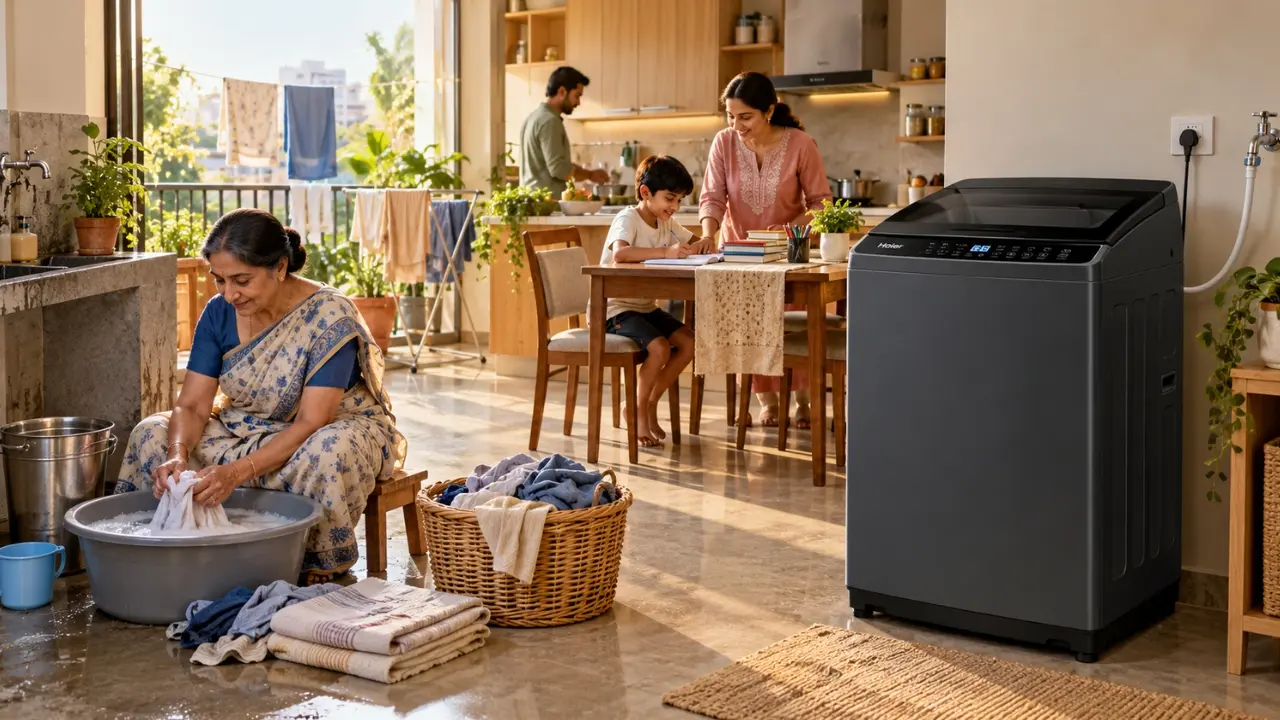

The washing cycle is complete in the washing machine. However, more work needs to be done. The water must be drained off and the clothes transferred to a second tub, then the time adjusted for the spin and waited for again.
That’s easily doable for some families. Those additional tasks can be a nuisance to others, especially if it means getting up in the mornings to cook breakfast, pack school bags and get ready for work.
That is where the issue of manual washing machine vs automatic washing machine comes into play.
Both types are good for normal washables. The difference comes in the amount of attention required, the use they make of water and how they fit into your daily life.
With the options like Haier’s semi-automatic, fully automatic top-load and front load washing machines, Indian households can get what they really need instead of purchasing the highest priced.
First, What Is the Difference Between Manual and Automatic Washing Machines?
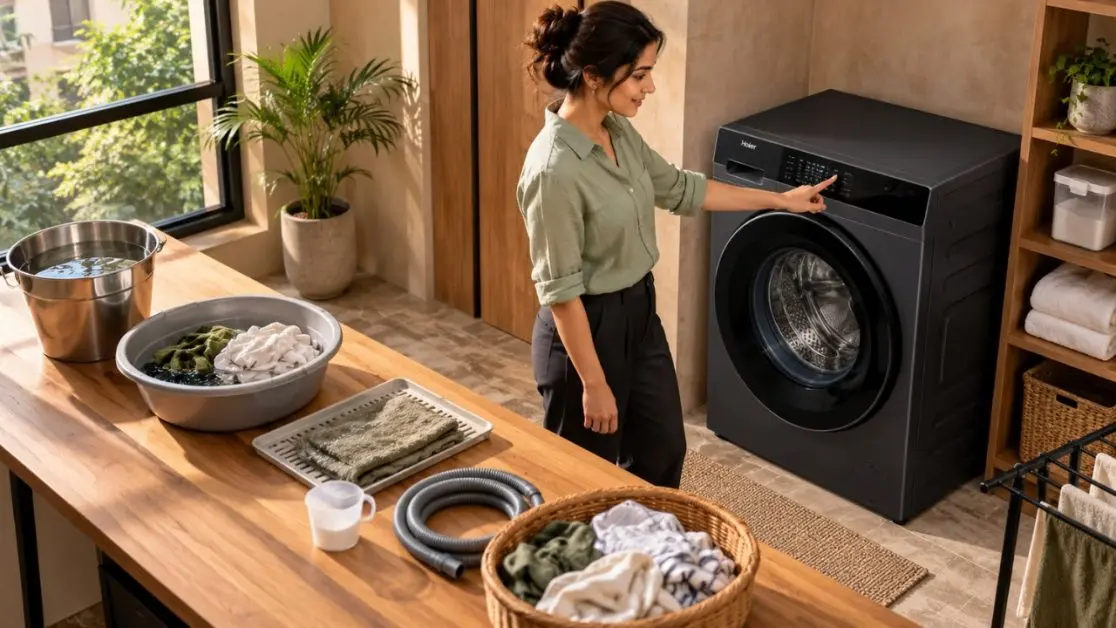
The difference between manual and automatic washing machines is that the manual ones operate on human power, while automatic models do so using a motor.
A manual washing machine is a machine that is more labour intensive. In India this is usually understood to be a Semi-Automatic washing machine which does the washing and spinning mechanically but needs manual operation between the steps.
A fully automatic washing machine automatically wipes, rinses and spins the laundry using a programmed cycle, as long as there is a water supply and drainage system available.
The Working of a Semi-Automatic Washing Machine
Most semi-automatic machines come with two tubs. One washes the clothes, while the other spins out excess water.
Typically it includes:
- Filling the washing tub with water.
- Putting clothes in the washing machine and detergent in.
- Choosing the wash programme/timer.
- Emptying of waste water and rinsing process.
- Transferring the clothes into the spin tub.
It definitely needs attention. But, it can be beneficial in homes where water is not always available for filling and washing.
The Operation of a Fully Automatic Washing Machine
The working principle of a Fully Automatic Washing Machine.
Fully automatic models make the process easier. Place the laundry and select the detergent, programme and press start.
The washing, rinsing and spinning are automatic.
This is especially handy when laundry should be done while doing other things around the house.
Manual vs Automatic Washing Machine: A Practical Comparison
When making your decision, take into account the differences of the two options you have in normal use.
| Comparison Factor | Semi-Automatic Washing Machine | Fully Automatic Washing Machine |
| User involvement | Requires manual intervention | Minimal intervention once the start. |
| Washing and spinning | Usually separate tubs | This was all done in one drum. |
| Water filling | May generally be filled by hand | Typically depends on a continuous water source |
| Water consumption | Requires hand filling and rinsing | Relies on the design of the machine and the programme |
| Initial purchase price | Generally more affordable | Usually higher |
| Convenience | Requires more attention | More appropriate for unattended cycles |
| Installation | Usually simpler | Needs appropriate water inlet and drainage facilities |
| Best suited for | Saving money on homes and fluctuating water availability | Looking for convenience in a busy household. |
There is no ‘best’ option or ‘worst’ option.
If your family can’t always predict how much water they will be getting, a semi-automatic machine may be more useful, if you wash clothes almost every day, an automatic machine could be better value.
When Semi-Automatic Washing Machines Are Still Worth Considering
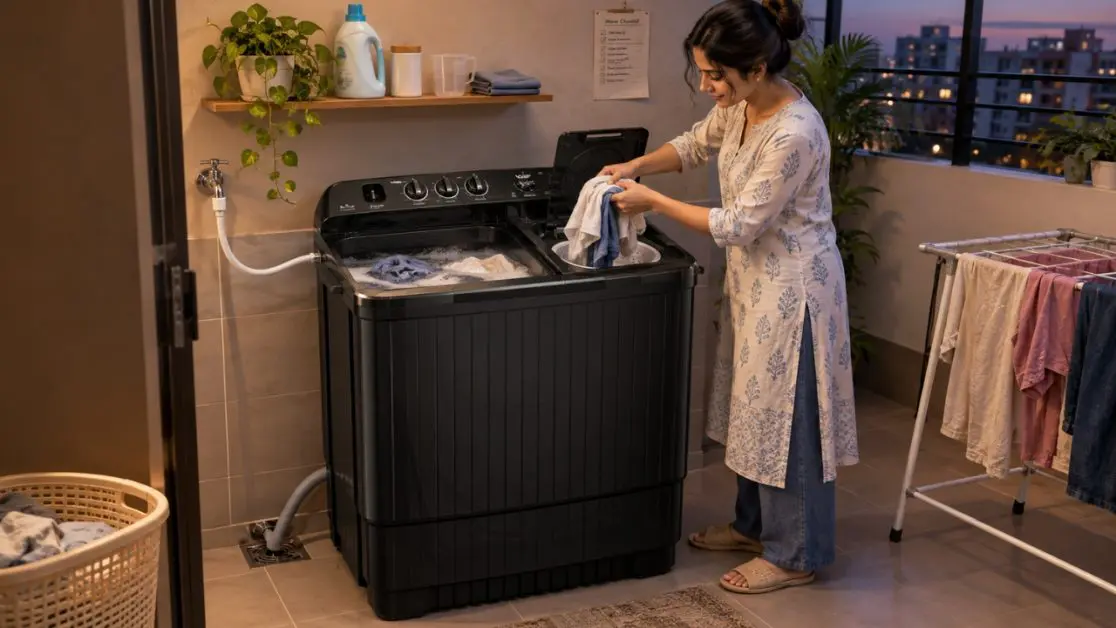
In urban households, it is now common practice to use fully automatic machines. Nevertheless, semi-automatic models are useful for certain practical applications.
1. You Want Greater Control Over Water Usage
When the city water is heated for washing only during specific hours, it may be convenient to fill the washing machine by hand.
In a semi-automatic model users are able to control water filling as per their availability. In reality, however, these figures will vary depending on the washing technique used, load size and rinsing habits.
2. You Prefer a Simpler Laundry System
Not all homes have a separate water connection for utilities.
Depending on the specific site requirements, semi-automatic machines can also be beneficial, but they need to be connected to an appropriate electrical system and safely drained.
3. Capacity to Wash More Than You Can Afford
The semi-automatic machines in general are less expensive than similar fully automatic machines.
This can have an impact for families who wash bed sheets, day-to-day garments and kids’ uniforms on a regular basis.
Discover Haier’s Semi-Automatic Washing Machines
Semi-Automatic Washing Machines that cater to the pragmatic needs of laundry. Practical and efficient laundry requirements catered to by Haier India.
The latter two models to consider are Haier HTW80-178 and Haier HTW90-196BBK.
Haier HTW80-178: 8 kg for Everyday Laundry
The Haier HTW80-178 Semi-Automatic Washing Machine comes with 8 kg washing capacity and 6 kg spin capacity.
Its features include:
- Magic Filter: Collects lint, threads and other things that get caught in the washing machine.
- Oxyi Dry: To minimize the moisture from the clothes after spinning.
- Spray Feature: Rinsing Support to remove detergent.
- Castor Wheels: Make moving the machine smoother.
- Anti Rat Mesh: Provides protection of entry of pests to the internal parts.
The model also features a selector for water level and four wash programs.
They provide a handy compromise between control and convenience for households that want to wash by hand.
Haier HTW90-196BBK: Larger Loads in More Room
The Haier HTW90-196BBK vacuum is designed for larger loads in more space. Haier HTW90-196BBK: Larger loads in more room:
If you have a lot of laundry to do during the weekend, washing capacity is important.
The Haier HTW90-196BBK offers a 9kg wash capacity and 6kg spin capacity.
It’s equipped with a Thunder Pulsator that generates multidirectional water flow for thorough cleaning.
Magic Filter, Oxyi Dry, Spray, castor wheels and Anti Rat Mesh are also available for the model.
It may have higher wash capacity, which could be helpful for families that are doing heavier laundry loads each week, but not if anything larger than the recommended load limit is put in the machine.
Why and When Should You Opt for a Fully Automatic Washing Machine?
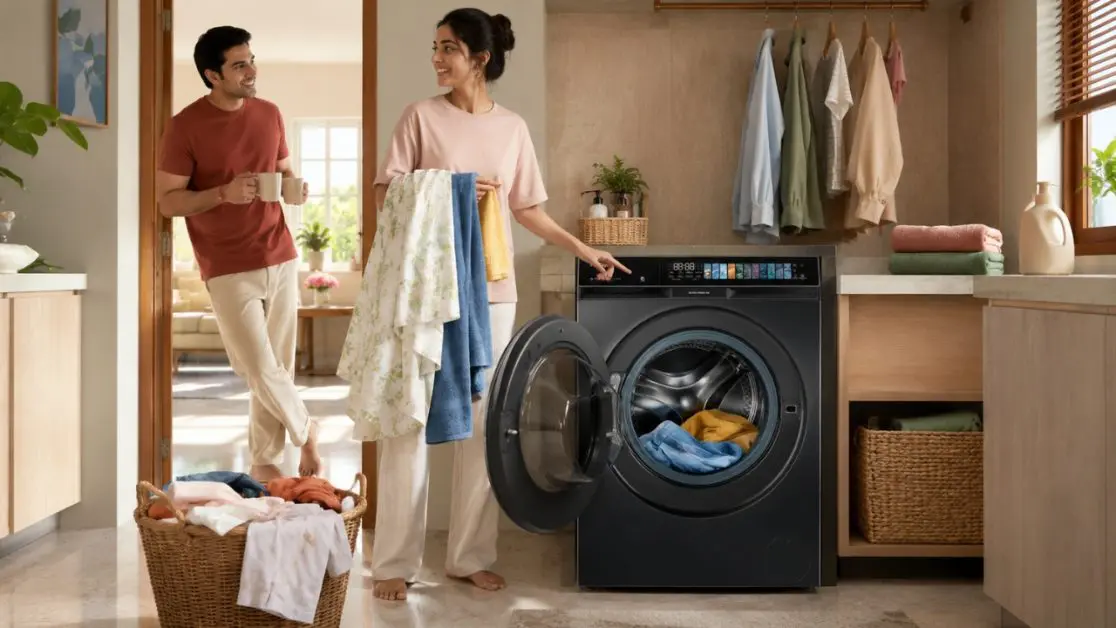
Consider how many times a day people have to stop working to do laundry.
The more often the answer is “frequently,” the more valuable automation will be.
A full automatic washing machine can be very helpful when:
- The working hours of both household members are heavy.
- Clothes should be washed several times/week.
- Older family members like to have fewer steps to do.
- Clean water and sanitation is provided in the house.
- There are special wash programmes for different fabrics.
There is another difference to be understood. Fully automatic machines are available in two styles, top load and front load, and don’t perform exactly the same functions.
Haier Fully Automatic Washing Machines for Various Homes
Haier HWM80-310BKN: Washing Top Load Convenient
If you’re seeking a washing machine for your household that can handle 8 kg of laundry, the Haier HWM80-310BKN 8 kg Top-Load Washing Machine is worth considering.
It has an Oceanus Wave Drum, which is designed to assist in the full cleaning of fabrics along with keeping them cared for.
Other features include:
- 5 Star energy rating – Allows consumers to identify how energy efficient the product is in relation to the applicable energy rating standard.
- Front Control Panel: Access to washing controls is easily available.
- Softfall Technology: Allows the lid to close gently.
- Magic Filter: Assists in trapping the lint while washing.
- Digital Display: Makes programme selection and monitoring easier.
The machine also has wash programme options for various needs of laundry.
If the family is used to loading clothes from top to bottom, a fully automatic top load may offer a comfortable experience without so many steps.
Haier F3 8 kg: Front Loading with AI One Touch Washing Technology
The Haier F3 8 kg features frontloading and AI One Touch washing technology. Haier F3 8 kg is a frontloading washing machine with AI One Touch technology.
Households that want to wash different fabrics throughout the week need something other than an automatic wash.
The Haier F3 8kg Front Load Washing Machine (EFL80-IM12F3BKU1) is another option.
It uses AI One Touch technology to detect the type of fabric, load and dirt, so that it knows which wash settings to choose.
The machine is also equipped with 525mm Super Drum, which facilitates the movement and cleaning performance of the fabrics.
These washing options are available: Cotton, Delicate, Baby Care, Stain Wash, Eco Wash and Quick wash.
The Eco Wash function of the model is engineered to control water levels and washing time based on the load to help manage water resources.
Choices such as these in the programme can be particularly helpful for a household that regularly washes office clothing, children’s clothing and delicate clothing.
The Most Important Questions to Ask Before Purchasing This Type of House
The washing machine is there for you, not you for the washing machine.
1. How Many Days Can You Live Without Water?
Consider a semi automatic machine if water availability is going to be a lot different.
If the device is fully automatic, verify the inlet and water pressure requirements of the manufacturer.
2. How Many Laundry Loads?
For households with a good amount of wash, an 8 kg or 9 kg machine might be the right choice, but it’s not necessarily the best option for a family.
Review the frequency of washing, clean bed sheets at home and number of items put in the wash.
Keep in mind, semi-automatic washing and spin may not be the same.
3. How Many Minutes Can You Spend on Laundry?
Semi-automatic washing can be comfortable if transferring clothes between washers is not an issue.
Fully automatic is more suitable if you want to start a programme and come back at the end of the cycle.
4. Electricity and Water Usage
Beware of assuming that one machine type will consume less electricity or water.
The consumption depends on the model, wash programme, load size and operating conditions.
Do not accept general claims; instead, check the relevant energy labels and manufacturer specifications.
5. What Will Be Easier to Maintain?
Regular washing machine maintenance is necessary for all washing machines.
The washer area is kept clean, clean lint filters if available, and follow detergent recommendations.
In the case of the front loading model, focus on the door seal and give it time to dry after washing, as mentioned in the user manual.
Therefore, Which Washing Machine Should You Select?
The word automatic has been removed from the equation, and the choice becomes more apparent.
If you prefer a little more control over the amount of water filling, limited buying budget or don’t mind getting involved in the washing process, select a semi-automatic washing machine.
If you prefer the top loading washing machine but need the convenience of an automatic machine, then you’re looking for the right top loading automatic washing machine.
If you’re looking for specialty fabric cycles and innovative wash features, you may want to check out a fully automatic front load washing machine.
Haier India provides solutions in these categories that enable homes to align the washing capacity and functionality with their daily lives.
Compare the features, specifications and models of washing machines in the Haier India collection before you decide.
Frequently Asked Questions
1. Is a manual washing machine better than an automatic washing machine?
Neither is universally better. Semi-automatic machines offer greater manual control and generally cost less initially. Fully automatic machines provide greater convenience by managing washing, rinsing and spinning through programmed cycles.
2. Which washing machine is better for Indian households?
It depends on water availability, household size, laundry frequency and budget. Homes with reliable water connections may prefer fully automatic machines, while semi-automatic models can be practical where water filling needs manual control.
3. Does a fully automatic washing machine consume more electricity?
Not necessarily. Electricity consumption depends on the model, motor, selected programme, wash temperature and load. Check the machine’s energy rating and specifications for a more meaningful comparison.
4. Can a semi-automatic washing machine wash heavy clothes?
Yes, provided the garments are suitable for machine washing and remain within the recommended capacity. Heavy items should be distributed properly, and the separate spin-tub capacity must also be respected.
5. What is the main difference between top-load and front-load washing machines?
Top-load machines allow laundry to be loaded from above, while front-load machines use a front-facing door and typically clean through drum tumbling. Their water usage, programmes and operating requirements vary by model.
6. Which Haier washing machine should I consider for an 8 kg capacity?
Haier offers the HTW80-178 semi-automatic model, HWM80-310BKN fully automatic top-load model and F3 EFL80-IM12F3BKU1 front-load model in 8 kg capacities. Compare their features, installation requirements and operating convenience to find the most suitable option.