
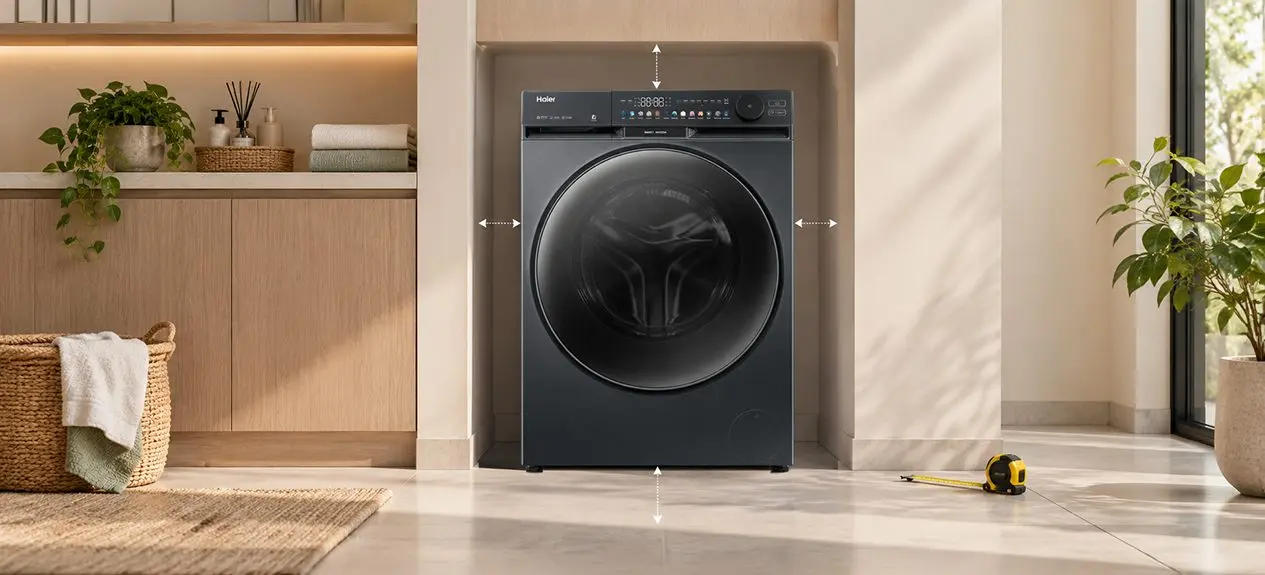

A washing machine may fit neatly into a corner on paper, but the available space can give you a reality check once you account for the door, hoses and lid. The washing machine size is only one part of the measurement. You also need enough clearance around the appliance for proper installation and everyday use. This guide covers the dimensions you can expect across Haier’s washing machine range, the space to leave around each unit, and the checks worth completing before the installer arrives.
Standard Washing Machine Dimensions
Standard washing machine dimensions depend on the loading type and the capacity. Across the fully automatic Haier models listed below, width runs from 520 mm to 600 mm, depth from 500 mm to 610 mm and height from 850 mm to 1040 mm. These measurements vary by model, so the specification sheet is the first thing to read.
Top Load vs Front Load Footprints
Top-load machines are narrow and tall, which is why Haier’s 7 kg top load (HWM70-306ES5N1) measures 520 x 540 x 930 mm and fits a utility corner with little floor space. Front-load machines run lower but wider across the front. The F9 9 kg comes in at 600 x 500 x 850 mm, so the depth stays modest even though the width grows.
Height matters differently for each type of machine. A top-load lid swings upward, so open-lid height is the number to watch if a shelf hangs overhead. A front-load door swings outward instead, which makes the floor space in front of it the thing to protect.
Size by Capacity (6.5 kg to 12 kg)
Capacity changes the numbers less than most buyers expect. Front-load machines at 8 kg, 9 kg and 10 kg share one footprint, and only the 12 kg model gets deeper, at 600 mm. Top-load machines grow taller instead, from 930 mm at 7 kg to 1040 mm at 11 kg. Haier has no 7.5 kg model, and if that is the size you searched for, the 7 kg and 8 kg rows below give the washing machine width and depth on either side of it.
| Model | Capacity | Width x Depth x Height (mm) |
| Top load HWM65-306S8 | 6.5 kg | 520 x 550 x 950 |
| Top load HWM70-306ES5N1 | 7 kg | 520 x 540 x 930 |
| Top load HWM80-310BK | 8 kg | 550 x 610 x 990 |
| Top load HWM110-H688BK | 11 kg | 550 x 570 x 1040 |
| Front load F3 | 8 kg | 600 x 500 x 850 |
| Front load F9 | 9 kg | 600 x 500 x 850 |
| Front load F5 | 10 kg | 600 x 500 x 850 |
| Front load F9 | 12 kg | 600 x 600 x 850 |
| Semi-automatic HTW80-178 | 8 kg | 810 x 496 x 990 |
Unsure how many kilograms of capacity your household needs?
Read this blog: How Much Laundry Is 7kg, 9kg or 10kg? A Practical Guide to Estimating Your Wash Load
How Much Clearance to Leave
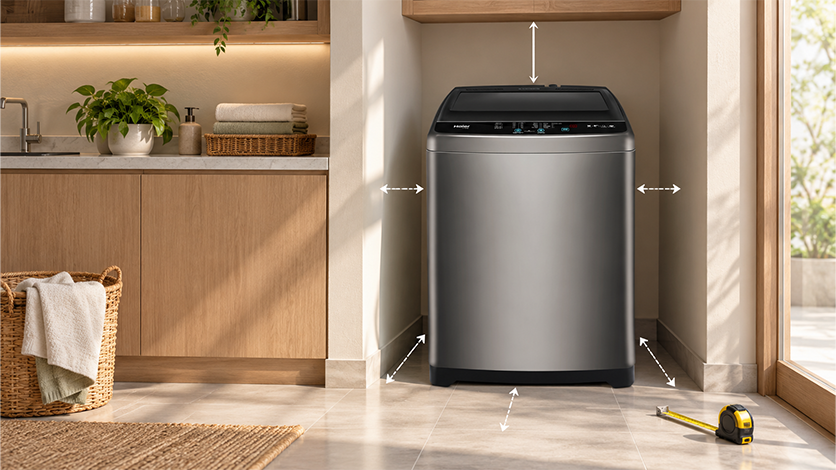
The measurements above cover the machine alone, with nothing around it. Washing machine installation clearance is the gap you leave around it, and Haier’s installation guide recommends a few inches on every side for ventilation and later servicing.
- Sides, Back and Top Gaps
A few inches lets air move and gives a technician a way to reach the panels. At the back, leave enough room for the inlet hose to curve without a tight bend. The drain hose is usually fixed between 60 and 100 centimetres high, as the manual specifies.
Top-load owners should also plan for headroom above the machine. The lid opens upward, so any shelf above the machine needs to sit well clear of its listed height of 930 mm to 1040 mm.
- Door Swing and Loading Space
Check which way a front-load door opens before you pick the spot. A wall or cabinet on the hinge side can cut the opening short, while clear floor in front makes loading easy, even with a full basket in hand. Top-load machines swap that floor space for vertical space, and the toughened glass lid with Softfall technology closes softly.
Measuring Your Space Before You Buy
Grab a tape and measure the width, depth and height of the spot, then add the clearance gaps from the section above. Its worth writing the numbers down before you shop. Set them against the washing machine width and depth in each product specification, and measure with the lid open for top-load models.
Next, walk the route from the front door to the room. Doorways, corridor turns, stair landings and lift cabins all count. Haier’s automatic models need a cold-water tap with a 3/4 inch thread, and the floor should be level and firm.
Fitting a Washing Machine in a Small Bathroom or Balcony
Tight spaces call for the smallest washing machine size that still handles your laundry. Among the fully automatic models listed here, the 6.5 kg top load is the narrowest at 520 mm, and the 7 kg model matches that width. If the machines depth is the bigger worry, the front-load range stays at 500 mm deep from 8 kg to 10 kg.
The 8 kg semi-automatic is wider at 810 mm, but its 496 mm depth and castor wheels make it easy to roll aside once the laundry is done. On a balcony, a covered corner close to a tap works best.
Installation Checklist (Water, Drain, Power)
Run through this list before the installer arrives. Good washing machine installation clearance also protects the hoses and the socket from strain.
- A cold-water tap with a 3/4 inch thread within easy reach of the inlet hose.
- A floor drain or standpipe nearby, with the drain hose at the height your manual specifies.
- A dedicated, earthed socket used without extension boards.
- A level, firm floor, with anti-vibration pads under the feet on tiles.
- Transit bolts and foam removed from the back panel before the first wash.
- One empty test cycle to check the hose joints.
Curious how levelling and transit bolts work on delivery day?
Read this blog: How to Install a Washing Machine: A Step-by-Step Guide
How Haier Designs for Real Homes
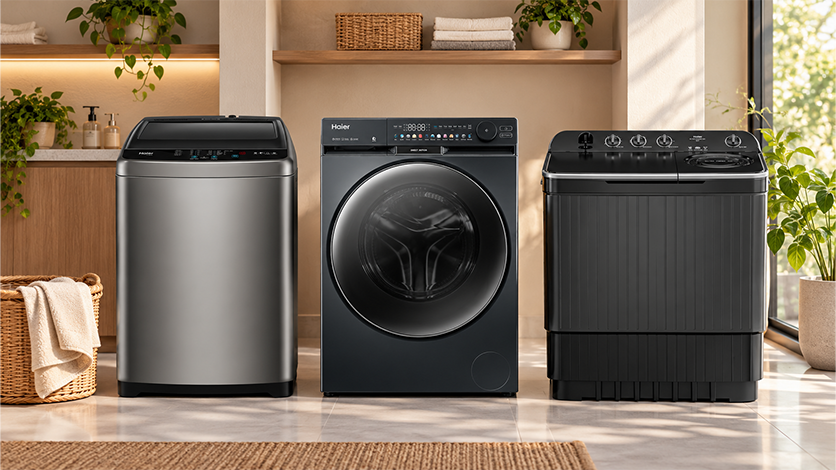
At Haier, we design each model around the rooms it will live in. Our 8 kg, 9 kg and 10 kg front-load washing machines share one footprint of 600 x 500 x 850 mm, so a bigger drum fits the same gap. The 525 mm Super Drum and Direct Motion Motor on our F9 models cut friction and vibration.
Our top-load washing machines start at 6.5 kg with a 520 mm width and carry Softfall lid technology. If you want a machine that moves easily, our semi-automatic washing machines come with castor wheels and anti-rat mesh. Put our specification sheets next to your measurements and the right fit becomes easy to spot.
Conclusion
A washing machine fits best when you measure twice, once for the machine and once for the gaps around it. Haier’s listed models run from 520 mm to 810 mm in width, so most corners have an option. Keep a few inches free on each side, and confirm the tap, drain and socket before delivery day.
Frequently Asked Questions
What is the size of a washing machine?
Size depends on the loading type and the capacity. The fully automatic Haier models above measure 520 to 600 mm wide, 500 to 610 mm deep and 850 to 1040 mm high. The 8 kg semi-automatic is 810 mm wide.
How much space does a washing machine need?
Plan for the machine’s footprint plus a few inches on each side, room behind for hoses, and headroom above a top-load lid. A 600 x 500 mm front-load machine needs a floor patch a few inches larger each way.
How big is a 9 kg washing machine?
The Haier F9 9 kg front-load machine measures 600 mm wide, 500 mm deep and 850 mm high. That matches the 8 kg and 10 kg front-load models, so moving up in capacity keeps the same gap.
What is the smallest washing machine size?
Among the fully automatic Haier models listed above, the 6.5 kg top load is the narrowest at 520 x 550 x 950 mm. Front-load machines are the shallowest at 500 mm deep, which helps in narrow bathrooms.
How much clearance should I leave around a washing machine?
Haier’s installation guide suggests a few inches on every side for ventilation and servicing. Leave room behind for the inlet hose to curve without a tight bend, and headroom above top-load models so the lid opens fully.
What is the size of a 7 kg washing machine?
The Haier 7 kg top load, HWM70-306ES5N1, measures 520 mm wide, 540 mm deep and 930 mm high. Its compact width suits utility corners, bathrooms and balconies where floor space is limited.