





The additional ₹300 or ₹400 you pay for electricity during the winter season may make you question if your geyser is using more electricity than it needs to.
After all, it only operates for a couple of minutes before your morning shower. What is its possible electricity consumption?
Well, it’s not just about the geyser’s capacity.
For many Indian homes, especially those that require hot water for daily bathing, a 15-litre geyser is a viable option. The amount of electricity it uses, however, is based on the wattage of the heating element, the length of time it takes to heat, the temperature of the water that is fed into it, and the frequency of reheating.
Knowing these can help you calculate running expenses and select an energy-efficient water heater that won’t affect your daily comfort.
How Many Units of Electricity Does a 15-Litre Geyser Use?
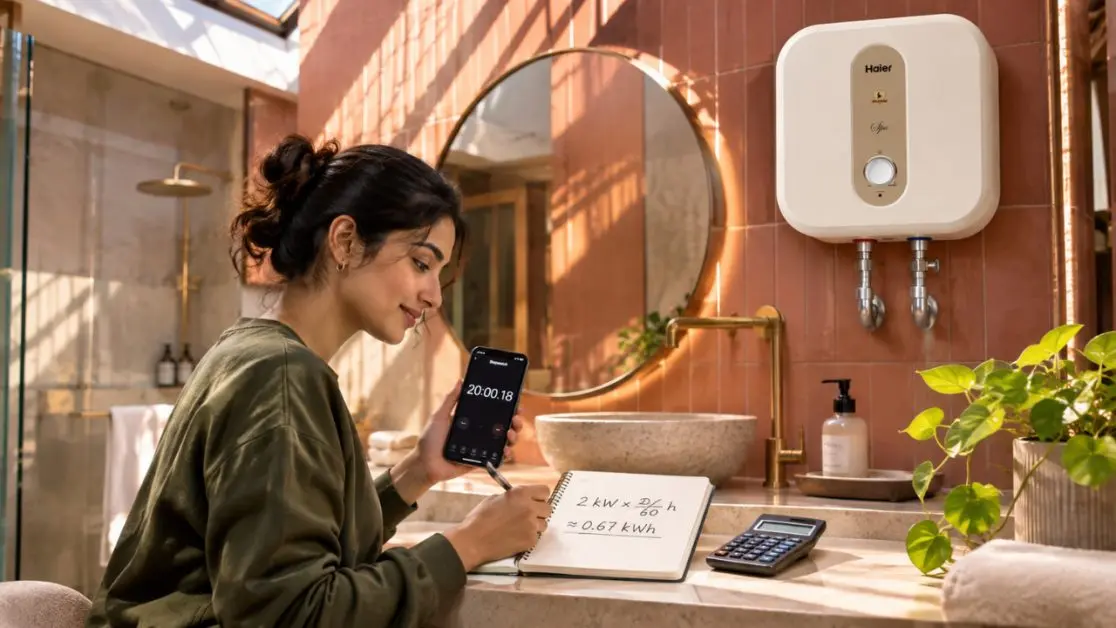
If the heating element in a typical 15-litre storage geyser is used for one hour, it will use 2 units of electricity.
However, this does not mean that your geyser uses 2 units each time you turn it on.
Most storage water heaters have a thermostat to prevent the water from being heated when it reaches the desired temperature.
If a 2000W geyser works for 20 minutes to heat water, its consumption would be about 0.67 units.
Understanding the Electricity Consumption Formula
The amount of electricity your geyser consumes can be worked out with a simple formula:
Electricity consumption (kWh) = Power (kW) × Active heating time (hours)
The following table shows the variation in consumption for a 2 kW geyser with the duration of heating.
| Active Heating Duration | Electricity Consumption |
| 10 minutes | 0.33 units |
| 15 minutes | 0.50 units |
| 20 minutes | 0.67 units |
| 30 minutes | 1.00 unit |
| 45 minutes | 1.50 units |
| 60 minutes | 2.00 units |
These are the figures for electricity used in active heating. Other minor electrical loads, such as thermostat-controlled reheating, may also be included in actual household consumption.
What Is the Monthly Electricity Cost of a 15-Litre Geyser?
Imagine a family of 2 people in Delhi who use hot water every morning.
Assume that they use their 2 kW geyser for a total of 30 minutes per day.
The calculation would be:
- Daily electricity consumption: 1 unit
- Monthly consumption: 30 units
- Assumed electricity tariff: ₹8 per unit
- Estimated monthly electricity cost: ₹240
Now, suppose the same geyser is actively heated for one hour each day.
At the same illustrative tariff, the monthly consumption rises to around 60 units, which will cost ₹480.
That’s a significant change.
Electricity tariffs, of course, differ from state to state in India, distribution companies and consumption slabs. The actual bill will be based on the tariff, taxes and other charges that may apply.
Also, note that the total heating time during the day is more important than the duration of the wall switch being on.
Why Does a 15-Litre Geyser Use More Electricity Sometimes?

Two 15-litre geysers can be owned by two different households, and the electricity bills will be very different.
Here’s why.
1. Incoming Water Temperature
In cities like Delhi, Chandigarh and Jaipur, tap water can be very cold in December and January as compared to summer.
The geyser needs to provide more heat to attain the desired temperature.
This means that even if your bathing habits don’t change, you could use more electricity during the winter.
2. Frequent Reheating
Over time, storage geysers will lose heat from their tanks.
The thermostat can turn on the heating element again when the water in the storage tank cools to a low enough temperature.
This heat loss and repeated heating can be minimised by using a well-insulated tank.
3. Household Water Consumption
The 15-litre capacity does not necessarily mean that the appliance can only deliver 15 litres of usable bathing water.
Hot water can be added to cold water to create a comfortable temperature.
However, longer showers, excessive hot-water flow and consecutive baths can require additional heating cycles.
4. Temperature Settings
Excessive hot water temperature wastes energy.
To give some perspective, the amount of thermal energy needed to raise 15 litres of water from 25°C to 60°C is about 0.61 kWh (ignoring heat losses).
The higher the set temperature, the more energy is needed.
5. Heating Element Condition
Mineral deposits can form on the heating elements and on the inside surfaces in hard water areas.
These deposits can disrupt heat transfer and cause maintenance issues.
Regular professional maintenance ensures that the appliance operates as designed.
How Haier’s 15-Litre Water Heaters Help Households Conserve Energy
When it comes to selecting a water heater, it’s not just about the lowest wattage.
Both heating performance, insulation, safety features and durability are equally important.
Haier India has developed a range of storage water heaters with a capacity of 15 litres to cater to these practical household needs.
Haier 15L Square Ivory 5 Star Water Heater (ES15V-SDI)
The Haier 15L Square Ivory 5 Star Water Heater is a compact square water heater with features designed to facilitate easy hot-water use.
It has PUF insulation that helps retain heat in the stored water, so it doesn’t need to be reheated so often.
Other features include:
- 5-star energy efficiency rating
- Smart Timer and Smart Memory functions
- RSC U-turn Flow Technology for better water flow
- Glass-lined tank for corrosion resistance
- Shock Proof and Dual Thermal Proof safety features
- 8-bar rated working pressure
The Smart Timer is especially important for families with regular bathing times.
Users can control hot-water heating as needed, without maintaining hot water unnecessarily.
Haier 15L Square Spa Ivory 5 Star Water Heater (ES15V-S1I)
The Haier 15L Square Spa Ivory 5 Star Water Heater is a flexible heating power option for households, with selectable 1 kW, 2 kW and 3 kW power options.
This enables users to select the heating rate that is suitable for their needs.
Importantly, higher wattage does not necessarily mean higher electricity consumption for the same amount of water at the same temperature. It mainly affects the heating rate of the water.
Additional features include:
- 5-star energy rating
- Incoloy 800 heating element
- Superior PUF/EPS insulation
- Glass-lined storage tank
- Bacteria Proof System
- IPX4 water resistance
- 8-bar pressure capability
It is a good option for homes with different hot-water usage times because of its insulation and flexible heating capabilities.
Haier 15L Square Spa Wi-Fi 5 Star Water Heater (ES15V-SD WIFI)
For those looking for a modern water-heating solution, the Haier 15L Square Spa Wi-Fi 5 Star Water Heater is a good choice.
It offers a choice of 2 kW and 3 kW heating, and a digital temperature display.
It has the following outstanding characteristics:
- 5-star energy efficiency rating
- Titanium-coated storage tank
- Titanium Guard heating element
- Superior PUF/EPS insulation
- Shock Proof protection
- Dual Thermal Proof technology
- Bacteria Proof System
- 8-bar rated pressure
The insulation reduces stored heat loss, and the corrosion-resistant tank and heating element contribute to durability.
When comparing these Haier models, buyers should take into account their preferred controls, heating versatility and installation needs, not just assume that all 5-star geysers will cost the same to run.
How to Save Electricity on Your Geyser: Some Practical Solutions
Little changes in daily routines can make a big difference.
Try these measures:
- Use an appropriate water temperature rather than overheating the water.
- Don’t use too much hot water when bathing.
- Where possible, use timer functions to match heating to household activities.
- If the geyser’s heating performance decreases, have it professionally checked.
- Look for the BEE star rating and energy-consumption label when buying.
- Choose a capacity that meets your family’s hot-water needs.
One thing to note: turning the geyser off as soon as it has heated the water may save on unnecessary standby reheating, but the savings will be dependent on the quality of the insulation and how quickly the water will be used again.
Do not override the thermostat or safety devices to save on electricity.
Is a 15-Litre Geyser Energy-Efficient for Indian Homes?
A 15-litre storage geyser is a practical solution for many Indian households that need hot water but don’t require a lot of storage.
It may be appropriate for bathrooms that are used by one or two people in succession, depending on bathing practices, incoming water temperature and shower flow rate.
But capacity is not the only measure of efficiency.
A 15-litre geyser with a suitable star rating can be a good option, especially if the user is careful about the time taken for the geyser to heat up and the amount of water used.
Haier India’s 15-litre water heater range combines 5-star-rated water heaters, heat-retaining insulation and model-specific safety and convenience features.
Check out Haier India’s 15-litre storage water heaters and get the water heater you need for your bathroom and hot-water usage.
Frequently Asked Questions
How many units does a 15-litre geyser consume in 30 minutes?
A 2,000-watt geyser consumes approximately 1 unit of electricity when its heating element operates continuously for 30 minutes.
Does a 5-star geyser reduce electricity bills?
A 5-star-rated storage geyser is designed to meet higher energy-efficiency standards. Actual savings depend on usage patterns, heat retention and the appliance being compared.
Is a 15-litre geyser sufficient for two people?
It can be sufficient for two people with moderate bathing requirements, although shower duration, water flow and the time between baths affect suitability.
Does a 3 kW geyser consume more electricity than a 2 kW geyser?
A 3 kW element consumes electricity faster while operating, but it can also heat the same water more quickly. Total energy consumption depends on heating requirements and losses, not wattage alone.