




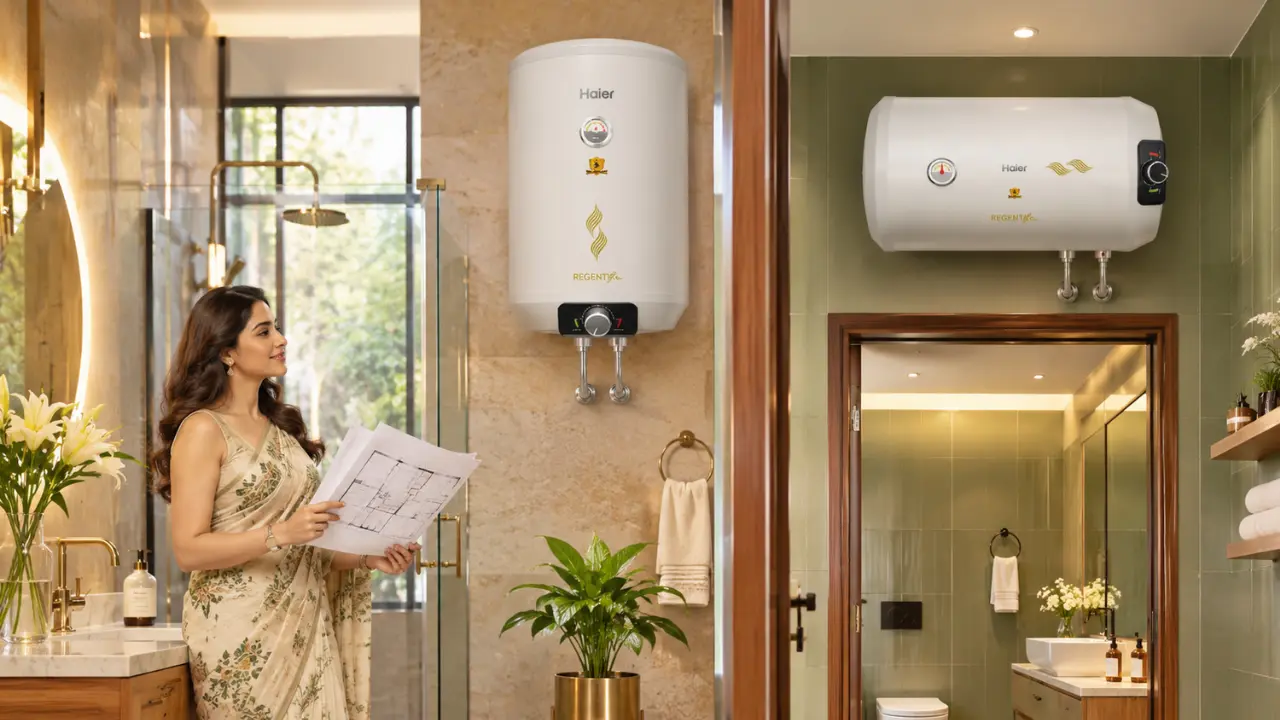

The area above your bathroom door is ideal for a geyser. Until you realize that the ceiling is too low, the plumbing connections are awkward, or the unit leaves little room for maintenance.
This is a typical scenario in Indian households, especially in apartments where space is at a premium. This is where the vertical and horizontal geysers differ.
The two designs are both designed to provide hot water when you need it. Their mounting orientations, space requirements and installation considerations, however, vary significantly.
So, which one is it?
The answer is not so much about the look, but more about the layout of your bathroom, the amount of wall space you have and how much hot water you use on a daily basis.
The Difference Between Vertical Geyser and Horizontal Geyser
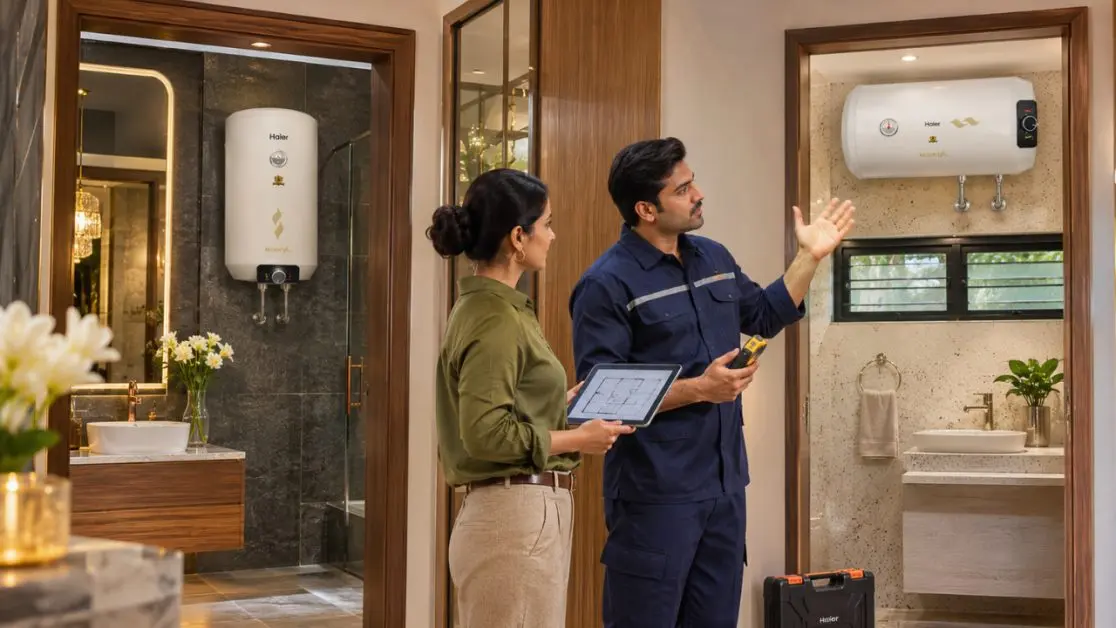
The basic difference between vertical geyser and horizontal geyser is very simple.
A vertical geyser is a cylindrical body that is upright, and a horizontal geyser is a tank that is mounted horizontally.
Both types of storage water heaters are storage water heaters, but their physical designs affect where they can be placed.
Vertical Geysers: For Vertical Mounting
Vertical geysers are often fitted on bathroom walls where there is enough space.
They are upright and can be used in bathrooms where there is enough vertical space and not as much horizontal wall space.
For example, if your bathroom is relatively high and there is an unobstructed wall next to the shower area, a vertical storage geyser might fit nicely.
Horizontal Geysers: A Practical Choice for Limited Height
Horizontal geysers are geysers which are intended to be installed horizontally.
They can be particularly useful in bathrooms where overhead cabinets, false ceilings or structural beams restrict vertical space.
Imagine a contemporary apartment bathroom with a small space between the door frame and ceiling. If the wall is wide enough and the manufacturer’s mounting specifications are followed, a horizontal geyser might be a more practical installation arrangement.
The key difference is that neither design is superior in all respects. Each is designed to meet a different space need.
Start With Your Bathroom Layout, Not the Geyser Capacity
When looking at water heater specs, first look at the actual space.
A geyser that looks small in a product picture can actually need a lot of space for pipes, electrical connections and servicing.
There Are Three Bathroom Situations to Consider
1. Bathrooms With High Ceilings
A vertical geyser may be a simple choice if there is enough continuous wall space.
It has an upright body which takes up less horizontal wall space, allowing for other bathroom fittings.
2. Bathrooms With False Ceilings
The height above the bathroom door may be decreased by false ceilings.
In such cases, a horizontal geyser might be more appropriate, as it has a body that is not vertical, but rather horizontal.
The width available, mounting strength and service clearance, however, should be checked.
3. Small Toilets With Multiple Fixtures
Placing a geyser in a bathroom with a shower enclosure, exhaust fan, storage cabinet and ventilation window may be difficult.
In this case, it’s not a matter of saving space, but rather the actual dimensions of the installation.
Does a Vertical Geyser Heat Water Better Than a Horizontal Geyser?
Not necessarily.
One of the misconceptions is that vertical geysers always perform better in terms of heating. The orientation of the tank may affect the temperature distribution and water mixing, but the actual performance will depend on the internal design.
There are several factors that warrant more attention:
- The wattage and design of the heating elements.
- The capacity and insulation of the tank.
- Thermostat performance.
- Withdrawal patterns for hot water.
- The technology of internal water circulation.
A properly designed horizontal geyser can be used to reliably heat a space if operated within its design limits.
Likewise, a vertical geyser is not necessarily more efficient in terms of electricity usage.
To make meaningful comparisons of energy, look at the BEE star rating, insulation and operating features of the appliance.
Haier REGENTA Water Heaters: Choices for Various Bathroom Spaces
If bathroom size is a factor in your purchase, it’s especially helpful to have various mounting options within a product line.
Homeowners can consider the vertical and horizontal models of Haier India’s REGENTA storage water heaters, depending on their installation needs.
Haier 15L REGENTA SLIM (RH) Cylindrical ABS 3 Star Water Heater
For bathrooms with restricted vertical clearance, the Haier 15L REGENTA SLIM (RH) offers a horizontal storage water heater option.
It has a 15 litre capacity, which may be suitable for households with hot water needs that fit this size of storage.
The model incorporates a number of features that are based on common usage and protection:
- Additional protection against electrical leakage with Shock Proof technology.
- Dual Thermal Proof (TTS) for two-stage overheating protection.
- IPX4 water resistant to protect against splashing water.
- Working pressure of 8 bar, suitable for consideration in high-rise residential buildings.
- Glass-lined tank designed to enhance corrosion resistance.
- PUF/EPS insulation to help retain stored water temperature.
- RSC U-turn Flow Technology to promote water flow in the tank.
It is especially important in its horizontal configuration when there is more wall width than installation height.
Haier 15L REGENTA Cylindrical 5 Star Water Heater
For bathrooms with sufficient vertical space, the Haier 15L REGENTA offers an upright option.
This model features a 15 litre storage capacity, 5-star energy rating and a 2.2 kW heating element.
It is notable for:
- CrystalShield Tank is designed to resist bacterial growth and be durable.
- For reliable heating, use an Incoloy 800 heating element.
- Heating water to 80°C in the designated mode to kill bacteria, called Bacteria Proof System.
- Dual Thermal Proof for overheating protection.
- Working pressure of 8 bar.
- IPX4 splash resistance.
This model is especially applicable to households that are considering two 15 litre options, and where vertical installation is possible and energy rating is a key purchase criterion.
Haier 25L REGENTA Cylindrical 5 Star Water Heater
Bathroom space is only one consideration. How much hot water your home consumes is just as important.
The Haier 25L REGENTA is a 25 litre vertical model for families who need more stored water.
It has a 5-star energy rating, 2.2 kW heating element, CrystalShield Tank and Incoloy 800 heating element.
The model also features Shock Proof technology, Dual Thermal Proof, IPX4 splash resistance and 8 bar pressure rating.
Its bigger capacity might be beneficial to families with higher hot water needs, but it’s only really helpful if the hot water is used a lot or if the water is hot when it comes in.
What to Check Before Completing the Installation?
The right geyser should fit into the bathroom without hindering access or safety of installation.
When buying, have a qualified installation professional evaluate the following.
The Strength of the Wall and the Position of the Wall
When water is added to the storage geysers, they become significantly heavier.
The supporting wall and mounting hardware should then be appropriate for the appliance’s filled weight.
Not all partition walls are suitable for a storage water heater.
Plumbing and Electrical Connections
Ensure that the inlet, outlet, power supply and drainage are compatible with the intended mounting location.
A vertical-only geyser should never be mounted horizontally, unless the manufacturer has specifically stated that it is allowed to be mounted horizontally.
Clearance for Maintenance
Keep the manufacturer’s recommended clearance around the appliance for inspection, servicing and component access.
A neat installation that interferes with future maintenance can become cumbersome over time.
Water Pressure
Apartment buildings may have varying water pressure conditions.
The models mentioned here are Haier’s REGENTA with an 8 bar rated working pressure. However, the installation should be within the manufacturer’s operating limits.
Which Geyser to Use in the Bathroom?
The easiest way is to match the orientation of the installation with the space available and then choose the right capacity.
- If the wall height is sufficient, and the bathroom is best suited for an upright installation, then a vertical geyser should be used.
- If the ceiling clearance is limited but there is adequate horizontal wall space, consider a horizontal geyser.
- Choose a 15 litre one if the water it stores is sufficient for your household needs.
- When your family requires more hot water storage, check out a 25 litre model.
- Don’t just use tank orientation to determine efficiency; compare energy ratings and insulation.
Keep in mind that capacity and orientation are addressing different problems. One is for the amount of water the appliance can hold and the other is for the space it will occupy in your bathroom.
Find the Right Fit With Haier India
A water heater should fit in with the bathroom design and provide hot water for your family’s needs.
Homeowners can compare various configurations without missing out on key product features with options like the horizontal Haier 15L REGENTA SLIM (RH), vertical Haier 15L REGENTA and larger capacity Haier 25L REGENTA.
Each model provides a unique set of features designed for heating performance, durability and protection, along with a different capacity and mounting design and energy rating.
Visit Haier India’s water heater range and see the specifications to find the right water heater for your bathroom.
The right geyser is not the one that fits on the wall. It’s the one that works for you, your hot water needs and your lifestyle.
Frequently Asked Questions
1. Which is better, a vertical or horizontal geyser?
Neither is universally better. Vertical geysers suit bathrooms with sufficient height, while horizontal geysers can be more practical where vertical clearance is restricted.
2. Can a vertical geyser be installed horizontally?
No, unless the manufacturer specifically approves horizontal installation for that model. Incorrect mounting can affect operation and safety.
3. Are horizontal geysers suitable for small bathrooms?
Yes, particularly when wall height is limited. However, they require adequate horizontal space and proper mounting clearance.
4. Does a horizontal geyser consume more electricity?
Not necessarily. Electricity consumption depends on heating requirements, insulation, efficiency, usage patterns and the appliance’s design.
5. Is a 15-litre or 25-litre geyser better for a family?
A 15-litre geyser may suit moderate hot water requirements, while a 25-litre model offers greater storage capacity. The appropriate choice depends on family size, bathing habits and frequency of use.