




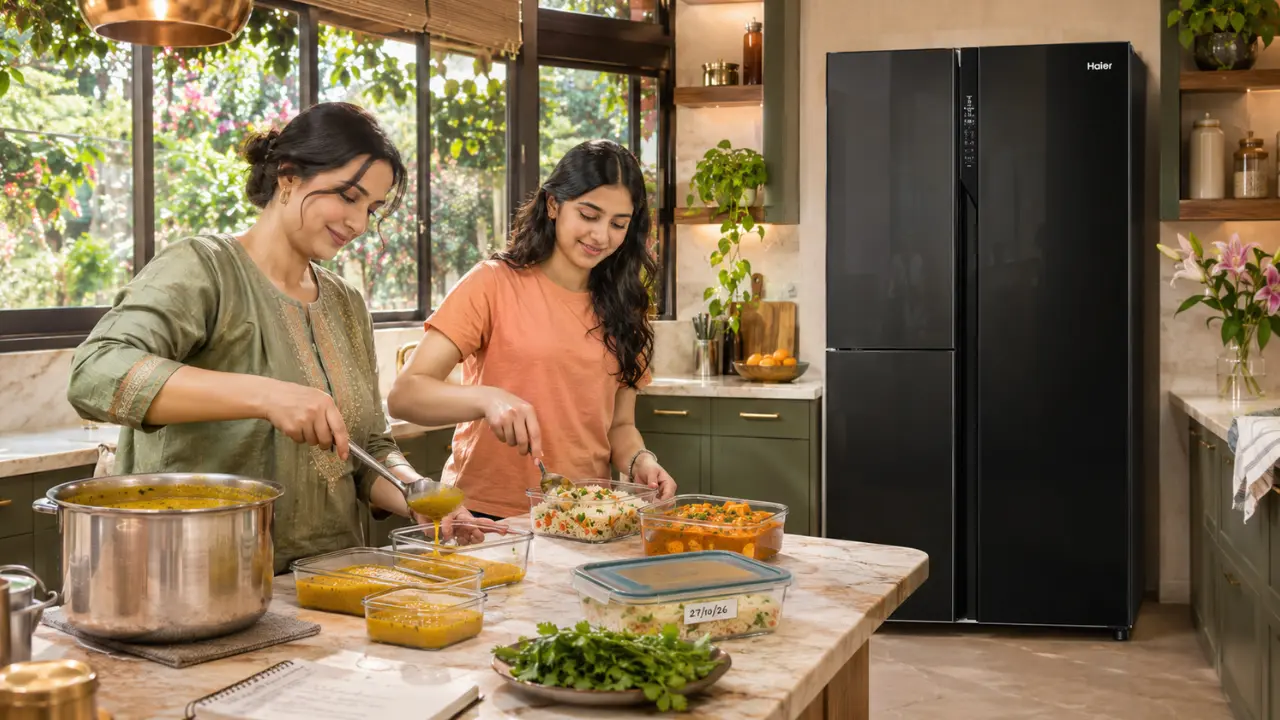

Dinner is over. The kitchen is spotless, the dishes are washed, and yet there is half a pot of dal still left on the stove. You decide to leave it there until it cools down completely.
Sounds reasonable, doesn’t it?
Other than that, you might not want to eat your leftovers after too much time.
It is common practice in many households in India to keep the freshly cooked food outside the house for several hours and then put it in the refrigerator. Some think it is damaging to the machine to put warm food inside. Others just forget about the food until after sleeping.
Well, not quite. Cooked food should be cool quickly, but not until it cools to room temperature.
Safe cooking times for leftovers and re-heating, before putting them into the refrigerator, can help curb bacterial growth and reduce food waste as well as simplify the process of preparing meals throughout the day.
Food Safety and the Two-Hour Rule: How Long Can Cooked Food Be Outside?
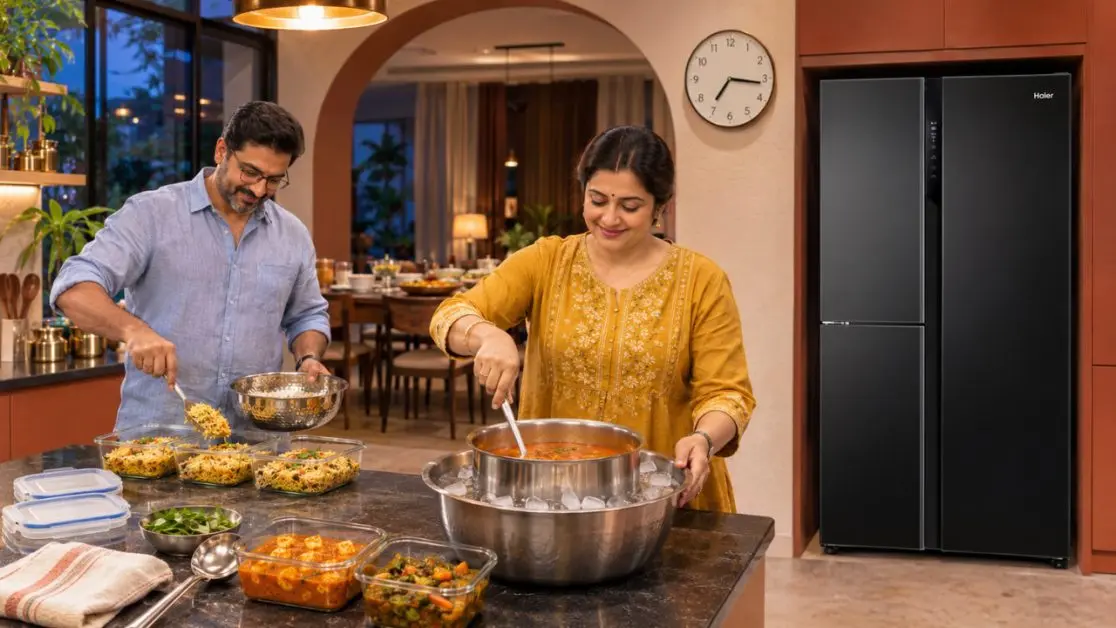
This is a good reminder for when you’re done cooking!
Perishable cooked food should be kept refrigerated for two hours or less after they are cooked or served. With a temperature in excess of 32°C outside the window, the time becomes 1 hour.
This could be of special concern in India where summer temperatures can rise significantly in the kitchen.
Why the urgency?
Bacteria grow best in the “food temperature danger zone” which is between about 5°C and 60°C.
Food in this temperature zone can go bad and be hazardous even if it appears and smells just like normal food.
Think about the following situations in everyday life:
- After lunch a large pot of rajma is left on the stove.
- In a covered pressure cooker, cooked rice is left until the evening.
- What is left of the paneer curry is placed on the dining table after the meal.
- Vegetable pulao is cooked in a pot to be ready for breakfast the next morning.
In all four scenarios, there can be a risk of food spoilage if the food is left out of the refrigerator for an extended period.
The implementation is very simple. Cool leftovers quickly after serving, and move to the refrigerator quickly.
Should You Refrigerate Your Food While It’s Still Hot?
Yes, it is okay to put warm food in the refrigerator. It doesn’t have to be totally cold.
But it’s not a best practice to have a large hot tub in the middle of the house.
Food that is cooked or is in the dishwasher will raise the internal refrigerator temperature for a brief period. Most significantly, the food will cool at the centre of the container much more slowly when it is stored in a deep container.
The solution?
Minimize the amount of food that goes into the containers prior to refrigeration.
Choosing the Right Size Containers Are Not as Obvious as You Might Think
Suppose you made three litres of sambar for an extended family.
If the whole amount is stored in a single, deep steel container, the centre could stay warm for several hours.
Now split the same sambar down among four shallow containers.
The larger exposed surface area will allow heat to dissipate more rapidly, aiding the food to cool down rapidly.
That is why shallow dishes are suggested to use for refrigerating leftovers.
At this stage a little preparation makes a difference.
The Practical Method for Safely Cooling Leftovers Before Refrigeration
No special equipment or difficult cooking skills are required.
Some simple precautions can make the remaining storage much more secure.
Step 1: Divide Large Quantities Immediately
After eating, divide the leftover food into smaller portions.
For example:
- Divide remaining dal into 2 or 3 small bowls.
- Serve cooked rice in small portion sizes for individual meals.
- Pour chicken curry from large slow-cooker into smaller containers.
- Keep in containers the leftover sabzi as per the amount needed later.
The smaller portions cool faster and reheat easily.
They also spare you the need of heating a full batch over and over again if you need just one serving.
Step 2: For Big Batches Use an Ice-Water Bath
The ice-water bath is also a good way to cool larger amounts of food or very hot food.
Set the cooking pot in a larger pot of cold water and ice. Make sure the water doesn’t enter the food.
Add the contents and gently stir with a clean spoon.
This is particularly helpful in liquid-based preparations like:
- Sambar
- Dal
- Vegetable soups
- Chicken stock
- Rasam
- Bulk gravy for big quantities of food.
Change the water around the thermometer when it is hot.
The premise is that the heat is removed rapidly, not slowly on the kitchen counter.
Step 3: Refrigerate Promptly
After dividing the food into shallow containers, put the food in the refrigerator promptly.
Remainders or small amounts of warm foods can be refrigerated immediately.
Don’t set cooked foods out because they are only slightly warm.
Keep your refrigerator at 4°C or below and use a refrigerator thermometer to check the temperature.
Step 4: Cover, Label and Organise
Keep in clean food grade containers that can be stored in the refrigerator.
After too much steam has vented, tightly cover the food to minimize contamination and spills.
For convenient storage:
- For easy identification of leftovers use clear containers.
- Write the preparation date on containers.
- Separate raw meat and seafood from ready to eat foods.
- Do not stack so many warm containers that they are stacked too close.
- Make sure there is enough room to allow cold air to move.
With good organisation the everyday food storage is made easier, especially if the refrigerator is used regularly by more than one family member.
Extra Care of Indian Food in Cooling?
Not all leftovers act the same.
There are some recipes that need extra care due to their ingredients, moisture or cook methods.
Cooked Rice and Biryani
There’s one thing to look at, and that is rice.
The uncooked rice can contain spores from a bacterium called Bacillus cereus which may cause food poisoning. These can survive cooking and can grow to be bacteria if cooked rice is not held at safe temperatures.
Reheating doesn’t necessarily eliminate toxins that may have formed.
It is important, therefore, to refrigerate cooked rice promptly preferably within one hour and avoid leaving it at room temperature overnight.
Make shallow containers for birani/pulao, rather than filling a big handi.
Black Lentils, Red Lentils and Yellow Gram
A lot of these foods tend to be very moist and are commonly made in large quantities.
If you use a deep vessel like rajma, it will keep the heat in a lot longer than the stove is turned off.
Divide leftovers into smaller containers and put them in the refrigerator immediately.
Gravy for Foods Such as Paneer and Dairy-Based Gravies
Foods that contain dairy, such as paneer butter masala, malai kofta, etc. are perishable.
Even when they have a thick layer of gravy or spices, don’t assume that they will be safe if they are not refrigerated.
Reheat them promptly and thoroughly before eating.
Meat, Chicken and Seafood
For non-vegetarian items heat control is important.
Refrigerate leftovers in the recommended time frame and away from raw foods.
If food is to be reheated, check it carefully to make sure it has reached 74°C all the way through.
Common Leftover Cooling Mistakes That Indian Households Should Avoid
Sometimes it’s not the refrigerator. It’s what it goes through before the food gets to it.
| Common mistake | Why it matters | Better approach |
| Leaving food overnight | Promotes the growth of bacteria for an extended period of time | If refrigerating, do so within recommended time limits. |
| Cooling food in deep vessels | The centre remains warm longer | Use shallow containers |
| Properly storing cooked rice. Safe storage of cooked rice. | Gets bacteria to grow and produces toxins | Cool and refrigerate as quickly as possible. |
| Overcrowding refrigerator shelves | Restricts airflow | Set out containers properly sized |
| Repeatedly reheating the whole batch again and again. | Leads to unneeded heating/cooling cycles | Store individual portions |
| Smell alone | Harmful bacteria can not give off obvious smells | Adhere to safe storage instructions |
One thing to note: when food is stored in the refrigerator, the bacteria grow more slowly but not necessarily to a level of safety.
When in doubt about the safety of perishable leftovers that have been left outside for more than the recommended amount of time, it is best to throw the food away.
How Haier’s 598L Smart Convertible Refrigerators Can Help You Store Food Each and Every Day
Two factors are important for safe leftover storage: cooling methods and the amount of available refrigerated storage space.
It can be difficult to keep track of several containers for larger families in India.
Think about a typical Sunday lunch.
Leftover dal, a bowl of paneer curry, cooked dal, cut vegetables and maybe some dessert. When you put the groceries for the upcoming week together, refrigerator space becomes precious.
This is where the well-designed refrigeration comes into play.
Haier India is presenting two smart three door side-by-side refrigerators, with capacities of 598L, for customers with varying requirements.
Haier 598L Black Glass 3 Door Smart Convertible SBS (HRT-683KGU1)
With a spacious interior and a host of functions designed to make daily refrigeration easier, the Haier 598L Black Glass 3 Door Smart Convertible SBS (HRT-683KGU1) provides ample storage for your items and makes your life easier.
Depending on the chosen mode, up to 83% of the refrigerator’s capacity can be utilized for refrigeration.
It can be great for having extra cooked food after a family get together or holiday dinner.
Other highlights of the area include:
- Expert Inverter Technology for energy-efficient compressor operation.
- Smart connectivity for compatible remote controls via Wi-Fi.
- Temperature control system with digital control panel for adjusting temperature without opening door.
- Developed by Deo Fresh Technology to absorb the bad smell and impurity.
- Shelves made from toughened glass for organising containers.
- Antibacterial removable gasket for easy cleaning.
- Jumbo Ice Maker (with the twist mechanism).
The black glass was also made visually appealing, making it an ideal option for modern Indian kitchens where the design of the appliances plays a crucial role.
Haier 598L Graphite Black 3 Door Smart Convertible SBS (HRT-683GKU1)
Alternatively, the Haier 598L Graphite Black 3 Door Smart Convertible SBS (HRT-683GKU1) can be considered.
The convertible storage, smart connectivity and inverter technology remains the same, but in a graphite black finish.
Convertible design makes it versatile for households that require more refrigerator space.
The refrigerator has a large interior space which allows the family to organise cooked food in separate containers if they tend to cook food in advance frequently.
Other features of the model include:
- Wi-Fi-enabled smart connectivity.
- Expert Inverter Technology.
- Digital Control Panel.
- Deo Fresh Technology.
- Toughened glass shelves.
- Removable antibacterial gasket.
- Large fruit and vegetable storage space.
The models are guaranteed for 2 years from purchase with a 10 year guarantee from the date of purchase for the compressor (subject to the specific terms of the warranty).
Significantly, these refrigeration functions promote the convenience of food storage. They are not a substitute for appropriate cooling, sanitary handling or recommended food safety practices.
How Many Days Can Cooked Leftovers Be Stored in the Refrigerator?
Properly cooling food is 50% of the task.
The timing of its use is important.
The general rule of thumb for most cooked foods when refrigerated is three to four days.
Some foods, however, can be stored for shorter periods of time, and the safety of some foods depends on the way they are prepared, handled and cooled.
The following are a few tips to help:
- Cool cooked rice as quickly as possible, and eat it within 24 hours.
- Eat most other cooked leftovers within 3-4 days, if they are stored in the refrigerator at a proper temperature.
- If you are not able to eat leftovers within the recommended time, freeze suitable leftovers.
- Reheat leftovers until they are hot enough to be 74°C.
- Throw out food if it looks, tastes or smells bad, but be aware that food can be unsafe even if there are no signs of change in its smell, appearance or taste.
When in doubt about how long a dish has remained outside refrigeration, don’t take chances.
Take Safe Food Storage Out of the Kitchen, and into the Rest of Your Life
After consuming a delicious home-cooked meal, care should still be taken.
Even if you have left the dal from lunch, cooled it down quickly and made another meal with it or saved some of the biryani after the family function, cooling them down quickly will help you avoid unnecessary food safety issues.
When you are cooking and eating a lot in your family, a good refrigerator that has ample room can make it a lot easier.
This Haier 598L Black Glass 3 Door Smart Convertible SBS (HRT-683KGU1) and Haier 598L Graphite Black 3 Door Smart Convertible SBS (HRT-683GKU1) has a spacious refrigerator with convertible feature and smart controls along with practical storage aspects as per the modern Indian households.
Visit Haier India Smart Convertible Fridge Range with a best fit model to your kitchen, storage needs and to make your food organization easier each day.
Frequently Asked Questions
1. Can I put warm food directly into the refrigerator?
Yes. Small quantities of warm food can be refrigerated directly. For larger quantities, divide the food into shallow containers or use an ice-water bath to accelerate cooling.
2. How long should leftovers cool before refrigeration?
There is no fixed waiting period. Refrigerate perishable food within two hours, or within one hour when temperatures exceed 32°C. Cooling can continue safely inside the refrigerator when food is stored in appropriately sized containers.
3. Is it safe to leave cooked food outside overnight?
No. Perishable cooked food left at room temperature overnight should generally be discarded, even if it appears normal.
4. Should leftover food be stored in steel or glass containers?
Both food-grade stainless steel and refrigerator-safe glass containers can be suitable. Container depth, cleanliness and proper temperature management matter more than the material alone.
5. Can a large refrigerator help with leftover storage?
Yes. A spacious refrigerator can make it easier to arrange separate food containers without overcrowding shelves. However, safe cooling practices and maintaining the correct temperature remain essential.