




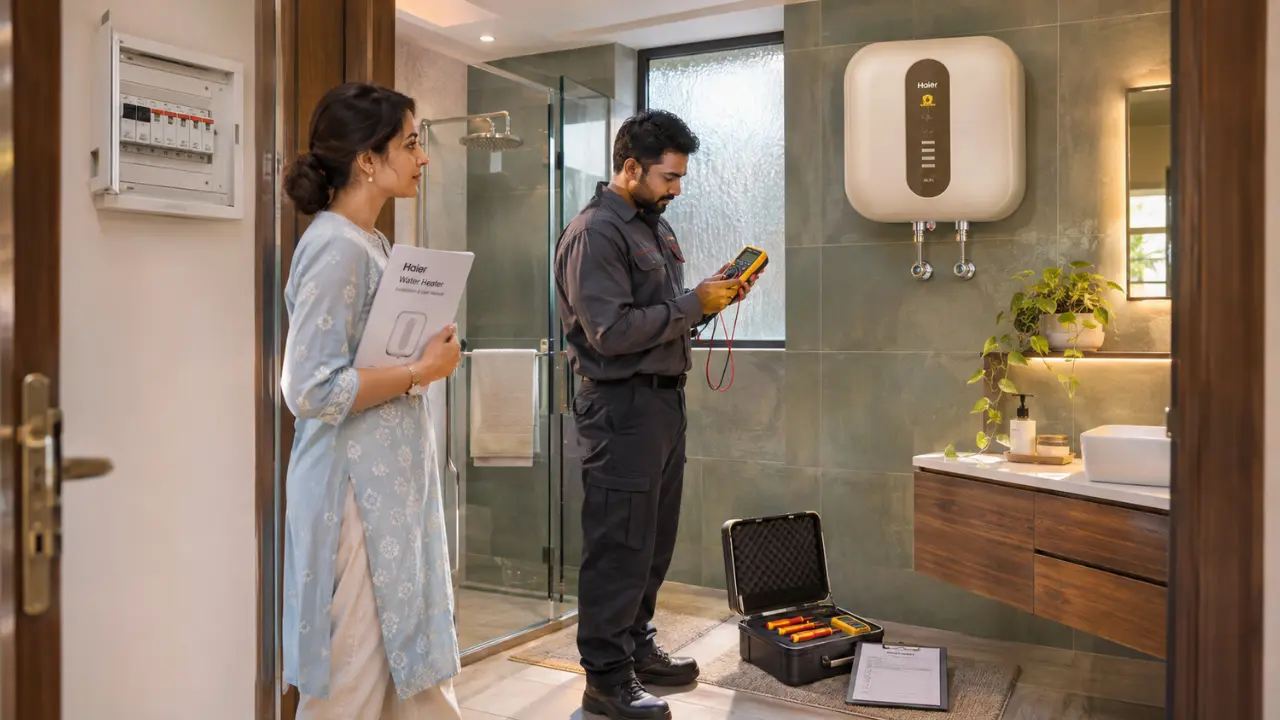

The new geyser is here. The bathroom wall is prepared, plumbing connections are made, and all is ready for installation.
However, before you turn it on, there is one question to ask: will your home’s electrical system be able to support the new water heater?
An electric geyser consumes a lot of electricity when it is used to heat water. Even a high-quality water heater can have electrical issues if the wiring is old or the socket is not the right type, or if the earthing is faulty.
This is especially significant in Indian households where the wiring is often outdated, voltage fluctuations are common, and bathroom circuits are shared.
It is important that an electrician check the power supply, the capacity of the wiring, the earthing, the circuit protection and connection points before installing an electric geyser. These tests are used to determine if the installation is appropriate for the appliance.
Start With the Geyser’s Power Requirements
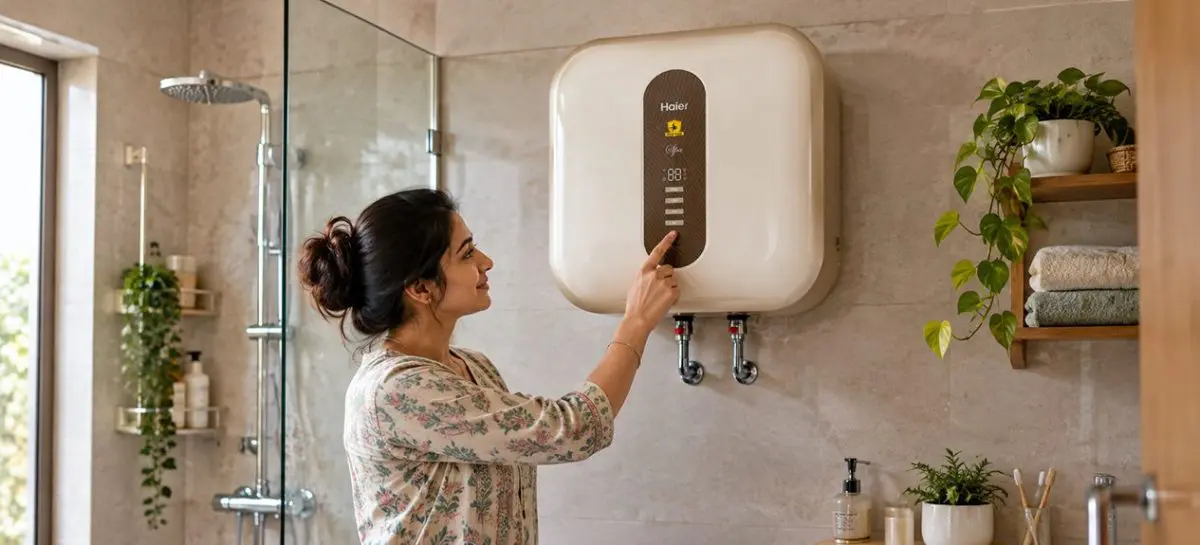
Not all electric water heaters are created equal.
A compact storage geyser might not be able to heat as much as a geyser that is designed to heat quickly. The higher the wattage, the more current will be required during operation of the heating element.
For instance, Haier India’s 15L Square Spa Wi-Fi 5 Star Water Heater (ES15V-SD WIFI) has 2kW and 3kW heating power options.
This difference is important when installing.
For a nominal supply of 230V:
- The 2,000W heating element requires about 8.7 amps.
- The current consumption of a 3,000W heating element is about 13 amperes.
- The actual current will be dependent on the supply voltage and operating conditions.
These figures show the importance of checking the electrical circuit before installing a geyser.
The wiring, protective devices and connection arrangement should be suitable for the maximum rated load of the appliance, as determined by a qualified electrician.
Seven Electrical Checks That Should Never Be Overlooked
1. Check Whether the Existing Wiring Can Handle the Load
An existing electrical connection to an older geyser may exist in a bathroom. This does not necessarily mean that it is appropriate for replacement.
Wiring can become outdated and worn over time. Undersized conductors, damaged insulation, and loose connections can contribute to the potential for overheating.
Prior to installation, have an electrician check:
- The condition and size of the electrical conductors.
- If the circuit is capable of handling the rated current of the geyser.
- Signs of overheating or damaged insulation.
- The suitability of existing junction boxes and terminals.
- If other appliances are connected to the same circuit.
The correct size of the wire is determined by the load, installation, cable length and applicable electrical standards.
Don’t assume that a connection is safe just because the last geyser was used.
2. Verify Proper Earthing
Earthing is one of the most important electrical safety requirements for a water heater.
A geyser works near water, metal fittings and damp surfaces. In the event of an electrical fault, effective protective earthing will allow fault current to flow and enable protective devices to function.
If not properly earthed, metal parts that can be touched may become dangerous.
The continuity of the earth and the effectiveness of the protective earth connection should be checked by a qualified electrician with suitable testing equipment.
This is particularly important in older houses and apartments where the earthing arrangement may not have been checked recently.
3. Check MCB and RCCB Protection
Before installing a geyser, two electrical protection devices should be considered.
The Miniature Circuit Breaker (MCB) is a circuit breaker that is used to protect the circuit from overloads and short circuits.
An RCCB, or Residual Current Circuit Breaker, is designed to detect a difference between the current flowing in and out of the circuit, and can help protect against some earth-leakage faults.
They both have different functions.
When installing a geyser in the bathroom, an electrician should verify that the appropriate RCD is installed and operating properly.
Remember:
- An MCB is not as effective as an RCCB in terms of earth leakage protection.
- An RCCB is not a substitute for overload and short circuit protection.
- The rating of the protective devices should be in accordance with the circuit design and applicable requirements.
Never bypass a circuit breaker that repeatedly trips. It could be a warning sign of a problem that needs to be fixed by a professional.
4. Examine the Socket, Switch and Connection Point
A loose electrical outlet can be a serious issue if a high power appliance is used for a long time.
Check for visible signs of damage like discolouration, cracks, damaged switch plates or burn marks.
But visual checks are not a reliable way to determine electrical safety.
The electrician should ensure that the connection arrangement is properly rated, properly terminated and meets the installation requirements of the geyser manufacturer.
Avoid extension boards, multipurpose adapters and temporary electrical connections.
5. Check for Voltage Problems
Does the light in your bathroom sometimes flicker when you turn on another appliance?
This does not necessarily mean there is a serious electrical problem, but it is advisable to investigate the issue before installing another high load appliance.
Electrical equipment can be affected by voltage fluctuations in terms of performance and reliability.
If the voltage is not what it should be, or if there is an unusual voltage drop, or if the connection is unstable or if there is a recurring electrical disturbance, an electrician should check the supply voltage and investigate the cause.
If you select a geyser that has the right protective features, you will have extra peace of mind, but this will not make up for unsafe wiring in the home.
6. Evaluate the Bathroom’s Electrical Environment
Bathrooms also pose other electrical risks as moisture and water can exacerbate the effects of electrical failures.
The installation site is thus a critical factor to consider.
Check whether:
- Electrical switches and connection points are located correctly.
- The geyser is fitted with the clearances as specified by the manufacturer.
- Moisture resistance of electrical connections.
- The filled water heater can be safely placed on the wall and mounted.
Water resistance should not be confused with waterproofing.
For instance, Haier 15L Square Ivory 5 Star Water Heater (ES15V-SDI) is water resistant to IPX4, which means it can resist water splashes under the specified test conditions.
This does not imply that the appliance can be submerged or installed in any location where water is found.
7. Check the Final Safety Tests Before Turning On the Power
After the geyser is installed and connected, it still requires a final inspection.
The electrician should conduct proper electrical safety tests and the installer should ensure that the water tank is full before turning on the heating element.
The following should be part of a proper commissioning check:
- Checking of electrical connections and protective earthing.
- Confirmation of correct circuit protection function.
- Water leakage checks around electrical equipment.
- Normal heating of the geyser.
- Assurance that the installation is in accordance with the product manual.
Avoid filling the tank with water and turning on a storage geyser, as the heating element may be damaged by dry heating.
Why Haier Water Heaters Are Worth Considering for Indian Homes
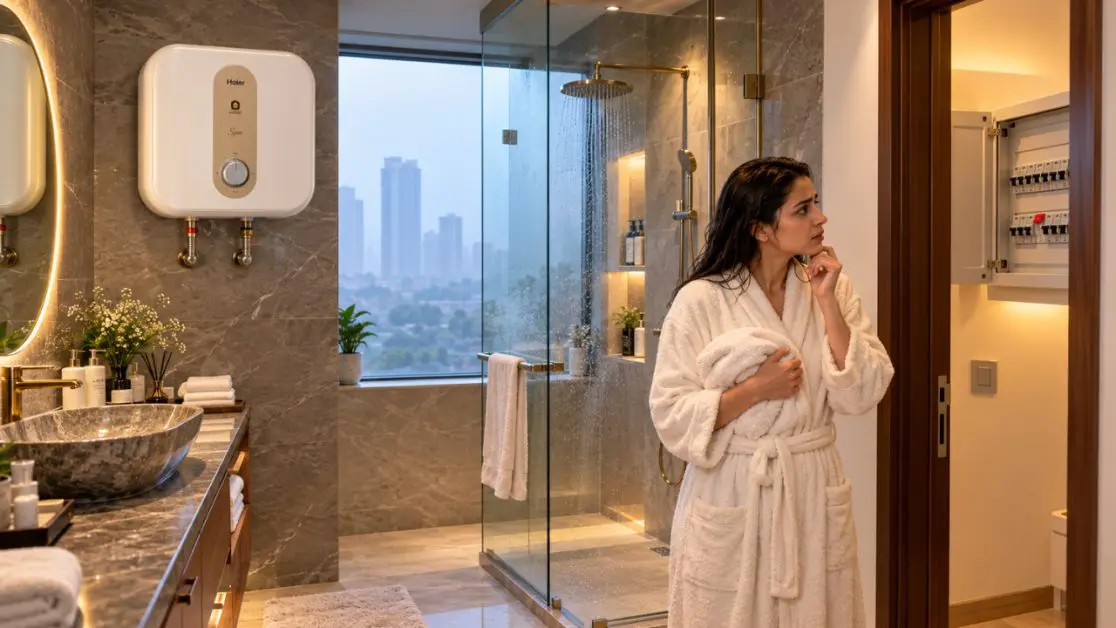
The first step in electrical safety is proper installation. But the safety features that are built into the water heater should also be taken into consideration.
Haier India’s Square Series storage water heaters are equipped with multiple protection technologies, which are suitable for a well-designed electrical installation.
Shock Proof Technology for Additional Protection
Haier 15L Square Spa Ivory 5 Star Water Heater (ES15V-S1I) is equipped with Shock Proof technology.
The product specifications state that this technology is intended to lower the voltage of leakage, which is an additional measure of protection against electric shock.
It is an important feature, particularly for an appliance installed in a bathroom.
But Shock Proof technology is not a replacement for correct earthing, correctly rated wiring or residual-current protection.
Dual Thermal Proof for Temperature Protection
Another factor to take into account when choosing an electric geyser is overheating.
Haier’s Dual Thermal Proof (TTS) technology is based on two levels of thermal protection.
The first is intended to prevent the water from being heated beyond about 75°C. A secondary thermal cut-off is provided to disconnect power at about 95°C if this protection fails.
This multi-layered design prevents over-heating.
The technology is offered in the mentioned Haier water heaters of Square Series, such as ES15V-SDI and ES15V-S1I.
Water Resistance and Durability
The Square Series also includes some features designed to facilitate reliable daily use of Haier.
These include:
- IPX4 water resistant to splashing water.
- MUV valve functionality for pressure relief, anti-vacuum protection and water drainage.
- Working pressure of 8 bar, for installations where the actual water pressure is within the specified limits.
- PUF insulation to minimize heat loss and multiple reheatings.
These features cover various aspects of the water heater’s operation. They should be used in conjunction with, not in place of, electrical installation safety.
Which Haier Electric Geyser Should You Choose?
After the electrical systems are inspected, selecting the right water heater is easier.
Haier India has a number of 15L Square Series models to explore.
Haier 15L Square Spa Ivory 5 Star Water Heater (ES15V-S1I)
This model is ideal for households that require a 15L storage water heater that has the necessary protective features.
It features Shock Proof technology, Dual Thermal Proof, glass lined tank, Incoloy 800 heating element and 8 bar rated working pressure.
It is also 5-star energy rated.
Haier 15L Square Ivory 5 Star Water Heater (ES15V-SDI)
This model is equipped with an LED display, smart timer, smart memory and remote-control features for homeowners who want more convenience.
It also has Shock Proof technology, thermal protection and a storage capacity of 15L.
Haier 15L Square Spa Wi-Fi 5 Star Water Heater (ES15V-SD WIFI)
This type of water heater is an option for households looking for a more advanced water heater.
It has 2kW and 3kW heating options, a digital temperature display, Shock Proof technology, Dual Thermal Proof and a titanium coated tank.
Because of the power options that can be selected, it is important to ensure that the electrical circuit is capable of handling the maximum heating capacity.
A Safe Installation Makes Everyday Comfort More Dependable
A new electric geyser should make your morning routine easier, not more complicated by the need to worry about the electrical connection behind the bathroom wall.
When installing, always remember the basics: appropriate wiring, good earthing, adequate circuit protection and a secure electrical connection.
After these are verified, other features like Haier’s Shock Proof technology, Dual Thermal Proof and water-resistant construction can add value.
Visit Haier India’s collection of electric water heaters and select the suitable model for your family’s hot water needs, and get it installed as per the product instructions.
Reliable hot water begins with a proper installation.
Frequently Asked Questions
1. Is earthing compulsory for an electric geyser?
Yes. Proper protective earthing is essential for the safe installation of an electric geyser. A qualified electrician should verify its effectiveness before the appliance is used.
2. Can I connect a geyser to a normal household socket?
Only if the socket, circuit, wiring and protective devices are appropriately rated and the arrangement complies with the manufacturer’s instructions. A standard low-current socket should not be assumed suitable.
3. Does an electric geyser need an RCCB?
Appropriate residual-current protection is an important safety measure for bathroom electrical installations. An electrician should confirm the correct protective arrangement according to applicable requirements.
4. Can voltage fluctuations damage an electric geyser?
Significant voltage fluctuations may affect electrical components and heating performance. Persistent voltage problems should be investigated before installation.
5. Are Haier Shock Proof water heaters safe without earthing?
No. Haier’s Shock Proof technology provides an additional protective feature, but it does not replace proper earthing, suitable circuit protection or professional installation.