
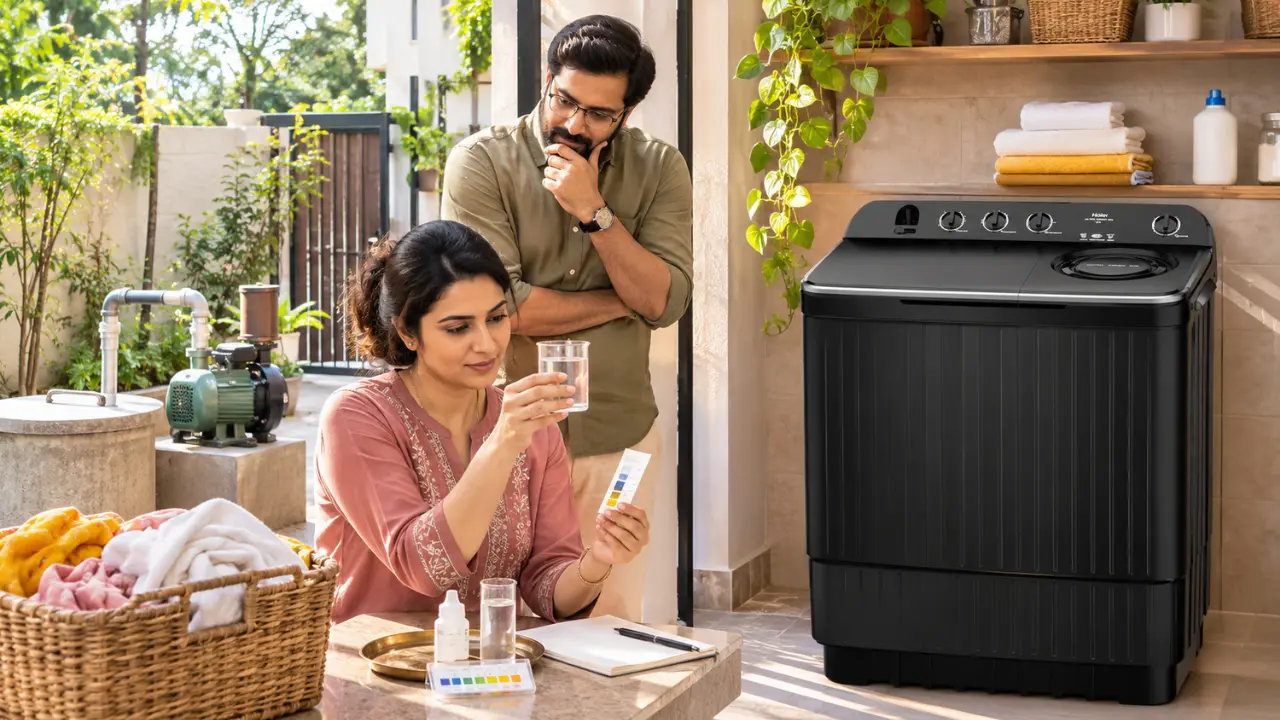

The washing machine is ready, the laundry basket is full, and the overhead tank is full. It looks like everything is normal until you notice something unusual. Your freshly washed clothes feel a bit stiff, the detergent doesn’t produce as much lather, or a small white deposit has started appearing around the washing tub.
The culprit could be the water coming from your borewell.
Borewell water is a daily necessity in many Indian homes, especially in independent houses, residential colonies and areas where the municipal water supply is limited. Of course, this brings up an important question: Can you wash clothes using borewell water without harming the washing machine?
Yes, provided the water quality is appropriate and proper precautions are taken. But not all borewell water is the same, and understanding its properties can make a significant difference to your laundry experience.
Can You Use Borewell Water in Washing Machines?
Borewell water may be used in a washing machine, but its suitability depends on the concentration of dissolved minerals, sediments and other impurities present.
Groundwater flows through layers of soil and rock before reaching your home, unlike treated municipal water. During this journey, it may pick up minerals such as calcium, magnesium and iron.
Some borewells yield relatively soft and clear water. Others provide hard water or water containing sediment.
The key point to remember is that borewell water is not necessarily unsafe. Issues typically occur when its mineral content or contamination is too high for the appliance to manage.
It is recommended to test the water quality and check the manufacturer’s operating requirements before installing your washing machine on a borewell supply.
What Happens When You Wash Clothes With Hard Borewell Water?
Hard water doesn’t necessarily cause an immediate washing machine malfunction. Its effects typically become noticeable over time, particularly if mineral deposits are not removed.
1. Detergent May Not Be as Effective
Hard water may contain calcium and magnesium ions that can interact with some detergent ingredients, especially those that are soap-based.
As a result, you might experience:
- Less lather during washing.
- Static cling on clothes after drying.
- Detergent residue remaining on fabrics.
- The need for a detergent formulation suitable for hard water.
Adding excessive detergent isn’t necessarily the solution. It can produce excess residue and make rinsing more challenging.
2. Mineral Deposits Can Accumulate
Do you see a chalky white film around bathroom taps or the edges of buckets?
When hard water is used repeatedly in washing machines, similar deposits can form inside washing machine components.
Mineral deposits can affect water passages, valves and other exposed surfaces over time. The extent varies depending on water hardness, temperature, washing frequency and maintenance.
3. Clothes May Lose Their Fresh Appearance
Some fabrics may feel less soft when washed in hard water, which can also contribute to dull-looking laundry.
Another concern is the presence of iron-rich groundwater. Depending on its concentration and chemical form, iron can cause yellowish or brownish staining.
This is especially frustrating when washing white school uniforms, light-coloured kurtas or regular cotton clothes.
How to Know If Your Borewell Water Is Hard?
Don’t wait for washing machine issues to arise before checking water quality.
Some household observations can be helpful.
| What You Notice | What It May Indicate |
| White deposits around taps | Scaling caused by calcium or magnesium ions |
| Clothes feel stiff after washing | Hard water or detergent residue |
| Yellow stains on white clothes | Possible iron content |
| Visible sand or muddy particles | Sediment entering the water supply |
| Poor detergent performance | Water hardness or unsuitable detergent |
These signs are not definitive.
To get a more accurate measurement, arrange a water quality test for hardness and related contaminants. A TDS meter cannot determine whether water is suitable for washing because it does not identify individual dissolved substances.
Which Washing Machine Is Better for Borewell Water – Semi-Automatic or Fully Automatic?
This is a decision worth considering, especially in Indian households where water supply and pressure can be inconsistent.
Both types of washing machines can experience issues with unsuitable water. Their operating methods, however, are different.
Semi-Automatic Washing Machines
Semi-automatic machines give users greater involvement in filling, washing, draining and transferring clothes for spinning.
This can be useful in homes where water is stored in buckets or where there is no continuous pressurised water supply.
The filling process can be controlled by the user, following the appliance instructions, rather than relying solely on an automatic inlet system.
However, manual filling does not remove dissolved minerals or make contaminated water safe.
Fully Automatic Washing Machines
Fully automatic machines wash, rinse and spin using programmed cycles.
They are typically connected to a suitable water supply with water pressure within the range specified by the manufacturer.
Inlet filters and valves may require extra attention if the borewell water contains significant sediment.
Both types of machines are not necessarily resistant to hard water unless the manufacturer specifically states so.
Haier Semi-Automatic Washing Machines for Practical Indian Laundry Requirements
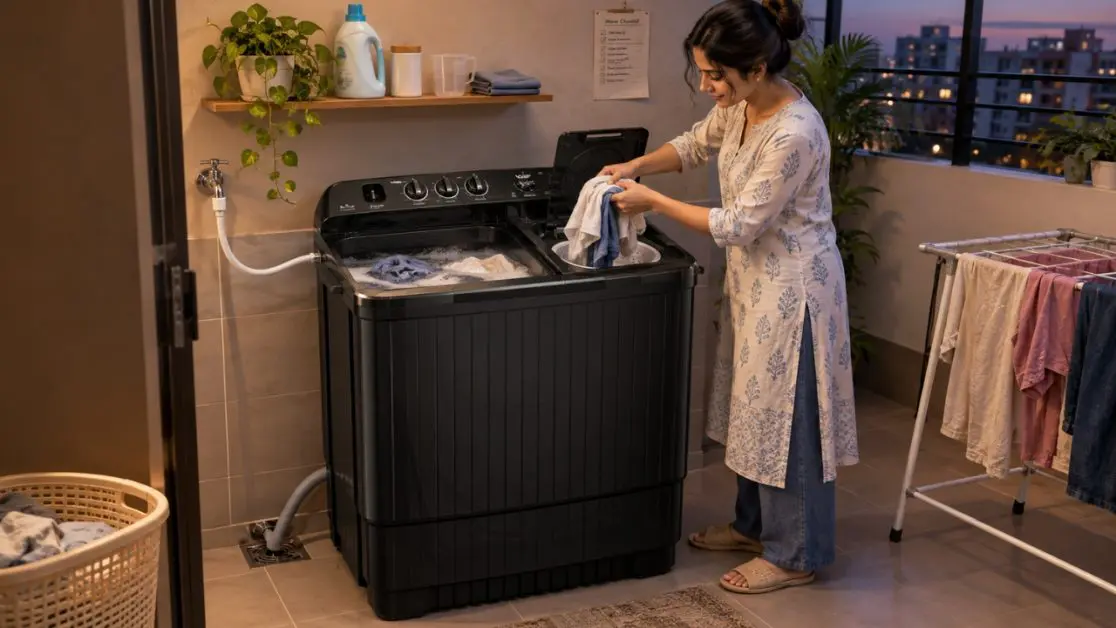
Haier India offers semi-automatic washing machines for households that require flexibility in washing arrangements and need more laundry capacity.
Three models worth exploring are the Haier Semi Automatic Washing Machine 10 KG 196BK (HTW100-196BK), Haier Semi Automatic Washing Machine 12 KG 196BK (HTW120-196BK) and Haier Semi Automatic Washing Machine 14 KG 196BK (HTW140-196BK).
These twin-tub models offer different washing capacities while sharing several practical features.
Thunder Pulsator for Effective Washing
All three models are equipped with Haier’s Thunder Pulsator, which generates powerful water movement in multiple directions during washing.
This allows clothes to move through the wash water for effective cleaning.
This feature supports washing performance and is not a hard-water treatment system.
Magic Filter for Lint Collection
During the washing cycle, Haier’s Magic Filter traps lint, threads and other loose particles.
This is especially helpful when washing everyday clothes, towels and cotton garments that can shed fibres.
One important distinction: the Magic Filter collects laundry debris. It will not remove dissolved calcium, magnesium or other minerals that cause water hardness.
Spray Function for Rinsing
The Spray feature helps rinse clothes and the inner tub by directing water to remove detergent residue.
When detergent performance is influenced by water conditions, proper rinsing becomes particularly important.
Oxyi Dry for Reduced Moisture
Haier’s Oxyi Dry technology helps reduce the moisture content of clothes after spinning, supporting quicker drying.
This can be helpful in humid conditions and during the monsoon season when drying clothes outdoors takes longer.
Select a Capacity That Matches Your Laundry
| Haier Model | Washing Capacity | Spin Capacity |
| HTW100-196BK | 10 kg | 6 kg |
| HTW120-196BK | 12 kg | 9 kg |
| HTW140-196BK | 14 kg | 9 kg |
The 10 kg model can be suitable for moderate-to-large laundry loads, while the 12 kg and 14 kg models offer additional washing capacity for larger households.
All three models also have castor wheels for easy repositioning and an Anti Rat Mesh to help protect internal components against pests.
Check borewell water quality before purchasing to ensure it meets the appliance’s operating requirements.
How to Protect Your Washing Machine From Borewell Water
Some preventive maintenance can help minimise groundwater-related problems.
Test the Water Before Installation
Check whether your borewell water is too hard or contains excessive iron or sediment.
If treatment is necessary, choose an appropriate solution based on the test results and appliance recommendations.
Consider Suitable Water Treatment
A sediment filter can remove suspended particles, while a properly selected water softener can help reduce hardness.
These perform different functions. A simple sediment filter will not reduce water hardness.
Use the Correct Detergent
Choose a detergent appropriate for your washing machine and local water conditions.
Do not exceed the recommended amount of detergent specified by the detergent manufacturer, even if clothes don’t seem sufficiently clean.
Keep the Washing Tub and Filters in Good Working Order
Regularly check and clean accessible filters and clean the washing tub according to the appliance manual.
Do not use strong acids or household descaling chemicals unless specifically recommended by the manufacturer.
Be Aware of Changes
When water starts entering slowly, clothes develop stains or deposits start appearing, investigate the issue early.
Sometimes, the problem is not a mechanical failure but rather the quality of the water.
Is It Possible to Use Borewell Water Without a Water Softener?
Yes, in some circumstances.
Even if the water supply comes from a borewell, a water softener is not always required.
If the water hardness and other parameters are found to be acceptable for your appliance after testing, further softening may not be necessary.
Where hardness is too high, however, suitable treatment can help control mineral accumulation and improve detergent performance.
Remember, a water softener doesn’t necessarily remove iron, sediment or microbial contamination. Treatment methods vary depending on the water quality issues.
Make Borewell Water Laundry More Manageable With Haier India
For many Indian families, using borewell water for washing clothes is a reality. The key is understanding the water supply rather than assuming that all borewells provide the same water quality.
If flexibility is important when managing wash water, Haier India’s semi-automatic washing machine range provides practical options for households.
The HTW100-196BK, HTW120-196BK and HTW140-196BK models offer choices for different household laundry requirements, with washing capacities of 10 kg, 12 kg and 14 kg, respectively, and features such as Thunder Pulsator, Magic Filter, Spray and Oxyi Dry.
Visit Haier India and explore its semi-automatic washing machine range to select a model according to your family size, washing needs and water availability.
With the right appliance, suitable water quality and regular maintenance, everyday laundry can become a lot easier.
Frequently Asked Questions
1. Can borewell water damage a washing machine?
Yes, borewell water can affect a washing machine if it contains excessive hardness, iron or sediment. Over time, mineral deposits may accumulate inside water passages and other components. Testing the water and following appropriate maintenance practices can help reduce these risks.
2. Which washing machine is better for borewell water, semi-automatic or fully automatic?
Semi-automatic washing machines can be convenient for households with irregular water supply because they offer greater flexibility in filling and managing wash water. Haier models such as the HTW100-196BK, HTW120-196BK and HTW140-196BK provide different washing capacities. However, neither machine type automatically removes water hardness.
3. Do I need a water softener for my washing machine if I use borewell water?
A water softener may be beneficial if your borewell water has excessive calcium and magnesium content. However, not every borewell requires one. Getting the water tested helps determine whether softening is necessary and which treatment method is suitable.
4. Can hard borewell water make clothes yellow or stiff?
Yes, hard water can contribute to stiff-feeling clothes because dissolved minerals may interfere with detergent performance. Yellowish or brownish stains may occur when groundwater contains iron. Using suitable detergent and addressing the underlying water quality problem can help maintain fabric appearance.
5. Does Haier’s Magic Filter remove hardness from borewell water?
No. The Magic Filter available in Haier semi-automatic washing machines such as the HTW100-196BK, HTW120-196BK and HTW140-196BK is designed to capture lint, threads and loose debris during washing. It does not remove dissolved minerals such as calcium and magnesium.