




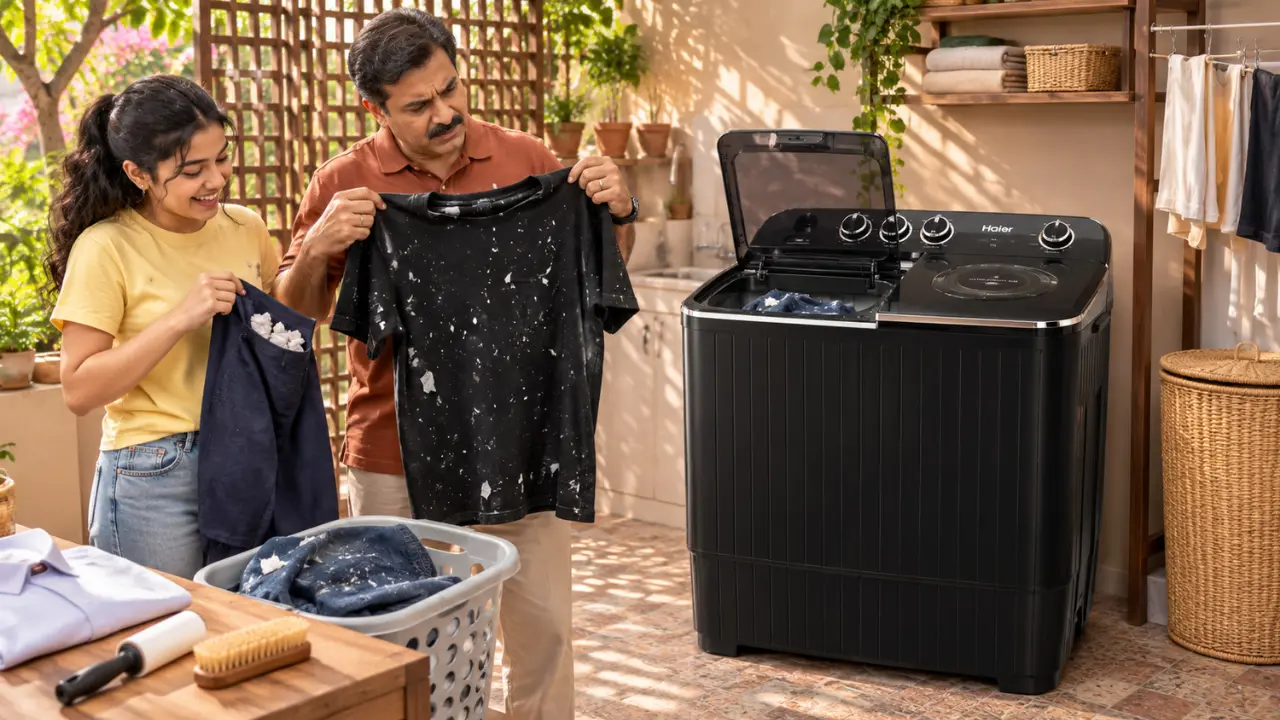

You pull open the washing machine, only to find a fresh load of clean clothes. Rather, your beloved black T-shirt appears to have been scattered with small bits of white paper. The jeans are not much better and even the bed sheet has absorbed some of the mess.
The culprit? Most likely a lost tissue in someone’s pocket.
It is quite common, particularly in Indian homes where school uniforms, office trousers, children’s clothes and daily laundry are washed together.
The downside is that sometimes the process of removing tissue fluff can take longer than washing the clothes. However, why does one little tissue make such a mess and what can be done about it?
What Happens When a Tissue Goes Through a Washing Machine?

A tissue is not meant to be washed in a washing machine.
It becomes weak when its paper fibres come in contact with water. The tissue gradually disintegrates as the clothes tumble around in the washing machine.
These fragments are carried in the wash water and deposited on various fabrics.
There are three factors that make the situation worse:
- Water absorption: The tissue absorbs water, which makes it less structured.
- Washing movement: Clothes are repeatedly touched, which causes the tissue to be broken into smaller pieces.
- Fabric interaction: Loose paper fibres get stuck in rough fabrics and stick to clothes.
At the end of the wash cycle, one tissue can be transformed into hundreds of white particles that are visible.
Interestingly, the washing machine isn’t necessarily malfunctioning. The problem begins with the tissue itself.
Why Does White Tissue Fluff Stick More to Some Clothes Than Others?
Have you ever noticed that a black cotton kurta gathers more fluff than a light-coloured shirt?
The texture of the fabric is important.
Cotton and Knitted Fabrics
Small paper particles can be trapped on the surface of cotton T-shirts, sweatshirts and knitted garments.
These materials rub against the wet tissue fragments and some fibres get trapped between the threads of the fabric.
Polyester and Synthetic Clothing
Synthetic fabrics can build up static electricity, especially when drying. This can cause light lint particles to stick to the surface.
Towels and Textured Materials
Towels feature raised loops that can trap bits of tissue.
Clothing and towels should also be washed together as particles can be transferred from one to the other.
The problem is more apparent when wearing dark-coloured clothes, as white paper fibres will stand out against the fabric.
How to Get Rid of Tissue Fluff from Clothes After Washing

Finding bits of tissue doesn’t imply that you should wash everything over and over again.
The best method will depend on the amount of paper left and if the clothes are wet or dry.
Step 1: Shake the Clothes Before Drying
Remove each piece of clothing to the outdoors or to an appropriate cleaning location and gently shake it.
Larger pieces of tissue can fall away right away.
Focus on pockets of trousers, inside of garments and sleeve folds.
Step 2: Allow the Clothes to Dry
When wet, small tissue particles tend to stick to wet fabric and are hard to remove.
Allow the clothes to air-dry completely.
After drying, many loose particles are easier to brush off.
Step 3: Use a Lint Roller
A lint roller is a great tool for getting rid of white lint from black pants, black shirts and cotton clothes.
Gently roll it over the affected areas.
For delicate fabrics, avoid applying excessive pressure.
Step 4: Use a Soft Clothes Brush
Use a soft fabric brush to remove paper particles that may be trapped in textured fabrics.
Scrub gently in the direction of the fabric weave.
Step 5: Rinse Again If Needed
If there is a lot of tissue debris in the load, empty the washing machine of any visible tissue debris and inspect the lint filter first.
Then consider rinsing the affected clothes again using clean water.
Do not add more detergent than is needed. Detergent will not dissolve tissue fragments and too much detergent can cause more rinsing problems.
Does a Washing Machine Lint Filter Help with Tissue Fluff?
Yes. Some loose fibres and debris can be trapped in a lint filter during the washing process.
But it can’t ensure that all the tissue pieces will be removed, especially if the paper has already been embedded in clothing.
That’s where a washing machine that has an effective filtration system comes into play.
Haier India semi-automatic washing machines come with Magic Filter technology which traps lint, threads and other debris during the wash cycle.
The filtration system helps to improve laundry quality by removing loose particles before they can pass through the wash water again.
However, pocket checks are still necessary. Even a washing machine with a lint filter can’t remove the effects of washing a forgotten tissue.
Haier Semi-Automatic Washing Machines with Magic Filter Technology
Haier has a range of semi-automatic washing machines that provide a practical washing experience with lint filtration for Indian households that wash laundry frequently.
There are three models to consider:
Haier 10 KG Semi-Automatic Washing Machine (HTW100-196BK)
Haier HTW100-196BK has a washing capacity of 10kg and Magic Filter technology.
The Thunder Pulsator generates water flow in multiple directions to ensure effective washing, and the Spray feature aids in rinsing.
Other features include:
- Oxyi Dry technology to help reduce moisture remaining in clothes after spinning.
- Castor Wheels for easy machine mobility.
- Anti Rat Mesh for pest protection of internal parts.
The model is recommended for those who want to buy a semi-automatic washing machine with a separate lint filtration system.
Haier 12 KG Semi-Automatic Washing Machine (HTW120-196BK)
The Haier HTW120-196BK offers a 12 kg washing capacity for households that wash larger loads.
It has a Magic Filter to catch loose lint and debris during washing and the Thunder Pulsator to facilitate effective cleaning with multi-directional water flow.
The machine is also equipped with Spray rinsing, Oxyi Dry, Castor Wheels and Anti Rat Mesh.
It has a spin weight of 9 kg, which is suitable for families who wash several clothes regularly.
Haier 14 KG Semi-Automatic Washing Machine (HTW140-196BK)
When it comes to laundry, large families can have a lot of sheets to wash, including bed sheets, everyday clothes and family clothes.
Haier HTW140-196BK has a washing capacity of 14kg and spin capacity of 9kg.
It also has Magic Filter technology to trap lint and debris during the wash cycle, as in the other models.
It also offers additional assistance for daily laundry needs with its Thunder Pulsator, Spray rinsing and Oxyi Dry.
These technologies enhance the washing experience, but the best prevention is to remove tissues from pockets prior to washing.
How to Prevent Tissue Fluff in Future Washes
To avoid tissue fluff in subsequent washes, the wash water temperature should be kept below 50°C.
The simplest one is under a minute before loading the machine.
Check pockets regularly when washing clothes.
There are a few habits that can make a difference:
- Look in all pockets: Look in pockets of jeans, school trousers, jackets and office clothes for tissues, receipts and loose paper.
- Separate towels and textured fabrics: Wash towels and heavily textured fabrics separately, if possible.
- Do not overload: Allow sufficient space for clothes to flow as per the machine’s capacity.
- Clean the lint filter: Empty lint filter as per manufacturer’s instructions.
- Check wash tub for paper remnants: Before loading another wash, check for paper remnants in the wash tub.
- Carefully sort dark clothes: Avoid dark clothes from shedding large amounts of lint.
The filter in the washing machine is one thing that is overlooked.
Lint that is not removed can reduce the effectiveness of the filter to trap more lint.
The filtration system should be maintained regularly to ensure it operates as designed.
Should You Rewash Clothes Covered in Tissue Fluff?

Not always.
If the clothes are otherwise clean and only have a light coating of paper particles, drying and brushing may be sufficient.
Rewashing is more useful when large pieces of tissue are left in the fabric.
Clean any accessible lint filter as per the user manual and remove any loose paper from the clothes before beginning another cycle.
Otherwise, the same debris can be recycled.
Always use the care label to choose the wash cycle for delicate clothing.
Cleaner Laundry Starts with Good Everyday Practices
A lost tissue can make a regular laundry day a very messy one. Thankfully, with a bit of patience, correct drying and appropriate fabric-cleaning techniques, most tissue fluff can be eliminated.
The prevention of the problem is even easier.
Simple steps like checking pockets, sorting laundry and keeping the washing machine’s lint filter clean can make everyday laundry easier.
Haier India’s 10 kg HTW100-196BK, 12 kg HTW120-196BK and 14 kg HTW140-196BK semi-automatic washing machines come with Magic Filter technology and convenient washing and rinsing options for families looking for a new washing machine.
Visit Haier India’s semi-automatic washing machine collection to discover the washing machine that meets your family’s laundry needs.
Frequently Asked Questions
1. Why do tissues leave white fluff on clothes after washing?
Tissues are made from soft paper fibres that weaken when soaked in water. During the wash cycle, movement and friction break these fibres into smaller fragments. The particles then circulate through the water and stick to clothing, particularly cotton, knitted fabrics and dark-coloured garments.
2. How do you remove tissue fluff from black clothes?
Allow the clothes to dry completely before removing the fluff. Once dry, use a lint roller or soft clothes brush to lift the white particles gently. If substantial tissue residue remains, shake the garments thoroughly and consider an additional rinse cycle.
3. Will washing clothes again remove tissue residue?
An additional rinse cycle may help remove loose tissue particles, but rewashing is not always necessary. First, shake the clothes, remove larger paper fragments and clean the washing machine’s lint filter. For lightly affected garments, air-drying followed by brushing may be sufficient.
4. Can a washing machine lint filter collect tissue particles?
Yes, a washing machine lint filter can capture some loose tissue fibres and debris during washing. Haier semi-automatic washing machines, including the HTW100-196BK, HTW120-196BK and HTW140-196BK, feature Magic Filter technology designed to collect lint, threads and other debris. However, no lint filter can guarantee complete removal of disintegrated tissue particles.
5. Why does tissue fluff stick more to dark clothes?
White tissue particles are more noticeable against dark fabrics because of the colour contrast. Additionally, textured cotton, knitted materials and certain synthetic fabrics can trap or attract loose fibres. This makes tissue residue particularly visible on black T-shirts, trousers and dark-coloured uniforms.