




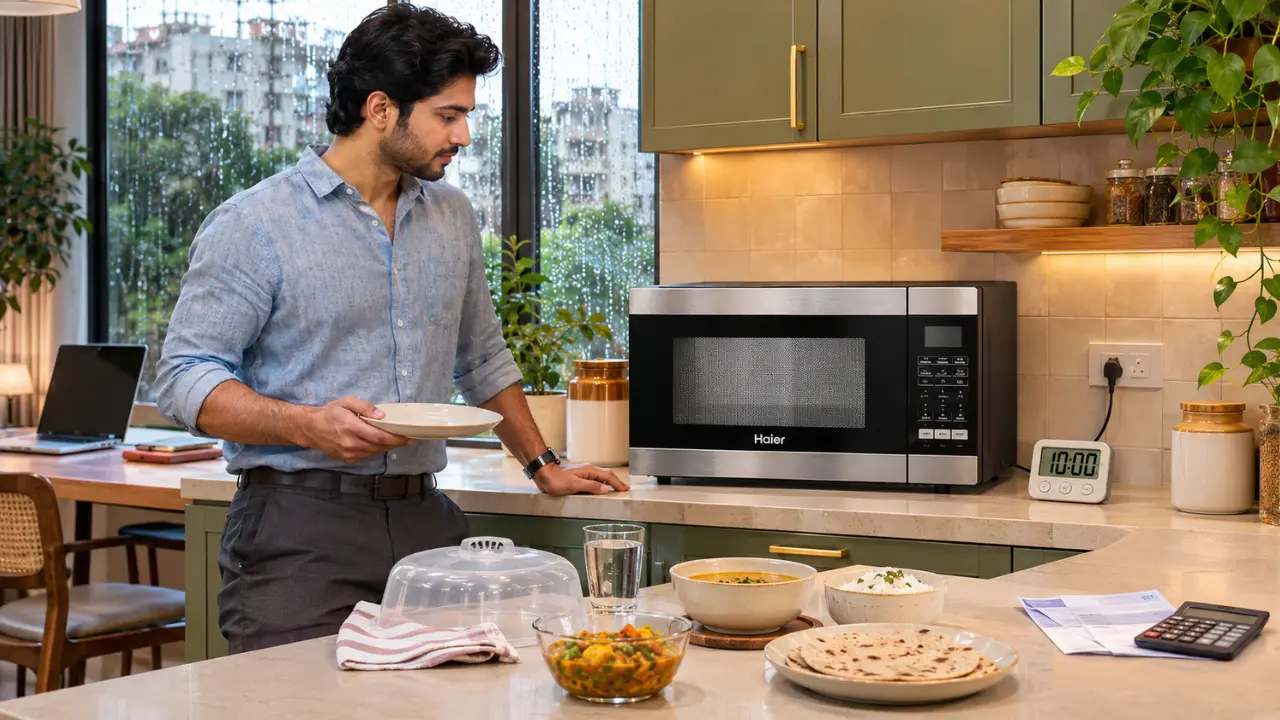

Lunch can be reheated in a microwave in 10 minutes, a quick snack for the evening or defrosting ingredients for dinner. But if the appliance is rated at several hundred watts, or even over 2,000 watts, it’s only natural to ask yourself how much electricity those few minutes actually use.
A microwave rated at 1,000 to 1,500 watts of electrical input power would use about 0.17 to 0.25 units of electricity in 10 minutes of continuous operation at rated input power. This means that at an electricity rate of ₹8 per unit, the cost of this is approximately ₹1.33 to ₹2 per session.
But the actual consumption is dependent on the input wattage of the microwave, cooking mode, power setting and cooking time. For example, a convection microwave oven for baking can use a lot more electricity than a microwave oven used to heat a bowl of dal.
The Difference Between the Wattage of the Microwave and the Electricity Consumption
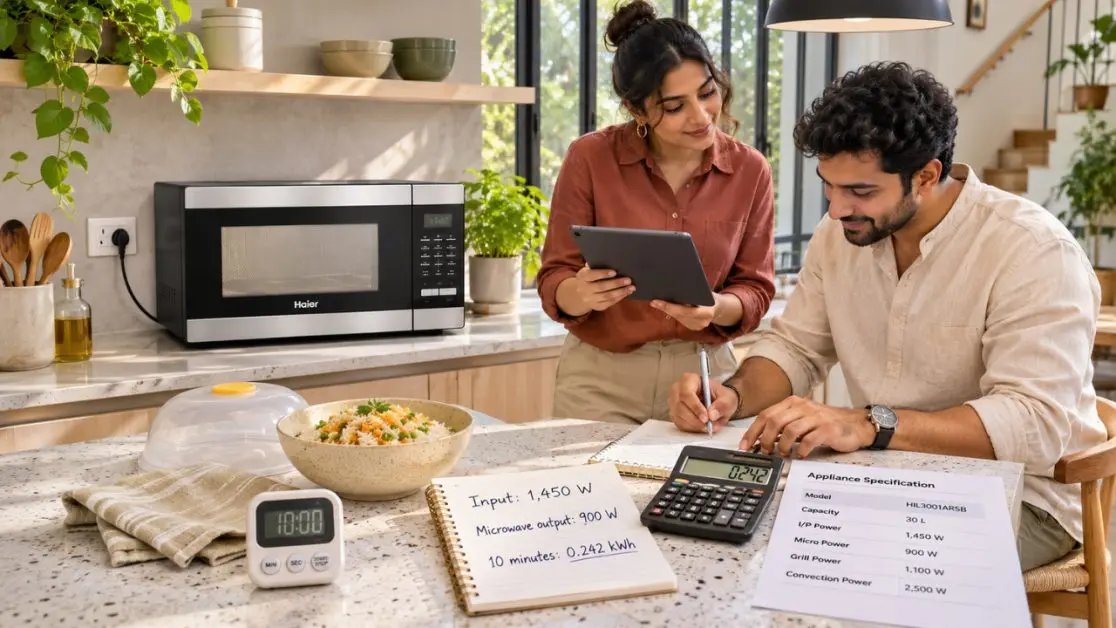
When you’re looking at the specs of a microwave, there’s one little thing that many people miss. The cooking power mentioned on the appliance is not necessarily the amount of electricity it draws from the power socket.
There are two power ratings that are relevant to microwaves:
- Input power: The amount of electricity consumed by the appliance when it is running.
- Microwave output power: Power output that is given off as microwave energy for heating and cooking food.
The Haier 30L Convection Microwave with In-Built Air Fryer (HIL3001ARSB) is a good option to consider. It has a rated input power of 1,450 watts and a microwave output power of 900 watts.
The 1,450 watts input is the key number to consider when calculating electricity usage in microwave mode, not the 900 watts cooking output.
If you use the wrong number, you may end up underestimating your electricity use for several months.
How to Calculate the Electricity Consumption for 10 Minutes
Special equipment is not required to estimate the amount of electricity your microwave uses. All that is needed is the electrical input rating of the appliance and a bit of arithmetic.
The basic formula is:
Electricity consumption (kWh) = Input power (watts) × Operating time (hours) ÷ 1,000
A microwave that has an input power of 1,450 watts would use:
1,450 × (10 ÷ 60) ÷ 1,000 = 0.242 kWh
This is about 0.24 units of electricity.
The Electricity Usage of Microwaves of Different Input Ratings
| Microwave input power | Consumption in 10 minutes | Estimated cost at ₹8/unit |
| 800 watts | 0.133 units | ₹1.07 |
| 1,000 watts | 0.167 units | ₹1.33 |
| 1,200 watts | 0.200 units | ₹1.60 |
| 1,450 watts | 0.242 units | ₹1.93 |
| 1,500 watts | 0.250 units | ₹2.00 |
| 2,000 watts | 0.333 units | ₹2.67 |
| 2,500 watts | 0.417 units | ₹3.33 |
These figures are based on continuous operation at the input power indicated. Actual consumption may vary depending on power cycling, temperature regulation and the selected cooking programme.
The tariff rates for electricity also vary from state to state, distribution companies and consumption slabs.
What Happens When You Cook Food in Different Microwave Cooking Modes?
A microwave is not just for heating up leftovers. Modern convection models can be used to bake, grill, roast and even air-fry food. The different cooking methods have different effects, naturally affecting electricity consumption.
Microwave Mode
In the microwave mode, electromagnetic waves are used to heat food. It is especially convenient for cooking rice, reheating curries and thawing frozen food.
These tasks typically have relatively short run times, so the total electricity use can be relatively low.
Grill Mode
Grill mode is a heating element that browns and crispens the surface of food. It can be used for making grilled sandwiches, paneer tikka and some vegetable dishes.
Consumption is a function of the electrical rating of the heating element and the duration of its operation.
Convection Mode
Convection cooking is a method of cooking food with a heating element and hot air circulation. Preheating may be necessary for baking cakes, cookies and pizzas, and then a longer cooking time.
This means that the total electricity use may be greater than the use of a quick microwave reheating.
Combination Mode and Air Fryer Mode
Combination cooking combines various cooking methods, and air frying fries food in a crispy manner with less oil.
They use electricity according to the programme, temperature, cooking time and heating elements used.
How Much Electricity Does a Haier 30L Convection Microwave Consume?
The Haier 30L Convection Microwave with In-Built Air Fryer is for households who desire more versatility in their cooking with a single kitchen appliance.
It has published power specifications of:
- Rated output power: 1,100 watts
- The output power of the microwave is 900 watts.
- Grill power: 1,100 watts
- Convection power: 2,500 watts
- Capacity: 30 litres
If the appliance is used in the microwave mode continuously for 10 minutes, it would use about 0.242 units of electricity, which would cost about ₹1.93 at an assumed tariff of ₹8 per unit.
Grill and convection operations will have different consumption patterns. The actual electricity consumption for these modes will vary with the heating cycle and programme selected.
Cooking Features That Make Everyday Use More Practical
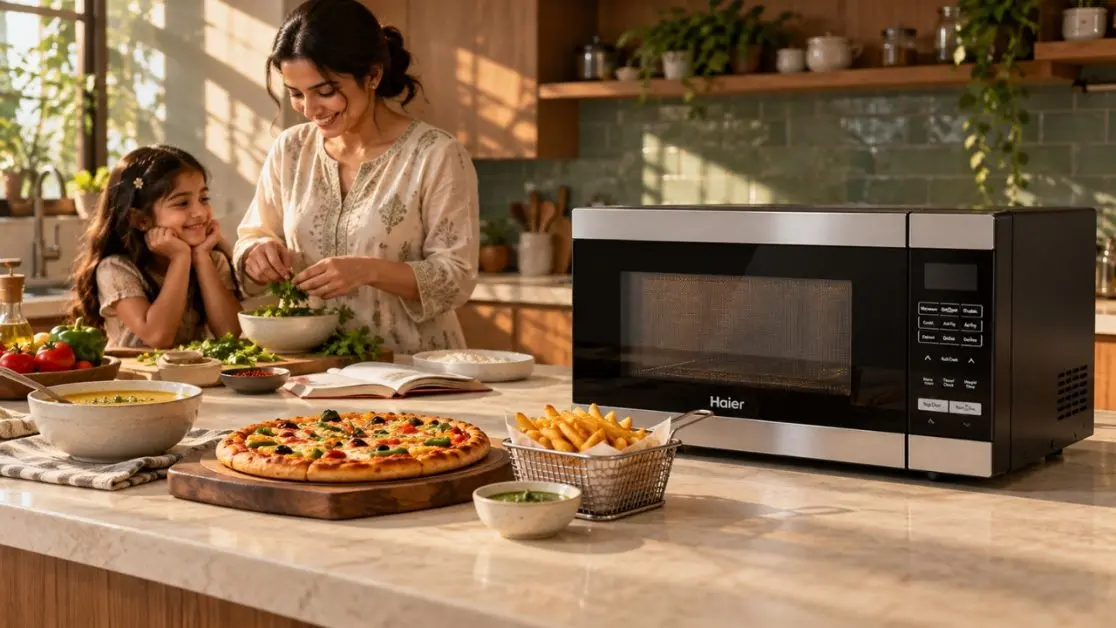
When buying a microwave, the only thing you need to consider is electricity consumption. The ease of use of the appliance is just as important.
The Haier HIL3001ARSB comes with a number of features that are useful in a typical Indian kitchen:
- Five cooking intensity levels to choose from based on the food needs.
- 305 auto cook menus with pre-programmed power and time settings.
- In-built air fryer with 36 dedicated air fryer menus.
- Automated motorised rotisserie for even cooking.
- Two combination cooking options for mixing cooking methods.
- Express cooking for quick start heating.
- Cavity and touch control panel made of stainless steel.
Whether you’re cooking breakfast before heading to work, or grilling up some starters for a weekend barbecue, the appliance can handle a variety of cooking needs without having to use multiple appliances for each job.
How Much Does Using the Microwave Every Day Cost You in Your Monthly Electric Bill?
Ten minutes doesn’t sound like much. What about if you use the microwave daily?
Let’s say a microwave has a rated electrical input of 1450 watts and an electricity tariff of ₹8 per unit.
| Daily usage | Monthly consumption (30 days) | Estimated monthly cost |
| 5 minutes | 3.63 units | ₹29 |
| 10 minutes | 7.25 units | ₹58 |
| 15 minutes | 10.88 units | ₹87 |
| 20 minutes | 14.50 units | ₹116 |
| 30 minutes | 21.75 units | ₹174 |
These estimates are based on continuous operation at the rated input power and do not include standby consumption, fixed electricity charges and other applicable charges.
If the microwave is used mainly for brief reheating periods, the running cost for the household might not be too high.
Simple Tips to Help You Save Electricity in Your Microwave

Changing a few everyday cooking habits can help avoid unnecessary electricity usage without compromising food quality.
- Only heat what you are going to eat.
- Cover with microwave-safe covers with adequate ventilation to keep moisture in.
- Add a little water to thick curries and gravies and stir them halfway through the reheating process to ensure even cooking.
- Do not preheat in the normal microwave mode.
- Use the correct power settings rather than the highest power setting.
- Use the recommended amounts for preset cooking programmes.
- Ensure that the microwave cavity is kept clean and that the air vents are not blocked.
- If possible, thaw frozen foods in the refrigerator first.
Also, keep in mind that the lower the power setting, the lower the overall electricity use is not necessarily. The total energy used may not be reduced in proportion if the food requires a lot more time to cook.
The objective is to select the appropriate cooking setting rather than simply the lowest one.
Make Every Minute of Microwave Cooking Count with Haier
The average 10-minute microwave use is only a small fraction of an electricity unit. The more important factor is how often you use it, the cooking modes you choose and whether you avoid unnecessary heating.
The Haier 30L Convection Microwave with In-Built Air Fryer (HIL3001ARSB) combines microwave cooking, grilling, convection baking, air frying and rotisserie cooking in one. It has five power settings and a wide range of preset cooking programs to suit everyday cooking or more complex dishes.
From yesterday’s rajma to freshly baked cookies or homemade tandoori starters, it’s easier to make everyday meals with the right cooking mode.
Visit Haier India to find the perfect microwave oven for your home and lifestyle.
Frequently Asked Questions
1. How many units of electricity does a microwave consume in 10 minutes?
A microwave with an input power of 1,000 to 1,500 watts consumes approximately 0.17 to 0.25 units of electricity in 10 minutes when operating continuously at its rated input power.
2. How much does it cost to run a microwave for 10 minutes in India?
At an electricity tariff of ₹8 per unit, running a microwave with an input power of 1,450 watts for 10 minutes costs approximately ₹1.93. Actual costs depend on your local electricity tariff and cooking settings.
3. Does a microwave increase the monthly electricity bill significantly?
Generally, short reheating sessions do not contribute substantially to monthly electricity bills. A 1,450-watt microwave operating at its rated input power for 10 minutes daily consumes approximately 7.25 units over 30 days.
4. Does a convection microwave consume more electricity than a solo microwave?
Convection cooking may consume more electricity because it uses heating elements and circulating hot air. However, overall consumption depends on the appliance’s input power, selected cooking mode and operating duration.
5. Does using a microwave at a lower power level save electricity?
Lower power settings may reduce average electricity consumption during operation. However, longer cooking durations can offset these savings. Selecting an appropriate power level and cooking time is more practical.