




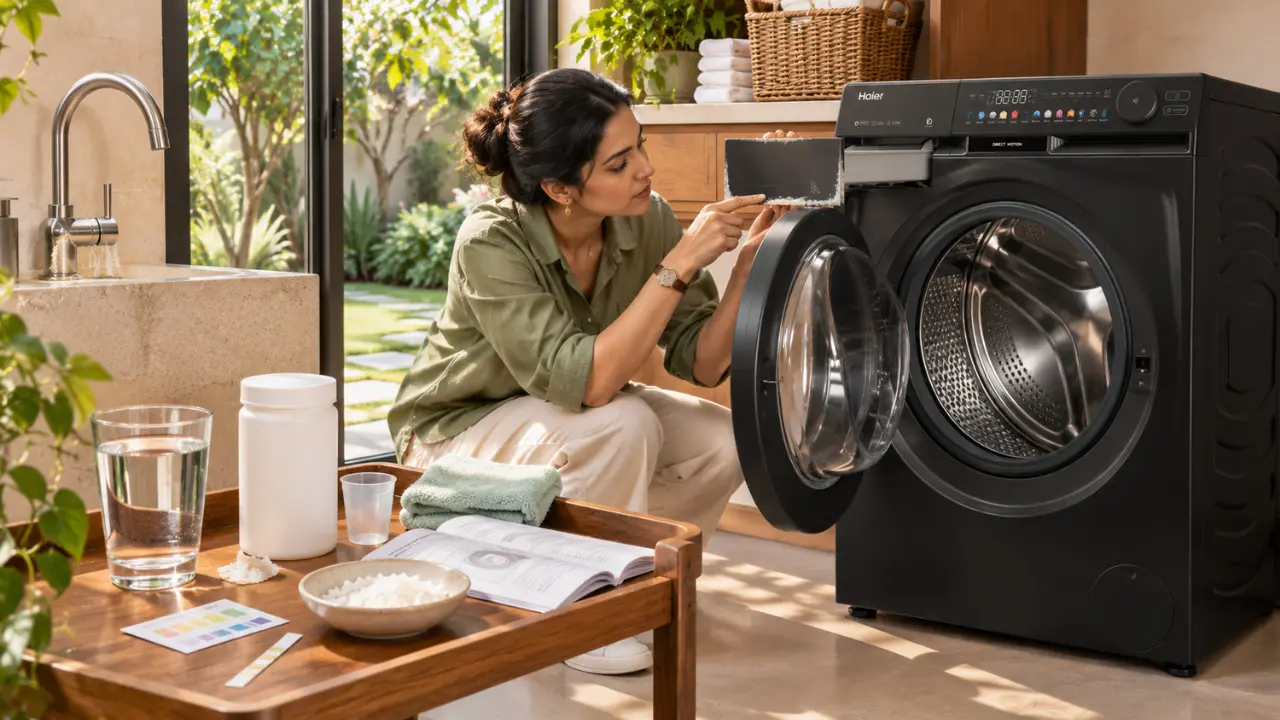

If you live in a hard-water region, you may need to descale your washing machine.
Your washing machine is done, your clothes are clean, and everything is normal. However, a thin film of mineral deposits can be accumulating somewhere inside the appliance.
This is especially applicable to Indian households that rely on borewell water, tanker water, or groundwater that contains high mineral content. The washing machine can run for months without any problems, and then hard-water issues start to show.
Perhaps the detergent drawer develops a chalky coating. Perhaps the clothes are a little stiff even after being rinsed. Sometimes, the drum may look clean but have an unpleasant smell.
These are indicators to look into.
Understanding how to descale a washing machine can help you prevent mineral deposits from becoming a larger problem. Most importantly, the process need not be complicated, as long as you use the proper cleaning method for your appliance.
Why Hard Water Causes Problems Inside Washing Machines

There are several reasons why hard water causes problems inside washing machines.
Hard water is water that has minerals in it, mainly calcium and magnesium. These minerals can deposit on the inside of a washing machine over time when water is used in the machine.
This deposit is often referred to as limescale.
Limescale is not the same as normal dirt and will not necessarily go away after a normal wash. In fact, the more you use mineral-rich water, the more stubborn the deposits will become.
Where Does Limescale Tend to Build Up?
Mineral deposits can form in a number of places:
- Washing drum: A thin mineral layer may grow on surfaces in contact with hard water.
- Heating components: Deposits can form on heating surfaces in machines with water heaters.
- Detergent drawer: Minerals may form a whitish deposit with the detergent residue.
- Water inlet components: Mineral deposits can cause water flow to become limited.
- Internal water pathways: Deposits may accumulate in hard-to-reach areas.
A key difference: detergent residue and limescale are not synonymous. A cleaning cycle can be used to remove normal residue but not necessarily hard mineral deposits.
Hence, it is important to give descaling its own attention.
How to Know If Your Washing Machine Needs Descaling
It’s not necessary to take apart your washing machine to identify potential warning signs.
Begin with what you can see.
Look for These Changes
- White or chalky buildup around the detergent compartment.
- Mineral stains around water-contact areas.
- Clothes that are very stiff after washing.
- Decreased water flow which is not due to supply pressure.
- Residue that does not go away after frequent drum cleaning.
These symptoms do not necessarily indicate limescale. Too much detergent, clogged filters, drainage issues, and inadequate rinsing can yield the same results.
A simple water-hardness test at home can help determine if mineral-rich water is a problem.
When you have hard water in your home all the time, it is especially important to do preventive maintenance.
How to Safely Descale a Washing Machine: Step-by-Step
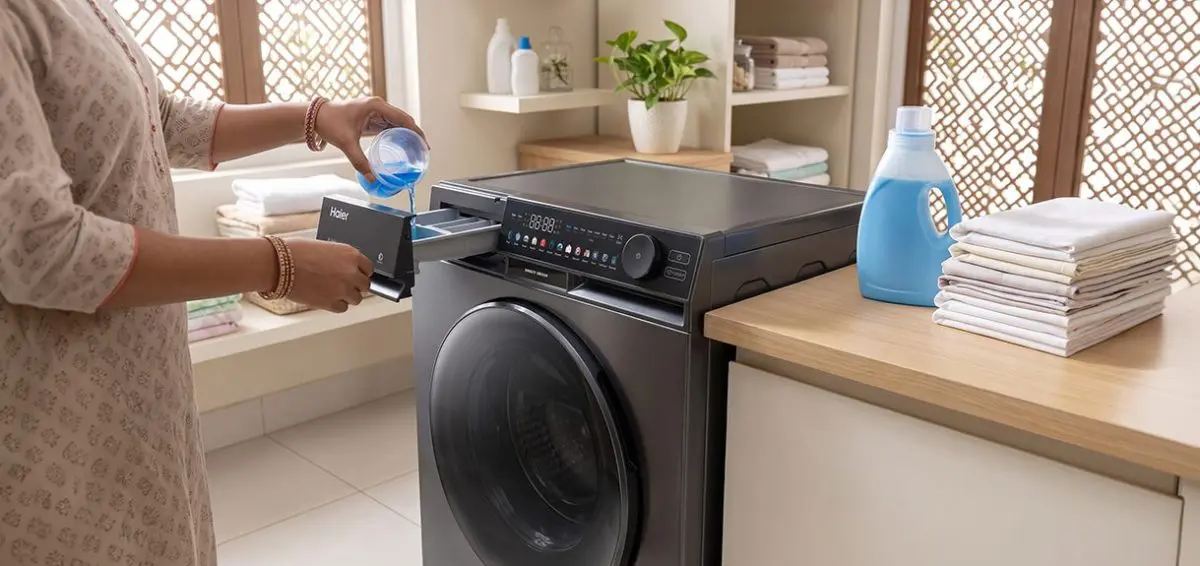
The best way to do this is to use a washing machine descaler that is designed for your washing machine.
Don’t assume all household cleaning products are safe for use inside machines.
Step 1: Check Your Washing Machine’s Instructions
Always check the appliance’s manual before adding any cleaning solution.
Look for the manufacturer’s instructions regarding:
- A product that has been approved for descaling.
- A special maintenance programme.
- Recommended cleaning temperatures.
- Limits on acidic cleaning chemicals.
- Any precautions for internal components.
The descaling process for washing machines varies from one appliance to another.
Step 2: Remove the Contents from the Washing Drum
Take out all clothing, towels, and other laundry.
Unless otherwise stated in the manufacturer’s instructions, descaling should be done with an empty drum.
Before using the drum, look for any coins, hair clips, or other small items that might have fallen in.
Step 3: Add the Approved Descaler
Use the descaler according to the instructions, if the product is suitable for your machine.
Some products are meant for the detergent compartment, while others are meant to be loaded directly into the drum.
Do not estimate the amount.
Using additional descaler doesn’t necessarily produce better cleaning. High levels can have an impact on seals, coatings, or other parts.
Step 4: Choose the Recommended Cleaning Programme
Select the programme listed in your washing machine manual or recommended by the descaler instructions.
If the appliance has a drum-cleaning programme, see if the chosen descaler is compatible with it.
Let the cycle complete without stopping.
Also, do not choose the hottest water temperature just because you think it will remove more deposits. The temperature will vary according to the appliance and cleaning product.
Step 5: Rinse and Inspect
Following the descaling cycle:
- If the instructions for use call for it, repeat the rinse.
- Check the detergent compartment for detergent residue.
- Clean easily accessible surfaces with a soft cloth.
- Look for any unusual smell or deposits.
- Leave the door slightly open to encourage drying.
If there are significant deposits left or the machine still has operational issues, it might be necessary to have it professionally inspected.
Can You Use Vinegar or Baking Soda to Descale a Washing Machine?
This is a common question, particularly in homes seeking affordable cleaning options.
Vinegar is acidic and will help to dissolve some mineral deposits. However, baking soda is not a good alternative to a special limescale remover.
The worry is about compatibility with appliances.
Some rubber parts or materials inside may be impacted by repeated or concentrated exposure to inappropriate acidic solutions.
Likewise, the chemical properties of vinegar and baking soda are largely cancelled out when they are mixed together, and the resulting solution is not suitable for descaling.
Therefore, only use cleaning products and methods approved by the washing machine manufacturer. Do not use descalers in combination with bleach or other household cleaning products.
How Many Times a Year Should You Descale a Washing Machine in a Hard-Water Area?
There is no single schedule that is suitable for all Indian households.
The frequency of descaling is determined by the hardness of the water, how often the appliance is used, the temperature at which it is used, and the manufacturer’s recommendations.
A family that washes several loads a day could be exposed to different minerals than a family that washes clothes twice a week.
Instead of following a random monthly schedule, take into account these factors:
- Mineral content in water source: Borewell and groundwater supplies may have high mineral content.
- Frequency of washing: The more often the washing is done, the more mineral-rich water will be used.
- Hard water: Heating hard water can cause some mineral deposits to form.
- Chalky deposits: If these are occurring regularly, then closer attention is required.
- Manufacturer advice: Always follow the manufacturer’s maintenance schedule.
If the water is especially hard, it may be beneficial to have the water tested and to consult with a professional about the possible treatment options to minimise recurring deposits.
How Haier Washing Machines Make Everyday Laundry Maintenance More Convenient
While regular maintenance is important, so is selecting a washing machine that makes daily laundry easier.
Haier India provides front-load washing machines with intelligent wash functions and dedicated cleaning programmes which can help with regular appliance maintenance.
For instance, Haier F9 comes in three sizes to meet the needs of different families for laundry.
Haier F9 9 Kg Front Load Washing Machine (HW90-DM14F9BKU1)
Haier F9 9 Kg Front Load Washing Machine is a combination of intelligent washing functions and a convenient 9 kg capacity.
It has the following distinguishing characteristics:
- One-Touch AI Wash: Automatically selects suitable washing parameters.
- Direct Motion Motor: Provides smooth and quiet operation.
- Dual Spray technology: Helps remove lint and residue during rinsing.
- Drum Clean programme: Supports regular drum cleaning.
- 525 mm Super Drum: Offers convenient space for laundry.
If you are worried about keeping your washing drum clean, the special Drum Clean programme is available for maintenance.
However, drum cleaning should not be confused with chemical descaling. Use the manufacturer’s instructions for mineral deposits.
Haier 10 Kg Fully Automatic Front Load Washing Machine (HW100-DM14F9BKU1)
For families that do lots of laundry, the Haier 10 Kg Fully Automatic Front Load Washing Machine is a better option.
It has a capacity of 10 kg, which is suitable for larger laundry needs, and One-Touch AI Wash automatically adjusts washing parameters based on the load.
Additional features include:
- AI Colour Panel: Offers intuitive operation.
- Direct Motion Motor: Supports smooth washing performance.
- Dual Spray technology: Helps reduce residual lint and detergent.
- Self Clean programme: Supports regular machine maintenance.
- Night Wash: Provides quieter laundry operation.
The Self Clean programme is especially helpful for keeping the washing machine clean as part of the household cleaning schedule.
Haier 12 Kg F9 Front Load Washing Machine (HW120-DM14F9BKU1)
The Haier 12 Kg F9 Front Load Washing Machine offers extra capacity for larger families without sacrificing convenience.
It has One-Touch AI Wash, a Direct Motion Motor, and Dual Spray technology, as well as a Self Clean programme.
It features a 525 mm Super Drum for larger laundry loads and the AI Colour Panel for easier programme selection.
The Self Clean function helps to maintain the drum’s cleanliness on a regular basis, but specific descaling should be done according to the instructions of the product and manufacturer.
Small Habits That Can Help Minimise Hard-Water Maintenance Issues
Descaling is used to remove mineral deposits. Other types of buildup can be reduced by daily activities.
Try to implement these practices:
- Use detergent based on the amount of laundry and water.
- Do not overload the washing drum.
- Wash the detergent drawer frequently.
- Maintain clean and dry accessible door seals.
- Follow the recommended drum-maintenance programme.
- Inspect the water inlet filter as per the user’s manual.
- Address any ongoing water-flow or drainage issues quickly.
Also, don’t forget that adding more detergent to make up for hard water is not always beneficial. Too much detergent can leave more residue in the machine.
Make Sure Your Washing Machine Is Ready for Any Load
Hard water is a common problem in homes, but mineral deposits don’t have to be an ignored maintenance issue.
The key is to identify deposits early, select the right descaling technique, and implement a sensible maintenance plan.
The F9 front-load washing machine range from Haier India combines smart washing technology, easy cleaning cycles, and various capacities for different Indian households.
If you are looking for a washing machine, check out Haier India’s washing machine range and choose the one that meets your family’s laundry needs, whether it’s the 9 kg, 10 kg, or 12 kg model.
A little care and attention today can make everyday washing more reliable in the years to come.
Frequently Asked Questions
1. How often should I descale my washing machine in a hard-water area?
Descaling frequency depends on water hardness, washing frequency, and the manufacturer’s recommendations. Households using borewell or mineral-rich groundwater may need more frequent maintenance. Check for visible deposits and follow the cleaning schedule recommended for your washing machine.
2. Can hard water damage a washing machine over time?
Yes, prolonged exposure to hard water can cause mineral deposits to accumulate on heating elements, water inlet components, and internal surfaces. Excessive buildup may affect heating efficiency and water flow. Regular maintenance and appropriate descaling can help manage these problems.
3. Is the Self Clean programme in Haier washing machines the same as descaling?
No. The Self Clean programme available in select Haier front-load washing machines helps maintain drum cleanliness. Descaling specifically targets mineral deposits caused by hard water. Always follow the manufacturer’s instructions before using a descaling product with any cleaning programme.
4. Can I use regular detergent to remove limescale from my washing machine?
Regular laundry detergent is formulated primarily for cleaning fabrics, not dissolving stubborn mineral deposits. While some detergents contain water-softening ingredients, they aren’t substitutes for an approved washing machine descaler. Use a compatible descaling product when mineral buildup requires treatment.
5. Does washing clothes in cold water prevent limescale buildup?
Cold-water washing may reduce certain types of mineral deposition associated with heating hard water. However, it cannot completely prevent limescale because calcium and magnesium remain present in the water. Regular inspection and appropriate maintenance are still necessary.
6. Which Haier washing machines offer dedicated drum-cleaning programmes?
The Haier F9 9 Kg Front Load Washing Machine (HW90-DM14F9BKU1) features a Drum Clean programme. The Haier 10 Kg Fully Automatic Front Load Washing Machine (HW100-DM14F9BKU1) and Haier 12 Kg F9 Front Load Washing Machine (HW120-DM14F9BKU1) offer Self Clean programmes. These features support routine drum maintenance but should not be treated as automatic limescale-removal systems.