
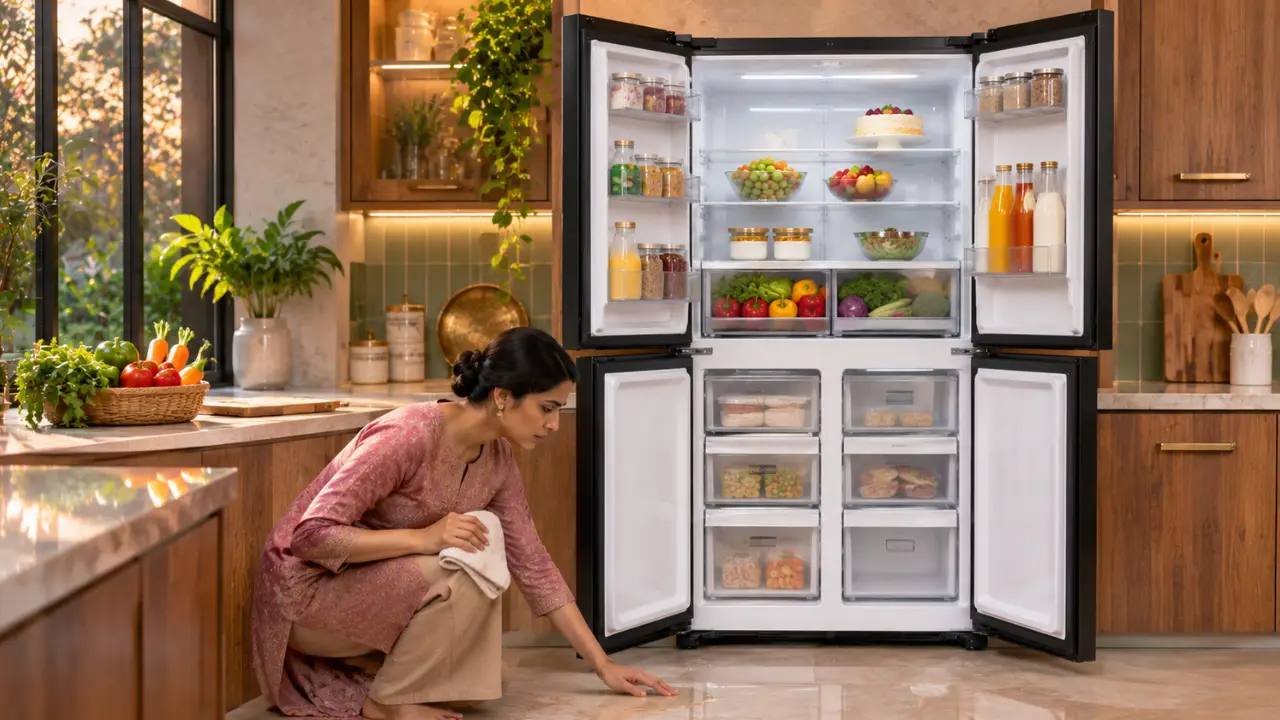

When you go to the refrigerator to get some vegetables for dinner, you see a small puddle of water close to the bottom shelf. Maybe there’s moisture underneath the vegetable drawer, or maybe there is a thin layer of ice that began to grow where it shouldn’t.
Your first thought? There’s a problem with the cooling.
Not necessarily.
In some instances, the issue is a little-known component of the refrigerator that most refrigerator owners never hear about: the defrost drain.
A refrigerator defrost drain allows water to be drained from the refrigerator during the defrost cycle. That water can back up in the appliance, refreeze or drip onto the kitchen floor if proper drainage isn’t provided.
Once you know how this part works, you will be able to detect early on any drainage issues and get the best out of your refrigerator.
What Is a Refrigerator Defrost Drain?

A refrigerator defrost drain is a channel that allows melted frost water to flow out of the cooling compartment.
For refrigerators that are frost-free, moisture may condense as frost on the evaporator coils during normal operation. This frost is periodically melted by the automatic defrost system to prevent an excessive amount of frost build-up.
This water must be discharged somewhere.
That’s where the defrost drain comes in.
It directs the water towards a collection tray, generally located near the bottom of the refrigerator. The collected water evaporates due to the heat produced in the normal operation of the appliances.
Typically occurs automatically, without user intervention.
How Does the Defrost Drain Work?
The drainage process is a series of related steps:
- Frost formation: Moisture from the air slowly freezes on the evaporator during refrigeration.
- Automatic defrosting: The refrigerator automatically defrosts at regular intervals to remove frost build-up.
- Water collection: The melted frost runs down into a channel below the evaporator.
- Water removal: This water is removed through the defrost drain and is directed towards the collection tray.
- Evaporation: The water collected slowly evaporates due to the normal operation of the refrigerator.
The drainage system depends on the design of the refrigerator.
All this happens automatically in a refrigerator that is operating correctly with no frost.
Why Is the Defrost Drain Important to the Performance of the Refrigerator?
The defrost drain doesn’t produce cold air or control the refrigerator’s temperature. Its job is not the same: it’s to control the water created by defrosting.
That responsibility is more significant than you may think.
1. Prevents Water Accumulation in Unwanted Places
Suppose you have just washed coriander, tomatoes and other vegetables and find water under the drawer in the lower part of the refrigerator.
This could be due to clogged defrost drain.
If the melted frost can not drain out of the intended drain, water can overflow into the refrigerator compartment.
This is prevented by good drainage.
2. Minimizes the Likelihood of Re-Icing
If the temperature drops low enough, the water that collects around the drainage hole may refreeze.
This can eventually form an ice blockage which will stop any subsequent defrost water from draining.
A clear drainage path is provided to let the melted frost flow away rather than collecting and freezing over and over again.
3. Helps Maintain a Cleaner Refrigerator Interior
Refrigerator water shouldn’t be inside where groceries are stored.
May cause wet spots, bad smells, and cleaning problems.
Although the defrost drain is not a hygiene treatment system, proper water removal helps to maintain a cleaner refrigerator environment.
4. Supports the Automatic Defrost Process
The automatic defrosting and water drainage are complementary.
The defrost system will melt the frost that accumulates, and the water will be removed by the drainage system.
When the drainage passage becomes blocked, the defrost system might still function, and water can collect in places where it should not.
This is why, even if the refrigerator is cooling properly, drainage issues should be addressed.
How to Check If the Refrigerator Defrost Drain Is Clogged?

Sometimes a drainage blockage doesn’t produce an error message.
The symptoms are commonly observed when performing normal kitchen tasks.
Keep an eye out for these symptoms:
- Dripping under the vegetable drawer or lower shelves.
- Frequent frosting in the bottom of the freezer compartment.
- Leaking refrigerator on kitchen floor.
- Wet spots that come back after being cleaned.
- Excessive water around the drainage area.
These symptoms are not, however, a sure sign of a blocked defrost drain.
These can also be caused by a damaged door gasket, condensation, spilled liquids or other refrigeration problems.
Where and when the water is coming from can aid a technician in determining the cause.
Why Does a Refrigerator Defrost Drain Clog?
There are several conditions that can hinder water flow, but a defrost drain is relatively simple.
Food Particles and Debris
If a drainage opening is accessible, the small pieces of food or residue can get into the drainage channel in refrigerator designs.
As time goes on, the debris can build up and block the water flow.
Ice Accumulation
Sometimes, water freezes in or around the passage for drainage.
This can be caused by drainage issues or issues in the defrost system.
Improper Refrigerator Levelling
Refrigerators should be set up as per the manufacturer’s instructions.
While not the root cause of all drainage issues, incorrect levelling can impact the flow of water through some drainage systems.
Defrost System Malfunctions
A clogged drain is not necessarily a standalone problem.
Unusual ice accumulation can be caused by issues with defrost elements and/or temperature control.
If the blockage keeps happening, it’s a good idea to have it professionally checked.
Is It Possible to Clean the Refrigerator Defrost Drain Yourself?

It depends on the refrigerator model.
A few refrigerators have easy access drainage openings, and others have drainage components behind internal panels.
Please check the appliance’s manual for any cleaning instructions before cleaning.
For models that have an accessible drain, basic precautions are:
- Unplug and turn off the refrigerator prior to cleaning.
- Clear off adjacent food and accessible shelves, as allowed by the manual.
- Inspect the drainage area for debris.
- Clean only surfaces that are accessible with manufacturer’s recommended procedures.
- Do not put sharp objects, metal wires or tools in the drainage passage.
- Do not pour boiling water down the drain or try to use too much force to melt the ice.
If the drainage opening is not visible or needs to be dismantled, call an authorised service professional.
If the leakages are repeated and if ice is formed or water gathers around the electrical components, it should also be investigated professionally.
What Makes Haier’s Auto Defrost Technology Easier to Use?
One of the factors that should be taken into account when selecting a refrigerator is its frost management during normal use.
Haier India has introduced refrigerators that come with automatic defrost systems, which will make it less frequent for people to have to defrost the refrigerator.
The Haier Lumiere 520L 3 Star Black Glass French Door Refrigerator (HRB-600KGU1) is one of the examples.
The four-door refrigerator has an Auto Defrost system, ample storage space, and intelligent cooling, making it a convenient choice for Indian homes.
Learn More About the Haier Lumiere 520L Refrigerator (HRB-600KGU1)
The Haier Lumiere 520L refrigerator has a number of features that cater to the daily needs of storing food.
Auto Defrost System
The refrigerator is equipped with an Auto Defrost system which defrosts the refrigerator automatically.
This will minimize the need for frequent manual defrosting. Drainage is also a crucial factor when dealing with the melt water that can result, as is the case with other frost-free appliances.
520L Capacity with Convertible Storage
The refrigerator’s capacity is 520 litres, providing ample space for food, fresh produce and drinks.
It has a convertible storage, which is useful when there are changes in the household’s needs.
For instance, if a family is hosting a party, they might require extra room for vegetables, desserts and cold beverages.
360° Surround Cooling
Haier’s 360° Surround Cooling technology is designed to distribute cooling throughout the storage compartments.
This aids in maintaining uniform cooling throughout the refrigerator.
Triple Inverter Technology
The refrigerator also uses Triple Inverter technology, which helps to keep the temperature stable and ensures energy-efficient performance.
Efficient management of a refrigerator’s cooling is an important consideration for households that keep the refrigerator running all the time.
AI and Haismart Connectivity
Smart Sense AI automatically optimizes temperature settings according to usage patterns, promoting energy conservation.
At the same time, the Haismart App enables remote control of the compatible refrigerator functions.
Smart Food Management is also included in the model, which allows you to track food stored in the refrigerator and make shopping lists.
Deo Fresh Technology
Haier’s Deo Fresh Technology is engineered to capture odours and impurities, while keeping things fresh.
It is especially helpful if you have a refrigerator with a variety of food items, such as fresh vegetables, cooked meals and dairy products.
These features complement the refrigerator’s automatic defrost feature but are not a replacement for the need to deal with an actual drainage blockage.
Small Component, Important Responsibility
A refrigerator defrost drain is not usually given much thought until water begins to leak out somewhere.
However, it plays a crucial role in controlling moisture generated in automatic defrosting.
Knowing the indicators of a clogged drain, taking the right precautions for cleaning the drain and hiring a professional service when needed can help ensure your refrigerator runs as you intend.
With the Haier Lumiere 520L 3 Star Black Glass French Door Refrigerator (HRB-600KGU1), the entire family can enjoy the benefits of Auto Defrost, convertible storage, Triple Inverter technology and smart connectivity, all in one well-designed unit.
Understand the Haier India refrigerator range and find cooling solutions for your family storage needs and kitchen habits.
Frequently Asked Questions
Where is the refrigerator defrost drain located?
The location varies by refrigerator model. It is commonly positioned beneath the evaporator area or behind an internal panel. Consult the user manual before attempting to locate it.
Does every refrigerator have a defrost drain?
Not every refrigerator uses the same drainage arrangement. Frost-free refrigerators generally have a system for removing defrost water, while direct-cool models may require manual defrosting.
Can a blocked defrost drain affect cooling?
A blocked drain primarily causes water accumulation or ice formation. Severe or recurring ice build-up may interfere with normal operation, particularly if other defrost system faults are present.
How often should a refrigerator defrost drain be cleaned?
There is no universal cleaning schedule. Follow the manufacturer’s maintenance recommendations and investigate recurring water accumulation rather than attempting unnecessary dismantling.
Does the Haier Lumiere HRB-600KGU1 have automatic defrosting?
Yes. The Haier Lumiere 520L 3 Star Black Glass French Door Refrigerator (HRB-600KGU1) features an Auto Defrost system, reducing the need for manual frost removal.