






You have loaded the washing machine and put in detergent and have chosen the wash programme. Things appear normal, but when you hit Start they start. It appears normal until you press Start. The machine states “loading water” and waits a long period of time before starting to wash.
The issue may not be related to the washing machine itself.
Low water pressure can disrupt the washing process in many homes in India, especially apartments with overhead water tanks or houses with an inconsistent water supply from the municipality.
A washing machine with auto settings requires continuous water to fill its drum, rinse clothes and carry out cycles. But, what pressure is really needed? And can a modern washing machine work properly when the water flow is weak?
If you have this information, you can avoid having to call for service, spot plumbing issues and select a washing machine that is appropriate for your household water source.
What Pressure Should Be Required for an Automatic Washing Machine?

The inlet water pressure is typically between 0.03 MPa and 1 MPa (or 0.3 to 10 bar) depending on the specific washing machine model and manufacturer.
These are minimum pressures for some machines, and should not be used in place of appliance installation manual specifications.
Water pressure is usually expressed in terms of bar, kilopascals (kPa) or megapascals (MPa).
For reference:
- 0.1 bar: Relatively low pressure, around 10 kPa.
- 0.3 bar: Around 30 kPa, a minimum that is accepted by some washing machines.
- 1 bar: ~ 100 kPa, high water pressure.
- 10 bar: Around 1,000 kPa, which can be the max. operating range of some models.
These numbers are not a measure of how many gallons of water are pumped into the machine each minute.
That distinction matters. The tap might seem to provide adequate water pressure, but the washing machine may not work properly when the inlet pressure is lower than required.
Always confirm the minimum and maximum inlet pressure for your specific model, before installing.
The Importance of Water Pressure Goes Below Your Thinking Level
An automatic washing machine doesn’t just gather water and begin to spin.
It is used in a series of operations, with water flowing in through an electronically controlled inlet valve. Once the machine has tracked the filling process is it ready to go ahead with the chosen wash programme.
If the pressure isn’t enough, it can throw off this sequence.
1. The Drum Takes Longer to Fill
Consider setting out the wash before heading to work. Typically, the machine starts its cycle in a short time.
But if the water flows in too slowly the filling stage can be much longer.
If the programmed filling time is exceeded, the machine could stay filling or it will show an error message about water inlet.
2. Rinsing Becomes Unpredictable
Water is needed in various cycles in automatic washing machines, such as the rinsing cycle.
If the supply is insufficient, the machine might not be able to carry out these steps within its “normal” operating time.
However, it is important to note that low water pressure does not necessarily result in poor rinsing of clothes. You can find many machines that will read the water level, and halt or report an error if it’s too low.
3. The Duration of the Wash Programmes Can Be Interrupted
The modern washing machines make use of sensors and electronic control to control various operations.
If the necessary water level is not reached, the machine may stop, prolong the filling time and/or an error message may appear.
Interruptions make people frustrated, particularly when washing school uniforms, office clothes or the entire family’s weekly laundry.
Is Low Water Pressure a Common Problem in Indian Homes?

Very regular especially when the water supply is dependent on overhead water tanks, shared use of water fixtures or regular municipal water supply.
Let’s take a look at a standard apartment block.
It is possible for multiple households to use water at the same time, for bathing, cooking, and laundry during the morning. This demand can have a consequence on the pressure that can be obtained at the individual outlets.
Other common causes are:
- Low water level in the overhead tank: If the overhead tank has a low water level, the systems with gravity flow delivery may not be able to supply enough pressure.
- Restricted valves: Partially closed supply valves decrease the flow available.
- Dirty inlet filters: Sediment and mineral deposits may block water from entering the machine.
- Restrictions due to narrow, old piping: Damage to pipelines from inside can impact water supply.
- Inconsistent supply from the municipality: The pressure might change during the day.
One thing to note is that the washing machine will not necessarily have less pressure when it’s on a higher floor. The actual type of pressure will depend on the plumbing system, the position of the tanks and pumping system of a building.
How to Check Water Pressure Before Installing a Washing Machine
Water pressure is the most critical factor to take into account when installing a washing machine.
It isn’t always an installation issue that will come to your attention if your home doesn’t have enough water pressure.
There are a couple simple tests that will help.
Start With the Water Supply Tap
Turn on the water supply to the washing machine water inlet and watch the water running.
Is the water flowing evenly? If another bathroom tap is turned on, does the flow of water into that tap decrease?
If there is a significant decrease, then there could be a common supply constraint.
But only visual observation would not allow a determination of the actual pressure.
Measure Pressure Using a Gauge
A plumber can attach an appropriate pressure gauge to the washing machine’s water supply outlet.
Ideally, the measurement should be made under the same operating conditions as the water is flowing because the static pressure and water flowing pressure may vary.
For instance, an outlet may have good pressure when no water is being consumed at other outlets, but then have a high drop during high usage from the other outlets in the home.
Check Inlet Hose and Filter
The water pressure is sufficient, but the water is not flowing into the appliance quickly.
If you think there may be a pressure problem, try to determine if:
- The inlet hose is bent, twisted or compressed.
- The supply valve is wide open.
- Sediment is deposited in the inlet filter.
- Hose connections are properly connected.
Before checking removable connections, turn off the appliance and shut off the water. Clean according to the manufacturer’s directions.
If the issue continues, do not attempt to do repairs yourself, but call for professional help.
Choosing the Right Washing Machine for Everyday Washing
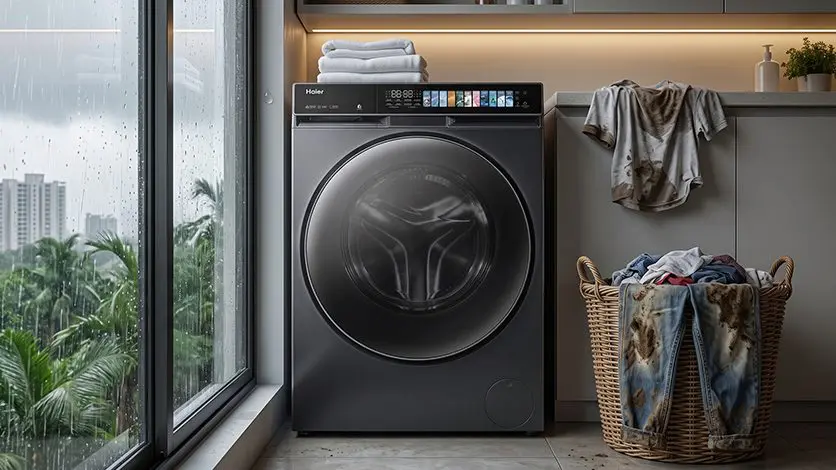
When it comes to washing machines for everyday washing, you have to always consider the essentials of choosing the right washing machine.
Water pressure is a crucial installation factor, but it shouldn’t be the only one to consider when choosing the washing machine.
Things like capacity, fabric care, wash programmes and ease of operation also have an impact on the laundry experience.
Haier India presents fully automatic front load washing machines categorized according to their home needs, intelligent wash features and various capacities.
Here are three models to consider.
Haier F3 8 Kg Front Load Washing Machine (EFL80-IM12F3BKU1)
The Haier F3 8 Kg Front Load Washing Machine is an ideal choice for those with an everyday need for convenient laundry solutions, serving couples and small families.
It has AI One Touch technology that automatically detects fabric type, load and dirty level to wash accordingly.
Other highlights include:
- 525 mm Super Drum: Gives more room for fabric flow and minimises tangling.
- Eco Wash: Varies water levels and washing time based on load.
- Smart Dual Spray: Helps rinse away lint and detergent residue around the drum and door area.
- Several wash programs: There are wash programs for delicate items, baby clothes, quick wash and cotton.
- 1200 RPM spin speed: Spinning with water at a good rate.
These are more versatile for households where there’s a combination of everyday office attire, casual clothing and sensitive fabrics.
Haier 10 Kg Fully Automatic Front Load Washing Machine (HW100-DM14F9BKU1)
Of course, the more people in the house the more laundry.
Check the paper towel racks, dressers and crib for bedsheets, towels, everyday clothes and children’s uniforms that can easily become significant loads to wash.
The Haier Washing Machine 10 Kg Fully Automatic Front Load is another capacity provider, with intelligent wash management.
It has the following characteristic features:
- One-Touch AI Wash: Identifies cloth fabric, load and dirt level and automatically sets wash parameters.
- Convenient operation: Operator-friendly interface of AI Colour Panel.
- Direct Motion Motor: Smooth, quiet and energy efficient.
- Eco Wash: Automatically adjusts water levels and washing duration according to the load.
- Night Wash: Reduces disturbance to operation during night time washing.
- 1400 RPM spin speed: Assists with water removal in the spin cycle of clothes.
This model is especially useful for families who frequently throw in a laundry basket containing both children’s and adult’s clothing, as it can accommodate up to 10 kg and is smart enough to wash them all in one.
Haier 12 Kg F9 Front Load Washing Machine (HW120-DM14F9BKU1)
For some, however, a greater washing power is required, particularly if they are washing larger bedding items like sheets and blankets and washing a lot of people’s clothes.
The Haier 12 Kg F9 Front Load Washing Machine caters to these needs by offering a large drum and intelligent functions.
It has many attributes, including:
- 12 kg washing capacity: Perfect for larger families who have heavier washing loads.
- 525 mm Super Drum: Designed to be able to carry larger loads and provide support for fabric movement.
- One-Touch AI Wash: Automatically sets wash conditions according to the fabric, load and dirt level.
- Direct Motion Motor: Assists with smooth, quiet operation.
- Smart Dual Spray: Assists to eliminate detergent residue and lint while rinsing.
- Wi-Fi connectivity: Allows a washing operation supported by the Haier smart application.
- 1400 RPM spin speed: Allows moisture to be removed during spinning.
The F9’s features make it an interesting choice for homes seeking to streamline their heavy chores.
Note: Intelligent washing does not replace the need for a minimum inlet water pressure. Before buying or installing, please refer to the installation manual of the Haier model or Haier’s authorised personnel to verify the exact operating pressure.
If You Find That Your Washing Machine Has Low Water Pressure, What Should You Do?
Changing the appliance should not be your initial solution.
Rather, determine where the restriction is coming from.
If the Problem Is With the Plumbing
Have a licensed plumber check the water supply line, valves and pressure.
If necessary, the plumber can suggest a change to the plumbing setup or a good pressure enhancing system.
All pump installations should meet the building and local water supply codes.
When the Washing Machine Has a Problem
When the washing machine suffers from a problem.
If there is sufficient pressure at other taps but the washing machine doesn’t fill up quickly, the inlet hose or the filter and/or inlet valve should be checked.
Do not make modifications internally on the water inlet of the appliance.
In the Event That the Water Pressure Drops or Rises Frequently
Experiment and see if any time of day is associated with lower pressure.
If supply is generally higher than demand during non-peak hours, scheduling washing might be one solution, as long as the pressure is not outside the operating range of the machine.
In situations where there is too much or too little pressure, or pressure is not steady, a pressure-regulating arrangement may be suitable, subject to professional judgement.
Provide Your Washing Machine the Correct Conditions to Perform
With the right installation and water supply, an automatic washing machine can make laundry a breeze.
Check the available inlet pressure, plumbing and manufacturer’s operating requirements before purchasing or installing.
After that, features like intelligent wash selection, appropriate drum capacity and easy controls add much more value.
Check out the Haier F3 8 Kg (EFL80-IM12F3BKU1), Haier 10 Kg (HW100-DM14F9BKU1) and Haier 12 Kg F9 (HW120-DM14F9BKU1) fully automatic front-load washing machines at the official Haier India website.
Select the capacity that’s right for you and ensure your unit fits the installation and simplifies everyday laundry tasks with Haier.
Frequently Asked Questions
Can an automatic washing machine work with low water pressure?
Yes, provided the inlet pressure remains within the minimum and maximum range specified for that model. Below the minimum requirement, the machine may fill slowly, pause or display an error.
Is 0.3 bar water pressure enough for a washing machine?
It can be sufficient for washing machines specifically rated to operate at 0.3 bar. Other models may require higher pressure, so check the manufacturer’s specifications.
Does a front-load washing machine need more water pressure than a top-load machine?
Not necessarily. Water pressure requirements depend on the particular model and inlet system rather than simply whether the machine is front-loading or top-loading.
Can low water pressure damage an automatic washing machine?
Low pressure commonly causes filling delays or programme interruptions. It does not automatically damage the appliance, but persistent inlet problems should be investigated rather than ignored.
Will a water pressure booster solve the problem?
A correctly selected and professionally installed booster may improve inadequate supply pressure. However, the resulting pressure must remain within the washing machine’s approved limits.