

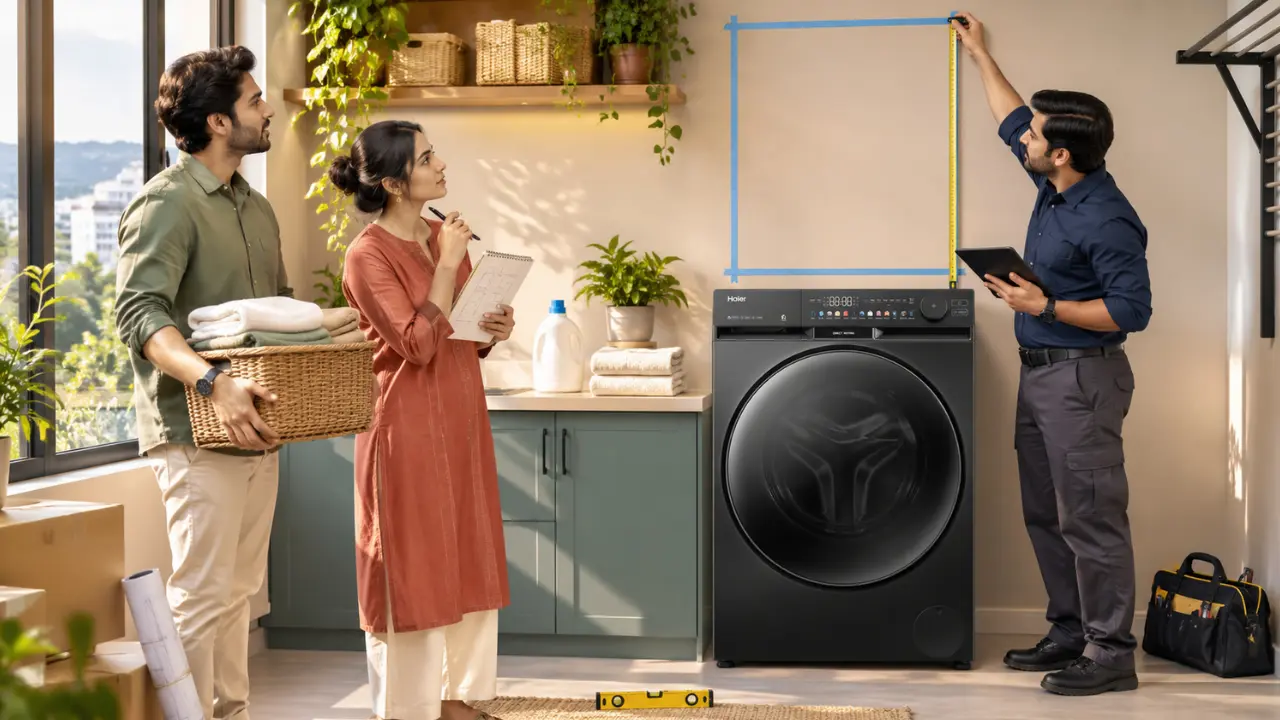

One corner of the utility area is taken up by a washing machine. The tumble dryer needs another. Before you know it, there’s not much room left for a laundry basket, much less for comfortable movement.
This is a common problem in many Indian households, especially in apartments where the balcony and utility area are already occupied by various appliances.
Of course, it’s easy to think of putting the dryer on top of the washing machine. It saves floor space and consolidates laundry activities.
However, is it possible to do it safely?
Yes, a tumble dryer can be stacked on top of a front-load washing machine, but only if both are approved for stacking, a compatible stacking kit is used, and the installation is done according to the manufacturer’s instructions.
The key is that not all front-load washing machines can be used with a dryer on top. Apparently sturdy machines may not be able to support extra weight.
Why Is the Dryer Placed Above the Washing Machine?
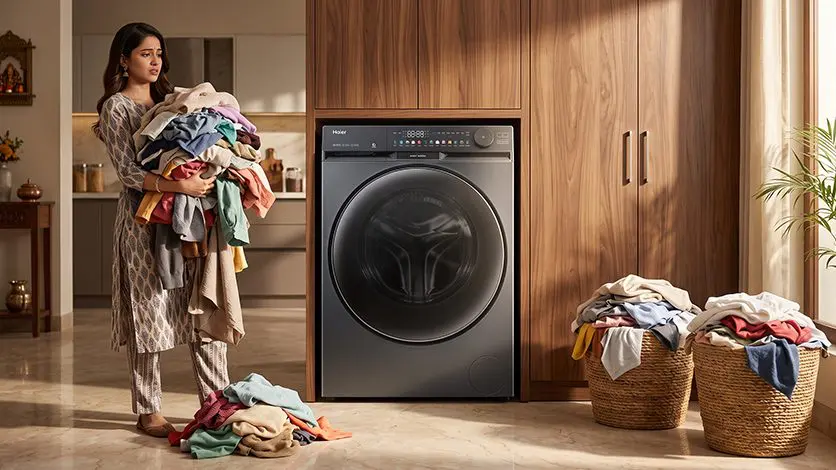
This is a practical arrangement for a reason.
Washing machines tend to be heavier than tumble dryers, especially when they are filled with water and wet clothes. They are built to allow for a large amount of movement when washing and spinning.
A tumble dryer, on the other hand, is typically lighter and won’t experience the same forces of spinning at high speeds.
If the manufacturer has approved the combination, then placing the washing machine at the bottom provides a more appropriate base.
A good stacked setup can have a number of benefits:
- Saves space in small utility rooms.
- Ensures washing and drying machines are kept in the same space.
- Minimises the amount of laundry that needs to be carried around the house.
- Makes better use of vertical space in apartments.
- Helps keep the laundry area more organised.
But the arrangement needs to be done properly. Simply installing one appliance on top of another is not a safe alternative to an approved installation.
Why Is a Front-Loading Washing Machine Good for Stacking?
The front-loading feature is helpful because the washing machine door stays accessible when another appliance is placed above it.
However, stacking compatibility is not guaranteed by front-loading construction.
1. The Washing Machine Must Support the Additional Weight
A tumble dryer is not weightless, and the weight of the clothes inside the dryer adds to this.
This load must be supported by the top panel and cabinet of the washing machine as per the stacking arrangement.
Don’t assume that a large-capacity washing machine will have more stacking strength.
2. Both Appliances Must Be Compatible in Size
A dryer should not be longer than the washing machine and should not be installed in a way that is not allowed by the manufacturer.
Before considering stacking, check:
- Width and depth of both appliances.
- Manufacturer-approved stacking combinations.
- Availability of a suitable stacking kit.
- Required ventilation and installation clearances.
- Total height of the assembled appliances.
A slight change in size can impact compatibility.
3. A Proper Stacking Kit Is Essential
A stacking kit is used to attach compatible appliances to each other and to prevent unwanted movement.
It can contain brackets, fixing components or other means of securing the appliances, depending on the approved arrangement.
Avoid homemade wooden supports, loose rubber mats or improvised straps unless specifically approved by the appliance manufacturer.
These alternatives can seem safe at first but can be dangerous when in use.
Why Do Washing Machine Vibrations Matter More Than You Think?

Think of a washing machine at the end of its spin cycle with bedsheets in the machine.
The drum speeds up, the clothes move, and the machine is subjected to varying forces. Vibration can increase if clothes are not evenly distributed.
Now picture an unsecured dryer on top.
That’s why installation quality is important.
What Can Make Vibrations Increase?
There are a number of common situations that can add up:
- The washing machine is not level on the floor.
- Incorrectly adjusted levelling feet.
- Too much or unbalanced laundry.
- Transport bolts that have not been removed during installation.
- Worn internal components.
- A stacking arrangement that is not secure.
If the washing machine is moving too much during the spin cycle, it should be checked before stacking.
Also, don’t assume that a quiet washing machine is approved for stacking.
Choosing a Front-Load Washing Machine for Everyday Laundry
The compatibility of stacking is not guaranteed and will need to be checked individually, but the right washing machine capacity and ease of washing can make a significant difference to everyday laundry management.
Haier India has a range of front-load washing machines in various capacities, such as Haier F9, which come with features that make washing easier.
Haier F9 9 Kg Front Load Washing Machine (HW90-DM14F9BKU1)
The Haier F9 9 Kg Front Load Washing Machine is a combination of capacity and intelligent washing functions for households that have regular loads of clothes, including bedsheets and other everyday fabrics.
It has the following main characteristics:
- One-Touch AI Wash automatically optimises washing parameters according to the fabric type, load and dirt level.
- Direct Motion Motor, for smoother, quieter operation with reduced vibrations.
- SuperDrum 525 with a drum diameter of 525 mm.
- Dual Spray technology to assist in the removal of any remaining detergent and lint from the drum area during rinsing.
- A maximum spin speed of 1400 RPM.
The machine also has wash programmes for various laundry needs, such as delicate and regular clothes.
This is especially helpful for Indian households that wash a combination of office clothes, casual wear and traditional garments.
However, its Direct Motion Motor does not make it compatible with dryer stacking. This must be verified separately with Haier.
Haier 10 Kg Fully Automatic Front Load Washing Machine (HW100-DM14F9BKU1)
When laundry loads become larger, additional washing capacity can be helpful.
The Haier 10 Kg Fully Automatic Front Load Washing Machine is equipped with One-Touch AI Wash, an AI Colour Panel and a Direct Motion Motor.
Its features include:
- Night Wash for quieter washing operation.
- Eco Wash for resource conservation.
- Dual Spray technology.
- Wi-Fi-enabled smart functionality.
- A maximum spin speed of 1400 RPM.
The washing capacity of 10 kg is suitable for larger families.
Its listed dimensions are 600 × 600 × 850 mm, but this does not necessarily mean that any specific tumble dryer can be installed above it.
Haier 12 Kg F9 Front Load Washing Machine (HW120-DM14F9BKU1)
Households with more people may need to deal with multiple laundry items in the same week, such as daily wear and bedding.
The Haier 12 Kg F9 Front Load Washing Machine offers more washing capacity and intelligent washing functions.
It includes:
- One-Touch AI Wash for automatic wash-setting adjustments.
- AI Colour Panel for easy operation.
- Smooth washing performance with Direct Motion Motor.
- Night Wash for quieter operation.
- SuperDrum 525 for accommodating laundry loads.
- Smart connectivity options for easy washing management.
It has a capacity of 12 kg, which is worth considering for families that need to wash a lot.
However, a bigger drum or cabinet is never a sign that a tumble dryer can be stacked on top. Approval from the manufacturer is still a must.
How to Check Whether Your Washer and Dryer Can Be Stacked
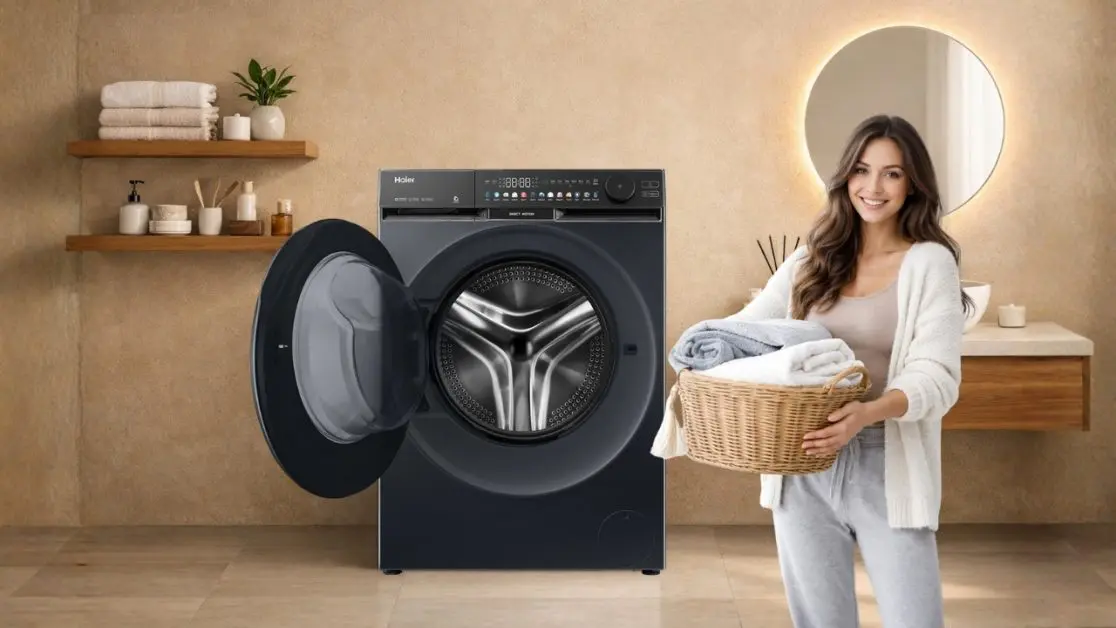
If you are looking to save space, you can find out if your washer and dryer can be stacked together.
Do these checks before buying a dryer or moving your laundry room.
Step 1: Identify the Exact Model Numbers
Find the model numbers of both appliances.
A general term like ‘9 kg front-load washing machine’ is not enough since there are different models that have different stacking requirements.
Step 2: Check the Installation Manuals
Check for instructions that refer to dryer stacking, compatible models or approved stacking accessories.
If the manuals don’t say it’s compatible, call the manufacturer.
Step 3: Check the Installation Area
The floor should be flat, firm and strong enough to hold the combined installation.
Sufficient space should also be available for ventilation, electrical connections, maintenance access and opening the appliance doors.
Step 4: Arrange Professional Installation
The compatibility of the appliances and installation of the approved stacking kit should be checked by a qualified installer.
Do not try to lift or support a large dryer without proper equipment and assistance.
Step 5: Monitor the Appliances After Installation
Once the appliances are installed, it is important to keep an eye on them.
During initial operation, check for unusual movement, rattling or instability.
If anything seems unusual, discontinue the use of the arrangement and schedule an inspection.
When Is Stacking Not the Right Choice?
While it is good to save space, it should not come at the expense of safety.
A side-by-side installation might be better suited when:
- Either appliance is not approved for stacking.
- There is no stacking kit available for the appliances.
- The floor is wobbly or uneven.
- The dryer is not accessible due to limited space.
- Ventilation clearances cannot be maintained.
- The washing machine already experiences excessive movement.
Another option could be a separate dryer stand, but it needs to be independently rated and installed according to the manufacturer’s instructions.
Make Your Laundry Space Work Better With Haier India
The first step in an organised laundry area is to have the right appliances for your home.
The Haier F9 9 Kg Front Load Washing Machine (HW90-DM14F9BKU1), Haier 10 Kg Fully Automatic Front Load Washing Machine (HW100-DM14F9BKU1) and Haier 12 Kg F9 Front Load Washing Machine (HW120-DM14F9BKU1) all have features designed to make everyday washing easier.
From One-Touch AI Wash to Direct Motion Motor technology, these models provide practical options for different laundry needs.
If you are planning to stack a tumble dryer, ensure that you check the exact model compatibility and approved installation guidelines with Haier India first.
Visit Haier India and discover the variety of front-load washing machines and select the washing solution that suits your family’s laundry needs.
The best laundry system isn’t always the smallest! It’s the one that is easy to use, practical and safe for everyday use.
Frequently Asked Questions
1. Can you put any tumble dryer on top of a front-load washing machine?
No, not every tumble dryer can be stacked on a front-load washing machine. Both appliances must be approved for stacking by their manufacturers. A compatible stacking kit and proper installation are essential to ensure stability and safety.
2. Do you need a stacking kit for a washing machine and tumble dryer?
Yes, an approved stacking kit is generally required when installing a tumble dryer above a compatible front-load washing machine. It helps secure the appliances and prevents unwanted movement during operation. Never place a dryer directly on a washing machine without the manufacturer-approved securing arrangement.
3. Can a tumble dryer fall off a washing machine during the spin cycle?
Yes, an improperly secured tumble dryer may shift or become unstable because of washing machine vibrations. Using a compatible stacking kit, ensuring proper levelling and following manufacturer installation instructions help minimise this risk.
4. Can you stack a tumble dryer on a Haier front-load washing machine?
Stacking depends on the specific Haier washing machine model, dryer compatibility and availability of an approved stacking kit. For models such as the Haier F9 9 Kg (HW90-DM14F9BKU1), 10 Kg (HW100-DM14F9BKU1) and 12 Kg (HW120-DM14F9BKU1), customers should confirm stacking compatibility directly with Haier India before installation.
5. Is it better to stack a tumble dryer or place it beside the washing machine?
Stacking can save floor space, making it useful for compact Indian apartments and utility rooms. However, side-by-side installation offers easier access to both appliances and may be preferable when stacking compatibility, ventilation or installation height is a concern. The right choice depends on available space and manufacturer requirements.