




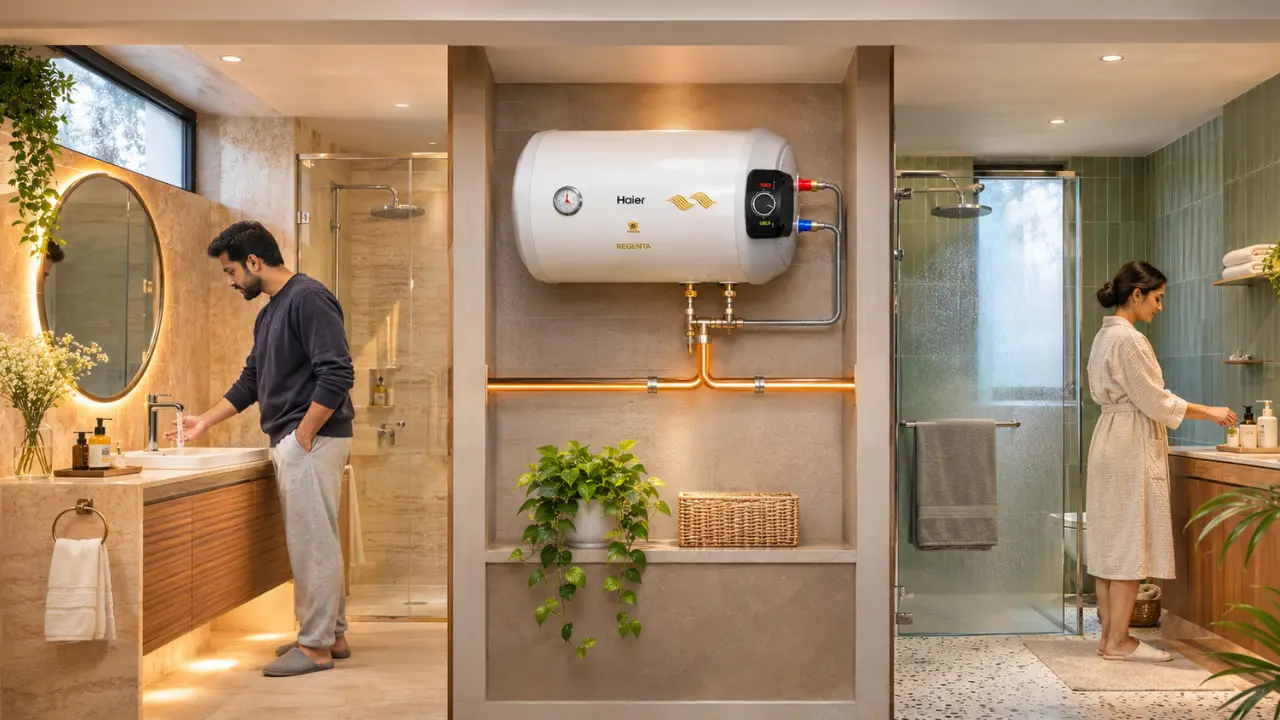

Two bathrooms. One geyser. It seems like a sensible solution, especially if you don’t want to have to install separate water heaters and deal with extra electrical connections.
But picture a typical winter morning. The master bathroom is being used for a shower, and the second bathroom has hot water running. Within minutes, the water temperature starts dropping.
Does that mean that one geyser cannot be used for two bathrooms? Not necessarily.
If the capacity, plumbing and heating efficiency of a single storage geyser is suitable for the household, then it can be used to provide hot water to two bathrooms. The question is, can it provide enough hot water when both bathrooms are in use?
Knowing these factors prior to installation can assist Indian households in making a more practical choice.
Is It Possible to Have a Single Geyser for Two Bathrooms?
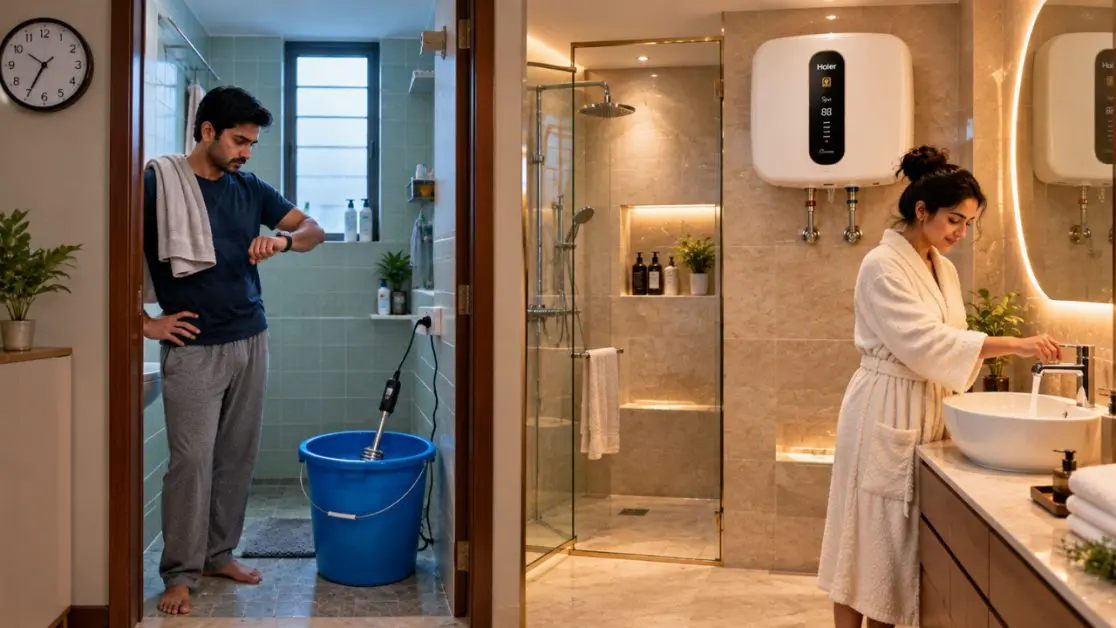
Yes, a single geyser can be used to provide hot water to two bathrooms if the plumbing system is designed accordingly.
Here, the water heater is connected to a shared hot water supply line that splits into two lines leading to the two bathrooms. When a hot water faucet is turned on, hot water flows from the storage tank through the pipes.
But if one geyser is shared, it doesn’t mean that both bathrooms will have unlimited hot water.
There are three factors that will help determine the comfort level of the arrangement:
- Storage capacity: The volume of hot water that can be stored before reheating is required.
- Simultaneous use: If both bathrooms are used at the same time.
- Plumbing distance: Distance and layout of plumbing from the geyser to each bathroom.
If the system is sized appropriately, it can be used occasionally or at different times. However, continuous showers in both bathrooms can use up a lot of hot water.
Heating Water Is the Least of Your Problems
Imagine a family of four in a 2 bedroom apartment.
The parents have their own bathroom attached and the children share the common bathroom. On weekdays, everyone gets ready for school or work within about an hour of each other.
When both showers are in use, the geyser will have to provide hot water to two outlets rather than one.
This will accelerate the loss of heated water from the tank.
At the same time, cold water is fed into the storage geyser to replace the water being used. The more water that is used, the less will be available for hot water, and the heating element will require time to heat the water back up.
No matter how powerful the heating element is, it can’t ensure continuous hot water if demand is greater than the heating and storage capacity of the system.
This is why it is important to consider geyser capacity before making a decision on a shared geyser installation.
Which Is Better, a 15-Litre or 25-Litre Geyser for 2 Bathrooms?
No one size fits all capacity. Water use is related to shower flow rates, shower time, the temperature of the water entering the house and the temperature desired at the tap.
When a 15-Litre Storage Geyser May Be Suitable
A 15 litre storage water heater can be used if:
- Both bathrooms are used at different times.
- Hot water use is fairly low.
- Long showers are not recommended, bucket baths are preferred.
- The bathrooms are located close to each other.
- Household members can provide adequate reheating time between uses.
For instance, if one bathroom is used mainly for bathing and the other for occasional handwashing, a 15 litre geyser might be suitable, following a professional evaluation.
It shouldn’t be automatically assumed to be adequate for two concurrent showers, however.
When a 25-Litre Storage Geyser Makes More Sense
A 25 litre storage geyser has a greater supply of hot water.
This extra capacity can be beneficial for families who have more bathers or several people taking hot water in a short time.
However, a 25 litre geyser is not enough to ensure that two showers can be used simultaneously.
The final decision should take into account the actual water usage and the time available for reheating.
How Bathroom Distance Affects Hot Water Availability

A geyser in one bathroom might need to pump hot water through several metres of pipe to get to the second bathroom.
On this trip, some heat may be lost through the walls of the pipe.
The longer the pipe, the more heat loss can occur, especially if the pipes are not well insulated.
There’s one more downside.
If a hot water tap is opened, the water that has been cooled within the pipe must be released from the pipe before the hot water can be released.
If a household is thinking about having a shared geyser, a plumber should check:
- The distance between both bathrooms.
- The option to place the geyser in the middle.
- Insulation for hot water pipes.
- Pipe diameters and pipe distribution.
- Water pressure at individual outlets.
- Compatibility with existing plumbing and safety valves.
An appropriately designed plumbing system can improve the practicality of a shared arrangement without unnecessarily increasing storage capacity.
Haier Storage Water Heaters Are Designed to Meet Various Household Needs
When you know what each type of geyser has to offer, selecting a geyser becomes easier.
Haier India offers storage water heaters in various capacities, mounting options and features to cater to the daily hot water needs.
Haier 25L REGENTA SLIM (RH) – ES25H-REGENTA SLIM (RH)
The Haier 25L REGENTA SLIM (RH) Cylindrical 3 Star Water Heater is a practical choice for households looking for a bigger storage capacity.
It has a 25 litre capacity, which means it will have a larger hot water reserve than a 15 litre model, so it’s worth considering if there are two bathrooms that share a supply.
The model includes:
- Efficient reheating with 2.2 kW heating.
- Durable and protective CrystalShield Tank.
- Incoloy 800 heating element for reliable heating.
- Working pressure 8 bar for appropriate high pressure installations.
- Overheat protection with Dual Thermal Proof technology.
- Shock Proof electrical safety technology.
- PUF insulation to minimize water loss through insulation.
The model also includes RSC U-turn Flow Technology, which facilitates water circulation within the tank.
It should be checked for suitability in 2-bathroom installations based on the simultaneous water demand of the household.
Haier 15L REGENTA SLIM (RH) – ES15H-REGENTA SLIM (RH)
A bigger storage tank is not necessary for all homes.
Haier 15L REGENTA SLIM (RH) Cylindrical ABS 3 Star Water Heater is a compact capacity water heater for moderate hot water needs.
It has a glass lined tank, Incoloy 800 heating element, Shock Proof protection, Dual Thermal Proof technology and an 8 bar pressure rating.
The water heater also features PUF/EPS insulation to help keep stored heat.
This model can be considered for apartments that have two bathrooms used one after the other, not at the same time, after assessing the plumbing system and usage.
Haier 15L REGENTA – ES15V-REGENTA (I)
The Haier 15L REGENTA Cylindrical 5 Star Water Heater is another choice.
This model features a 15 litre storage capacity and 5-star energy efficiency rating.
It has the following main characteristics:
- 2.2 kW heating element.
- CrystalShield Tank.
- Incoloy 800 heating element.
- Bacteria Proof System.
- Dual Thermal Proof protection.
- Working pressure of 8 bar.
- PUF heat retaining insulation.
This 5-star rating is especially relevant for those who are considering the energy efficiency of the model when they are comparing it with their hot water needs.
Energy efficiency and hot water capacity are two different things, though. The higher the star rating, the smaller the tank does not necessarily mean the more it can be used at once.
When Should You Install Two Separate Geysers Instead?

Not every geyser is a shared geyser.
If both bathrooms are used simultaneously, it might be more convenient to install separate water heaters.
It is also advisable to consider separate installations when:
- Toilets are spaced far from each other.
- Several household members take consecutive showers.
- Independent temperature control is desired.
- Long pipe runs result in long waiting times.
- The current plumbing system is not capable of providing a common supply.
Two suitably sized geysers can be installed to supply hot water independently, but the requirements for installation and electricity usage should be calculated for the household’s specific needs.
Before Connecting One Geyser to Two Bathrooms, Make Sure to Perform the Following Checks
Before you go any further, have a professional plumbing and electrical inspection.
The installer should ensure that the selected geyser is suitable for the proposed distribution system, water pressure and electrical circuit and installation requirements of the manufacturer.
Avoid modifying safety valves or making unauthorised changes to the appliance.
Most importantly, don’t choose a geyser just because it seems to have enough capacity on paper.
The actual bathing habits are as important.
Select the Appropriate Haier Geyser for Your House
Two bathrooms can be served by one geyser, though this is most effective if storage and plumbing is designed to meet the practical needs of the home.
If you use it moderately and sporadically, you might want to consider a 15 litre model. The Haier 25L REGENTA SLIM (RH) provides extra storage space and heating, insulation and safety options for households that need more space.
Visit Haier India’s website at shop.haierindia.com to check out the various types of storage water heaters and compare them before making the final decision for installation.
It is not just a matter of heating more water. It’s all about having hot water on tap when you need it.
Frequently Asked Questions
1. Can a 25-litre geyser supply two bathrooms simultaneously?
Yes, a 25-litre geyser can be connected to two bathrooms through suitable plumbing. However, the duration of simultaneous hot water supply depends on water flow rates, temperature settings and usage.
2. Can one 15-litre geyser serve two bathrooms?
It may serve two bathrooms with moderate or staggered usage. It is generally less suitable for prolonged simultaneous showers.
3. Does connecting two bathrooms increase electricity consumption?
Electricity consumption depends primarily on the amount of water heated, temperature requirements and heat losses. Connecting an additional bathroom does not automatically double electricity consumption.
4. Will hot water pressure decrease when both bathrooms are used?
It can. Simultaneous usage may reduce pressure or flow at individual outlets depending on the plumbing layout and available water supply.
5. Is a separate geyser better for each bathroom?
Separate geysers can offer greater convenience when bathrooms are used simultaneously or are located far apart. The best arrangement depends on household demand, installation conditions and available space.