




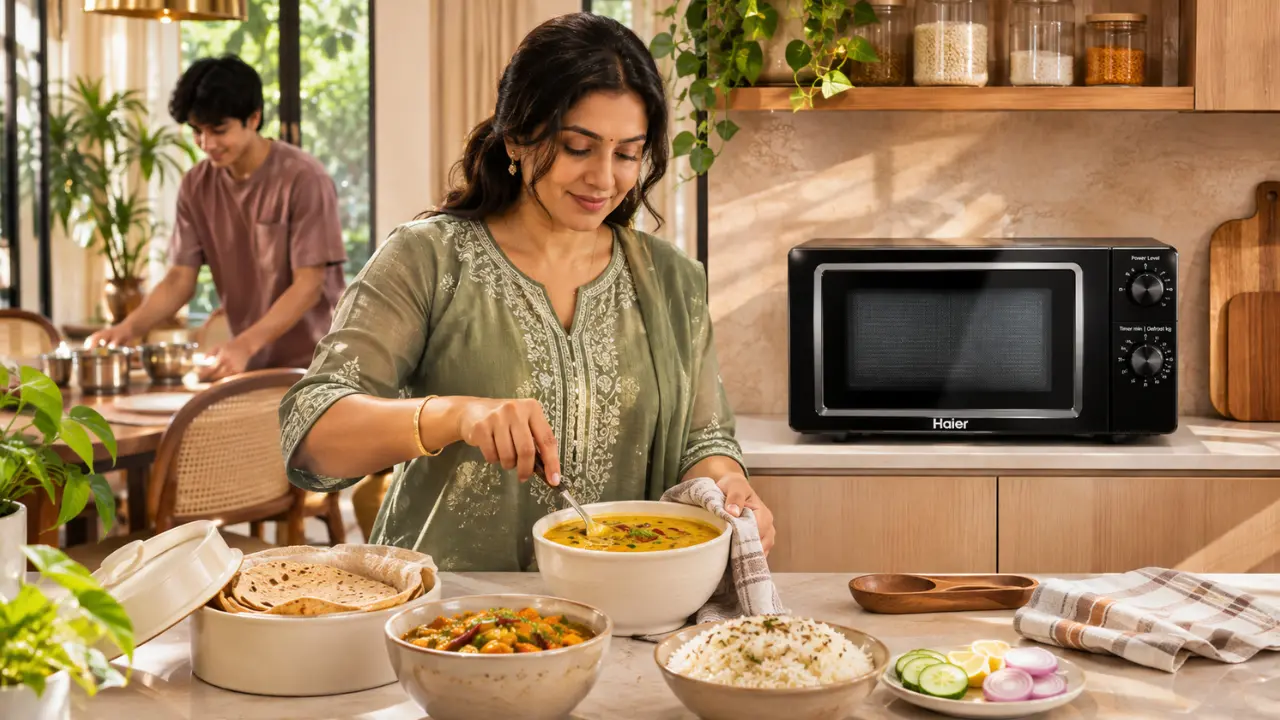

The dal is bubbling around the edges and is only slightly warm in the middle. You place it back in the microwave for another minute, and discover that it is too hot in some areas.
Sound familiar?
The issue may not be the length of time the food is being cooked. It may be the power setting you have set on the microwave.
Most people use their microwave ovens at full power, whether they’re empty or filled with food. The same is done with a bowl of rice, frozen paneer, chocolate or yesterday’s sabzi. However, the microwave response to different foods varies.
Knowing the power levels of the microwave can help you to make your cooking more predictable. It assists you to make decisions about when to cook food at a high temperature and when to cook at a lower temperature, and why sometimes it is better to cook at a lower temperature.
Understand What Microwave Power Level Is and How It Works
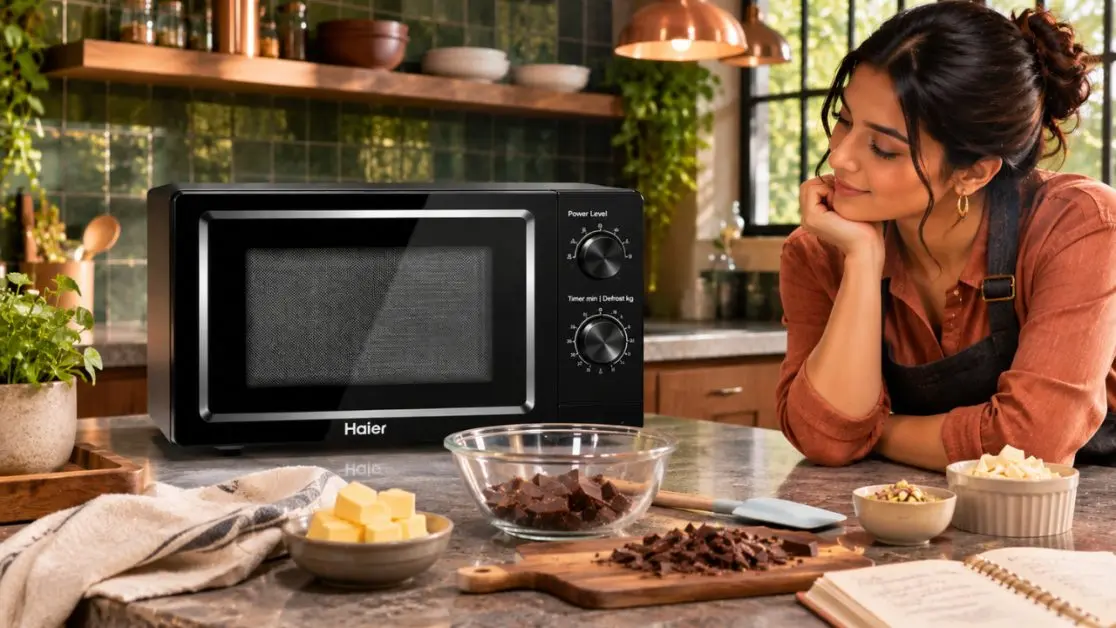
The power level of a microwave is the amount of microwave energy that is supplied to food during a specific time period, typically as a percentage of the maximum microwave power that the oven can deliver.
For example, a microwave oven with a maximum power of 700 watts:
- The 100% power setting is about 700 watts of microwave power.
- 80% power is around 560 watts average.
- The average power output is about 350 watts at 50% power.
- The average power output is about 210 watts for 30% power.
There is a technical difference, though.
Many conventional microwave ovens don’t continuously produce lower microwave power. Rather, they cycle between periods of full power heating and periods where the magnetron is turned off.
Therefore, if the microwave is set to 50% power, it will likely run at full power for about half of the heating time.
Some microwave ovens have an inverter which can control the energy output of the microwave in different ways, depending on the design of the oven.
This is important for foods that are delicate or for food that needs to be defrosted slowly.
What Power Level to Set for Different Foods in the Microwave?
Consider the type of food, its quantity and the result you want before selecting a power setting.
1. High Power: When Speed Matters
For foods and liquids that require relatively rapid heating, use high power, typically 80-100%.
Common examples include:
- Bringing water to a boil and then cooling it down to drink for tea or coffee
- Cooking soups and other liquid foods
- Properly moistened cooking of some vegetables
- Cooking and reheating small amounts of rice.
- Making ready-to-eat food for the microwave
Stirring and standing time can help to even out the heat, even at full power.
2. Medium Power: For Controlled Heating
Medium power (50-70%) is good for foods that require slower cooking.
Consider a thick dal in the refrigerator. Can be difficult to heat evenly because of its consistency, especially if large.
Heating at a moderate power level with occasional stirring can yield better results than continuous heating at full power.
Medium power can be helpful for:
- Reheating gravies and curries
- Heating some dairy products
- Cooking larger amounts of food.
- Cooking foods that need to be cooked at a slow temperature.
3. Low Power: For Delicate Ingredients
For controlled warming, softening and some defrosting, lower microwave power settings (10–30%) are helpful.
An example that is familiar is butter.
When it is at its highest power, the edges can melt and the middle can be solid. A lower setting will give the butter more time to heat through.
Likewise, chocolate can burn or get grainy if it is heated too high. Better control is achieved with short heating times at lower power, and frequent stirring.
The power level and cooking time will vary depending on the model of the microwave and the amount being cooked.
Does Lower Microwave Power Mean Lower Electricity Consumption?
Not necessarily.
Reducing the microwave power does not necessarily mean reducing the electricity consumption.
In the case of conventional microwave ovens, the reduced power is achieved by turning the magnetron on and off. Cooking times might then be longer.
For instance, cooking for 2 minutes at full power and 4 minutes at 50% power does not mean that the electricity consumption will be reduced by 50%.
The actual energy used is influenced by such things as:
- Microwave input power
- Heating duration
- Power-control technology
- The amount and the temperature of food.The amount and the temperature of food.
- Efficiency of the appliance
One other point to understand is the difference between the output power of the microwave and its electrical input power.
A microwave with a cooking power of 700 watts can consume significantly more power from the electrical outlet.
The 700 watts refers to the amount of microwave energy put into the heating process, not the electrical use of the microwave.
How Haier Microwave Ovens Make Everyday Cooking More Convenient
When you know how to use the power settings on the microwave, you’re not just looking at the capacity, you’re looking at how you’ll use it.
Haier India has microwave ovens that are tailored to meet the needs of various households, such as single microwave models for everyday cooking and convection microwave models for more versatile cooking.
These differences are illustrated by two options.
Haier 19L Solo Microwave Oven With Inverter Technology (HIL1901MBPB)
The Haier 19L Solo Microwave Oven With Inverter Technology (HIL1901MBPB) is a convenient choice for families that mostly reheat their meals in the microwave and cook simple meals.
It has a microwave output of 700 watts and a capacity of 19 litres.
The technology of its inverter is especially relevant to the discussion of power management in the context of microwaves.
Inverter technology is an electronic power-control method, as opposed to the typical microwave design, which often controls average power by turning the power on and off repeatedly.
The model also contains:
- Cook, reheat and defrost in one microwave.
- A transformer-based design for energy-saving operation that is implemented electronically.
- A maximum operating noise level of 57 dB(A)
- A light construction with its electronic transformer.
- A separate defrost cycle for frozen foods
These are all common kitchen needs that don’t add a lot of complexity to a person who is reheating breakfast, warming lunch or defrosting food before cooking dinner.
Haier 23L Convection Microwave Oven (HIL2302CRSH)
Not all households only reheat food in their microwave.
Some families prefer to cook baked items, try out new snack ideas or use different cooking techniques in the same appliance.
The Haier 23L Convection Microwave Oven (HIL2302CRSH) meets these more general needs.
One feature of particular interest is its Auto Cook Menus, which automatically presets the power level and cooking time for recipes that are supported.
This saves the time of having to manually set each cooking time.
The model also provides:
- 205 Auto Cook Menus for a variety of preparations
- Combination cooking with microwave, grill and convection mode
- Recipes with multiple cooking times.Recipes with several cooking times.
- Cooking without oil for supported dishes with little or no oil.
- A convenient cleaning cavity made of stainless steel.
- A deodoriser function to control cooking smells after they have been prepared.
The cooking feature is particularly helpful if a recipe calls for more than just microwave cooking.
For example, a baked vegetable dish might require both deep and surface browning. The microwave setting can be used to heat the food, and grill or convection settings can be used to achieve the desired finish.
Importantly, the power settings for the microwave and the convection temperature settings are for different purposes. One controls the temperature of the hot-air cooking and the other controls the microwave energy.
Five Common Mistakes That People Make When Using a Microwave
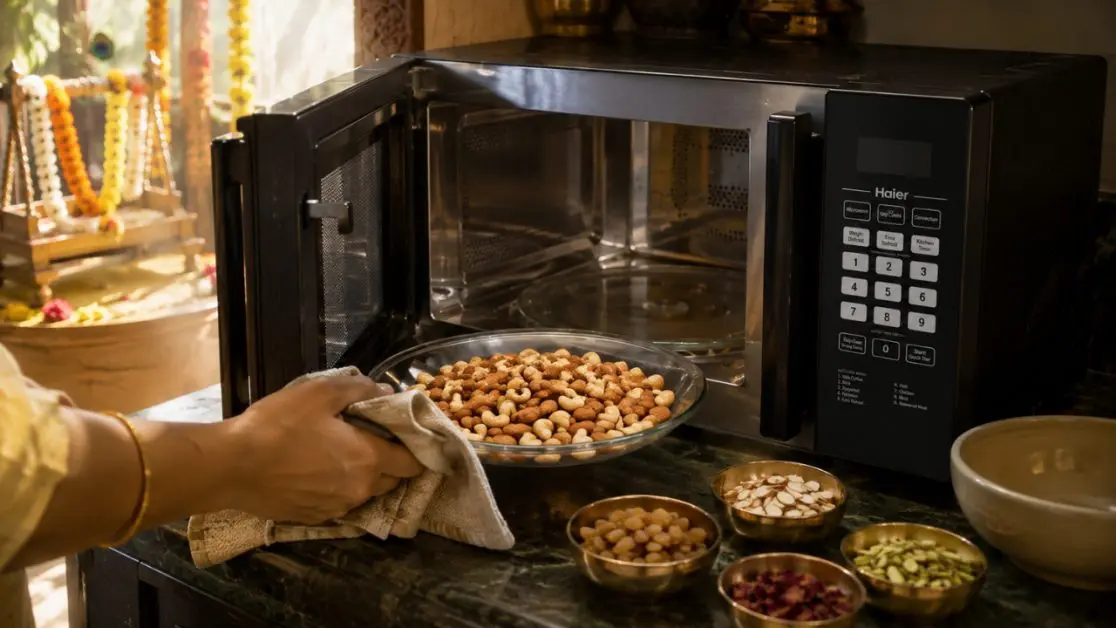
No microwave oven can make up for all cooking errors.
There are some common sense things to be aware of.
1. Using Maximum Power for Everything
High power isn’t necessarily appropriate for butter, chocolate, thick gravies or frozen ingredients.
Select the setting based on the food and not the highest setting.
2. Ignoring Standing Time
Heat continues to be redistributed in food following the termination of microwave heating.
A brief standing time may help to even out the temperature, but it is not a substitute for checking that food is well cooked.
3. Mixing Up Wattage and Power Level
A 700-watt microwave operating at full power isn’t equivalent in cooking speed to a 1,000-watt microwave operating at full power.
When using recipes, always take into account the appliance’s rated output.
4. Thawing at Maximum Speed
High power defrosting will start cooking the outside of the frozen food while the inside is still frozen.
Follow the recommended defrost programme or use reduced power and follow safe food-handling procedures.
5. Not Stirring or Rotating Food
The heating of the microwave may be uneven.
The use of the turntable, the correct use of gravies and the rearrangement of food all help to minimize temperature differences.
The Proper Way to Select the Right Power Setting for Your Microwave Every Time
There is no universal power setting that is ideal for every recipe.
One good way to start is to think about the texture and temperature of the food.
Higher power might be suitable for liquids and small reheating jobs. When preparing a thick mixture, use moderate power and stirring may be more effective. Lower settings or specific programmes are usually better for delicate ingredients and defrosting.
Follow manufacturer’s operating instructions, use microwave-safe cookware and ensure reheated food is cooked to a safe temperature.
Whether it’s cooking leftovers of rajma or enjoying frozen snacks, microwave power levels can significantly impact daily convenience for Indian households.
Haier India microwave range has options for these varied cooking preferences. The Haier 19L Solo Microwave Oven With Inverter Technology (HIL1901MBPB) is designed for everyday microwave use, while the Haier 23L Convection Microwave Oven (HIL2302CRSH) offers preset menus and various cooking functions to extend the use.
Check out Haier India microwave oven range and choose a model that fits your kitchen, cooking style and needs.
Frequently Asked Questions
1. What does 50% power mean in a microwave?
A 50% microwave power setting delivers approximately half the maximum microwave output on average. Conventional models commonly achieve this by alternating between full-power heating and off periods.
2. Is 700 watts enough for a microwave oven?
Yes. A 700-watt microwave can handle routine reheating, defrosting and suitable cooking tasks. Some preparations may require longer heating times than they would in higher-output models.
3. Which microwave power level is best for reheating food?
Medium to high power is generally suitable, depending on the food. Thick gravies and larger portions may benefit from moderate power, stirring and sufficient standing time.
4. Can I defrost frozen food at 100% microwave power?
It isn’t generally recommended. Full power can partially cook the outside before the centre has thawed. Use a dedicated defrost setting or the manufacturer’s recommended lower power level.
5. Does an inverter microwave use less electricity?
Inverter technology changes how microwave power is regulated, but electricity savings are not guaranteed for every cooking task. Actual consumption depends on the appliance design, power setting, food quantity and operating duration.