
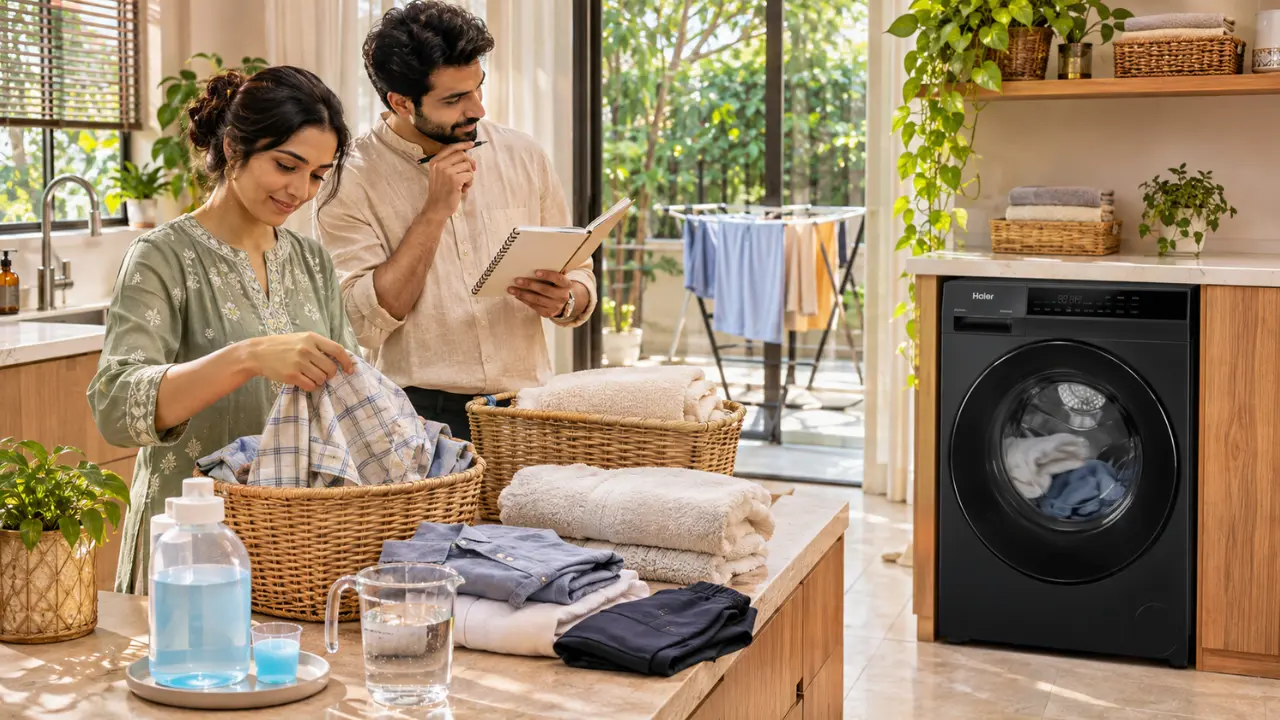

You put in the washing machine, choose a programme and press the start button and then you get on with your day. The machine fills, washes, rinses and spins. Everything happens automatically.
But, do you ever ask yourself how much water does one wash use?
You may be surprised at the answer, especially if you’re still deciding on a washing machine by the drum size.
An average washing machine requires about 40-80 litres of water per cycle with a frontload model, or 80-150 litres or more with a traditional top-load machine. These are general per capita consumption calculations, not target numbers. Actual use will vary with the design of the machine, wash programme, laundry load and rinse setting.
The differences are important to know to the household with a weekly laundry task, and to avoid wasting water without any reduction in its ability to clean.
How Many Gallons of Water Does a Washing Machine Use?
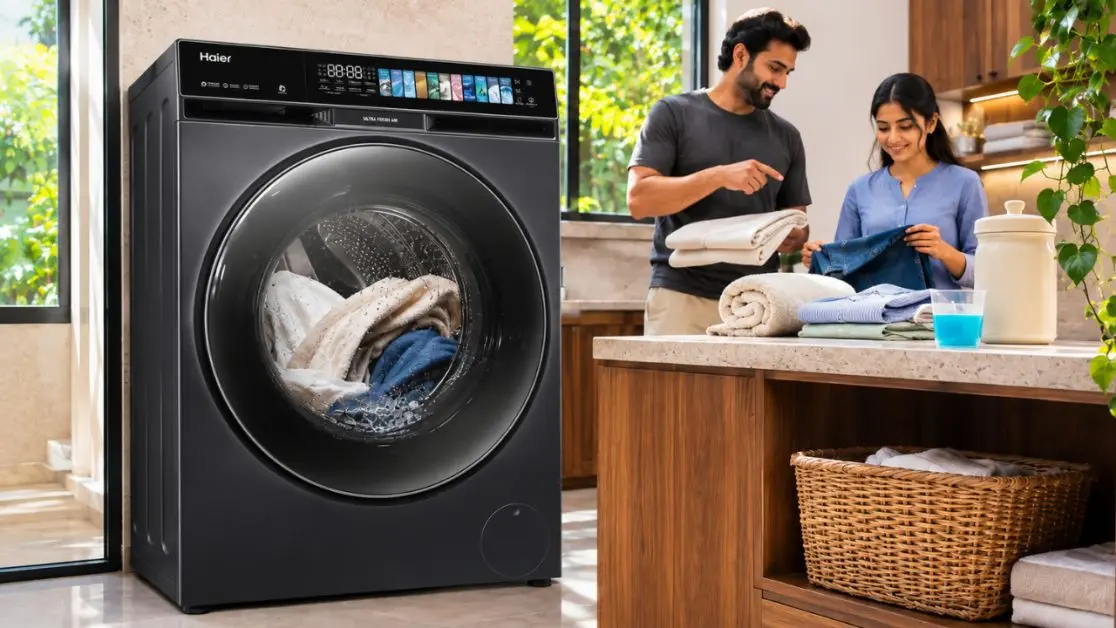
There is no one correct answer. Even two washing machines with the same capacity of 8 kg can use different quantities of water to wash the same types of laundry.
The main difference is in the way that the machines clean the fabrics.
Front-Load Washing Machines
With a front-load washing machine, the clothes are lifted and tumbled in a relatively small amount of water and detergent solution within a horizontally-rotating drum.
The clothes do not have to be completely submerged during the wash cycle as in traditional washing.
Front load washing machines typically use 40–80 litres of water per wash, depending on the programme, but it can be higher for bigger loads, extra rinses and specific programmes.
This washing process is especially significant for households seeking to regulate their daily water consumption, which is why front-loaders are crucial.
Top-Load Washing Machines
In a conventional fully automatic top load washing machine, the water level is usually higher since the washing action is usually based on the clothes being immersed in water.
Depending on capacity, technology and programme selection, water consumption may range from approximately 80–150 litres or more per cycle.
But modern high efficiency top loaders can use a lot less water than the traditional designs.
Semi-Automatic Washing Machines
Semi-automatic washing machines enable the user to control water filling and/or to reuse washing water for adequate subsequent loads.
They consume a lot of water, depending on the amount of washing done.
Someone who keeps reloading and draining the tub frequently may use a lot more water than a person who uses the tub carefully each time it is used.
The key difference: The washing machine’s capacity indicates how much dry washing machine loads it can hold, not the amount of water used.
What Causes the Increase in Water Use During the Wash?
Imagine a normal Sunday night in a typical Indian home. There are bedsheets to wash, children’s uniforms to put on and several towels that need to be washed from the previous week.
This means the washing machine works harder, of course.
But the number of clothes isn’t the only factor affecting water consumption.
1. Laundry Load and Fabric Type
The amount of water absorbed by heavy cotton clothes, denim jeans, bed sheets and towels varies.
Some washing machines from modern times can change some washing parameters by the load of what they wash.
This prevents a single set of rules being used for each load.
2. Wash Programme Selection
The water amount used in a washing programme is not the same for all programmes.
For example:
- Everyday Wash: For normal washing.
- Eco Wash: Focuses on efficient use of resources, optimising the washing parameters.
- Hygiene programmes: Can use various temperatures, wash times and rinsing steps.
- Delicate Wash: Applies washing motions and settings to the fabric that are appropriate.
- Quick Wash: For more appropriate smaller loads or light soiled loads (Depending on the model).
The shorter a programme is, the less water is used, is a widespread misconception.
Not necessarily. A programme that is quick may focus on the washing time, while an Eco programme can focus on how to save water and energy.
3. Additional Rinse Cycles
The use of an additional rinse adds another rinsing phase which, in general, raises total water use.
For specific laundry needs, extra rinsing might be beneficial, but is not necessary for every wash.
4. Overloading the Drum
It may be tempting to fit as much clothing as possible into one load.
However, an overloaded drum may limit the movement of the garment and impact on cleaning or rinsing.
If clothes are not washed effectively the first time, then there’s no reason to save water by washing them a second time.
How Haier Washing Machines Make Water Management Smarter
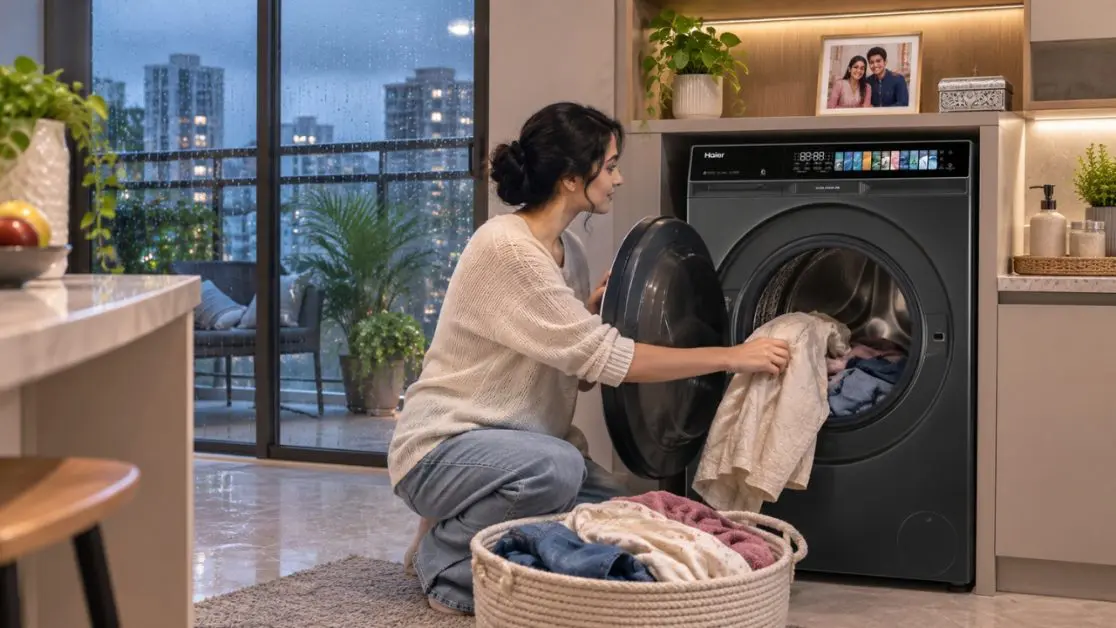
Reducing unnecessary water consumption isn’t simply about using less water. The machine should also ensure proper cleaning efficiency.
That is where intelligent washing technology can be of great service.
Haier India’s front load washing machine comes with AI washing and Eco wash features to maximize washing parameters based on the laundry requirement.
Let’s examine three models that illustrate how these technologies can be integrated into the daily lives of Indians.
Haier F3 8 Kg Front Load Washing Machine (EFL80-IM12F3BKU1)
The Haier F3 8 Kg Front Load Washing Machine (EFL80-IM12F3BKU1) provides intelligent washing options for the household that needs an 8 kg front-load washing machine for regular laundry.
It has AI One Touch technology that automatically detects fabric type, laundry load and dirt level and chooses the appropriate washing setting.
Additionally, the model has a feature called Eco wash wherein the water level and the wash time is automatically adjusted according to the load.
Other highlights include:
- 525 mm Super Drum: Allows fabric movement when washing.
- 14 Wash Programmes: AI Wash, Eco, Quick, Baby Care and Delicate.
- Smart Dual Spray: Works during rinsing to help lift the remaining lint and detergent from the door gasket area.
- Inverter Motor: Efficient washing operation.
- 1200 RPM Spin Speed: Assists in removing water from washed clothes.
For families managing office wear, school uniforms and day-to-day cotton clothes, AI washing coupled with Eco Wash provides an efficient solution for laundry needs.
Haier 10 Kg Fully Automatic Front Load Washing Machine (HW100-DM14F9BKU1)
For larger families, extra washing power may be required, especially if they have more than one bedsheet, towels and everyday clothes to wash.
Haier 10 Kg Fully Automatic Front Load Washing Machine (HW100-DM14F9BKU1) comes with 10 kg capacity along with its intelligent washing controls.
It has the One-Touch AI Wash that detects the type of fabric, loading and dirt level to set the proper wash settings.
The model’s Smart Wash technology can adapt to the laundry conditions, such as water level, spin speed and washing time.
The automatic weighing and selection of washing parameters in the Eco Wash function provide additional support for water and energy saving.
Additional features include:
- AI Colour Panel: Interactive panel to operate the machine.
- Direct Motion Motor: Ensures smooth and quieter washing.
- 16 Wash Programmes: Accommodates different fabric and laundry requirements.
- 1400 RPM Spin Speed: Helps to extract moisture in the spinning process.
- Night Wash: Quieter running for laundry during the night.
Unlike most washing machines, it doesn’t need users to guess the settings they need for each wash, making daily laundry much easier to manage.
Haier 12 Kg F9 Front Load Washing Machine (HW120-DM14F9BKU1)
When you wash a lot of laundry in your home every week what happens?
There must be enough drum capacity but the machine has to be intelligent when the load is smaller.
The Haier 12 Kg F9 Front Load Washing Machine (HW120-DM14F9BKU1) meets these needs by offering a spacious capacity and an AI-driven washing system.
It uses Smart Wash technology to identify the fabric type and sets the washing parameters, such as the water level, spin speed and washing time automatically.
Eco Wash automatically adjusts to the right water level and washing time.
The machine also has:
- 525 mm SuperDrum: Designed to provide greater washing capacity and fabric movement.
- One-Touch AI Wash: Selflessly adjusts to the washing conditions with the help of the inbuilt AI sensors.
- Direct Motion Motor: Assists in smooth and quieter running.
- Smart Dual Spray: Aids in rinsing away residual lint and detergent from the area around the door gasket.
- Flexibility of different laundry requirements, 14 Wash Programmes.
- Wi-Fi Connectivity: Compatible smart washing controls.
With intelligent washing settings, this model is suitable for larger Indian families for handling large laundry loads with ease.
How Much Water Can You Save by Changing Your Laundry Habits?

Think about a home that does one wash per day.
So for a machine that uses 100 litres or more per wash, monthly use would be about 3,000 litres of water from 30 washes.
Now think of another machine that uses an average of 60 litres for the same number of cycles.
The monthly demand would be about 1800 litres.
The difference is 1200 litres per month.
This is a “typical” calculation of course. It is not a guarantee of a savings on a specific Haier product or the amount of consumption it provides.
However, it proves the need to consider water usage in choosing a washing machine.
Here Are 5 Ways to Save Water in Your Washing Machine
Better laundry habits doesn’t mean you have to sacrifice clean clothes.
Some common sense steps can make a difference.
- Choose the appropriate load size. Do not run multiple small loads when not necessary; but do not overload the drum as directed.
- If appropriate, use Eco wash. Choose the programme depending on the type of fabric, soil and machine directions.
- Excessive extra rinses are not necessary. Only use extra rinse cycles when it is necessary to do so in relation to the laundry needs.
- Measure detergent correctly. Too much detergent may cause more foam and rinsing may be difficult.
- Maintain the washing machine. Ensure the detergent drawer, drum and easily accessible filters are kept clean as per manufacturer’s instructions.
Lastly, don’t assume that the 12 kg washer will use more water than the 8 kg washer.
Actual consumption will vary according to the programme, water load of the laundry and the water-management technology of the laundry machine.
How to Measure Water Use of a Washing Machine?
The best way to get information on water use for a particular programme is to check the model’s official specification or user guide (if available).
When comparing models, the quoted number should be for a specific test programme and not for all wash cycles.
Another method of estimating household consumption is to use an appropriate water meter to record the difference between start and stop, but with no other water-using appliances or water taps operating during the measurement.
Soft washes the laundry in the same weight and programme to make accurate comparisons.
Make Every Wash Count with Haier India
While water usage is a significant factor when selecting a washing machine, it’s important to take into account other factors.
Your laundry needs, fabric diversity, and the need to control every day laundry should be met by an appropriate appliance that gives you the capacity to wash the amount of laundry your family uses, wash various fabrics properly and have control over the laundry as needed.
Haier India’s F3 8 Kg (EFL80-IM12F3BKU1), 10 Kg (HW100-DM14F9BKU1) and 12 Kg F9 (HW120-DM14F9BKU1) washing machines combine intelligent washing technology with eco wash technology to offer better management of laundry.
Whether you’re washing a few shirts for the office or doing the family’s weekly laundry, it’s important to select the right wash settings.
Visit Haier India and discover its washing machine for front loading and select the suitable washing machine for your family according to its size, fabric care and water management.
Frequently Asked Questions
How many litres of water does an 8 kg washing machine use?
An 8 kg front-load washing machine may use approximately 40–80 litres per cycle, depending on its technology and programme. Check the specific model’s published consumption data for a more accurate figure.
Does Eco Wash really save water?
Eco Wash programmes are designed to optimise resource consumption. On Haier models equipped with the described Eco Wash technology, automatic weighing helps match water levels and washing time to the laundry load. Actual savings depend on operating conditions and the comparison programme.
Does a 12 kg washing machine use more water?
Not always. A larger machine may consume more water for substantial loads, but intelligent load detection can adjust water levels for smaller loads. Capacity alone doesn’t determine consumption.
Does Quick Wash use less water?
Not necessarily. Quick Wash primarily reduces washing duration for suitable laundry. Its water consumption depends on the machine and selected programme.
Which washing machine is better for saving water?
A front-load washing machine with suitable load-sensing and Eco Wash features is worth considering. Compare published water consumption figures alongside capacity, wash programmes and your household’s laundry requirements.